
Short answer
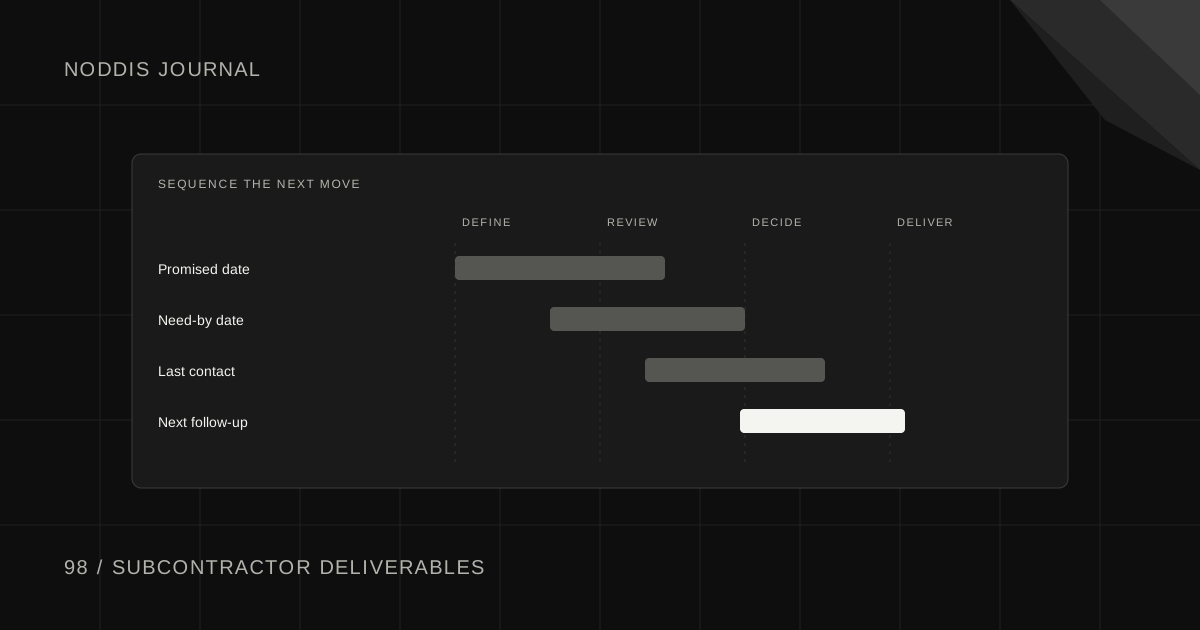
To track subcontractor deliverables, keep one list of everything each subcontractor owes you, with two dates on every row: the date they promised and the earlier date you actually need it. Follow up on a fixed rhythm tied to how close that date is, and record every contact, so a slipping deliverable is visible while there is still time to act.
What counts as a subcontractor deliverable?
A subcontractor deliverable is anything another firm has agreed to hand over so that your work can continue. The form depends on the industry:
- Engineering and design: drawings, calculations, survey data, reports, review comments.
- Construction: submittals, shop drawings, a finished phase of work, inspection sign-offs, closeout documents.
- Government contracting: past performance write-ups, resumes, pricing inputs, monthly reports.
- Manufacturing and aerospace supply: quotes, certificates, first articles, finished parts.
The common thread is dependency. You cannot finish until they deliver, and your client will not accept "our subcontractor was late" as an answer. For federal contracts the regulation says so directly: "The prime contractor is responsible for managing its subcontracts." The U.S. Small Business Administration describes prime contractors the same way: "They manage any subcontractors and are responsible for ensuring that the work is completed as defined in the contract." That places the tracking job with the prime.
How do you track subcontractor deliverables in one tracker?
Track subcontractor deliverables in one tracker that holds enough to answer three questions for every item: what is owed, when it is truly needed and when you last checked. Nine columns cover it.
| Column | What goes in it |
|---|---|
| Deliverable | The specific item, such as "structural calculations, level 2" |
| Subcontractor | The firm and the person who owes it |
| Your owner | The person on your team who follows up |
| Promised date | What the subcontractor committed to |
| Need-by date | The latest date that does not delay your own work |
| Status | Not started, in progress, delivered, accepted, late |
| Last contact | The date of the last confirmed exchange |
| Next follow-up | The date you will check again |
| Evidence | Where the delivered item or the confirmation lives |
Two details matter most. "Delivered" and "accepted" are different statuses, because a drawing that arrives with errors is not done. The need-by date should sit a few working days before the point where a delay reaches your client.
How often should you follow up with a subcontractor?
Follow up with a subcontractor on a rhythm that tightens as the need-by date approaches. A fixed cadence is easier to keep than a judgment call each morning, and the subcontractor learns to expect it.
| Time to need-by date | Follow-up rhythm | What you ask |
|---|---|---|
| More than 30 days | Every two to four weeks | Is the date still good? Anything you need from us? |
| 8 to 30 days | Weekly | What is finished, and what is left? |
| 7 days or fewer | Every two days | Will it arrive on the date? What could stop it? |
| Past the promised date | Daily, then escalate | What is the new date, and what do you need to hit it? |
The rhythm above is a working pattern, not a standard, so adjust it to your contract and the size of the item. Ask questions that have specific answers. "How's it going?" invites "fine".
Check your own side too. A subcontractor waiting on information from you is your delay, not theirs.
What do you send when a deliverable is late?
When a deliverable is late, send a short message that states the item, the missed date, what it now holds up and the question you need answered. Leave blame out, and ask for a date.
Subject: [Deliverable] for [Project]: new date needed
Hi [Name],
The [deliverable] was due on [promised date] and I have not received it. We need it by [need-by date] to keep [next milestone] on schedule.
Can you confirm today the date you will deliver, and tell me if anything on our side is holding you up?
If [need-by date] is not possible, I need to know now so I can adjust the plan with our client.
Thanks,
[Your name]
The last line gives the subcontractor a reason to answer honestly. Bad news two weeks early is something you can plan around. For more wording, see the client email templates for stuck work, which adapt to subcontractors with small changes.
How do you escalate without damaging the relationship?
Escalate in steps that each change who is involved, and say in advance what the next step is. Surprise is what damages a working relationship.
- The working contact. Two follow-ups after the missed date.
- Their manager or principal. A short note, copied to your contact, asking for a committed date.
- Your client. A status update with the risk, your plan and any decision you need.
- The agreement. The remedies your subcontract provides, used with advice.
Aim to solve a late deliverable at step one or two. Step three is uncomfortable and necessary, since a client who learns of a delay from you can still help. The guide to recovering a delayed client project covers that conversation.
How does Noddis track what subcontractors owe you?
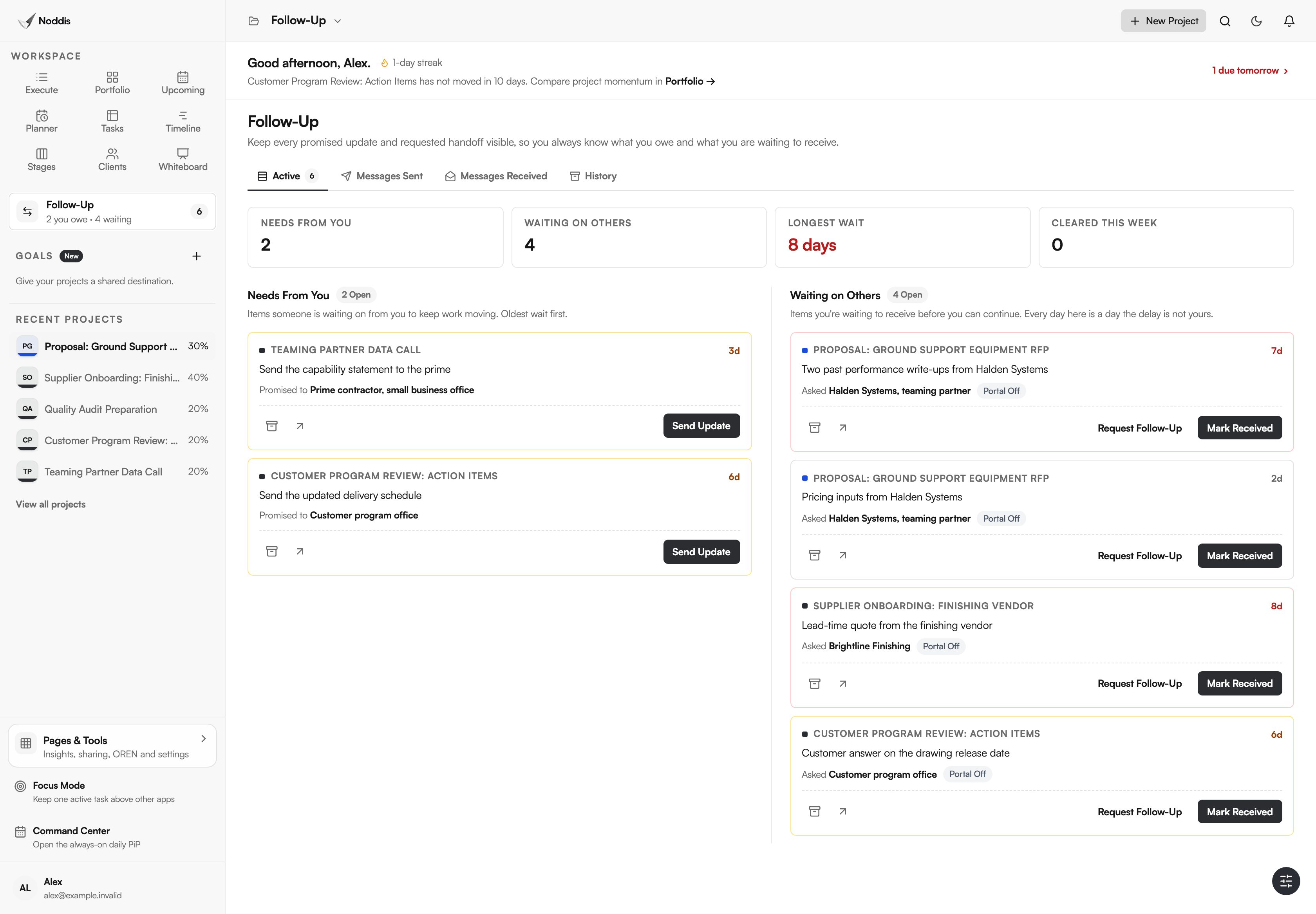
Noddis is a project management app that keeps tasks, follow-ups, and related project details connected. When we built Follow-Up in Noddis, we split it into two lists, Needs From You and Waiting on Others, and gave every open item an age in days.
Each deliverable becomes a Waiting on Others item on the task it blocks, with the subcontractor's name and promised date. The age gives you the "last contact" pressure without a column to maintain, and what you owe the subcontractor sits in the other list. On Pro, a follow-up goes out as an email and the reply returns to the item. Workflows for contractors and for aerospace and defense suppliers show the list in use.
Your next step
List every item a subcontractor owes you this month, and add a need-by date beside each promised date. To list your waiting items with ages, open the live demo.
Common questions
Who is responsible when a subcontractor is late?
Toward the client, the prime or general contractor is. Your agreement with the subcontractor may give you remedies, but the client's contract is with you. That is why tracking belongs to the prime: you need to know about a slip early enough to cover it, re-sequence the work or warn the client.
Should subcontractors see the tracker?
Share the parts that concern them. A subcontractor who can see their own items, dates and status has fewer excuses and fewer questions. Keep your need-by dates, internal notes and other firms' items private. A short list sent by email each week does the job if you do not want to share a live document.
How is this different from tracking your own tasks?
A task is yours to finish. A deliverable you are waiting on can only be followed up. They need different lists and different habits: work the task list, and review the waiting list on a schedule. Mixing them hides the waiting items, which are the ones most likely to hurt the date.

Katleen is the founder of Noddis. She runs client projects through her app studio, 693 Labs, and builds Noddis around the problems that work creates.
Last reviewed . Feature details reflect Noddis at the time of review.