
Short answer
If you are working out how to get subcontractors to finish punch list items, send each trade its own short list with a location for every item and one return date. Make it a single trip, verify the work yourself, and release final payment only as your subcontract allows, once the items are closed.
Free resource
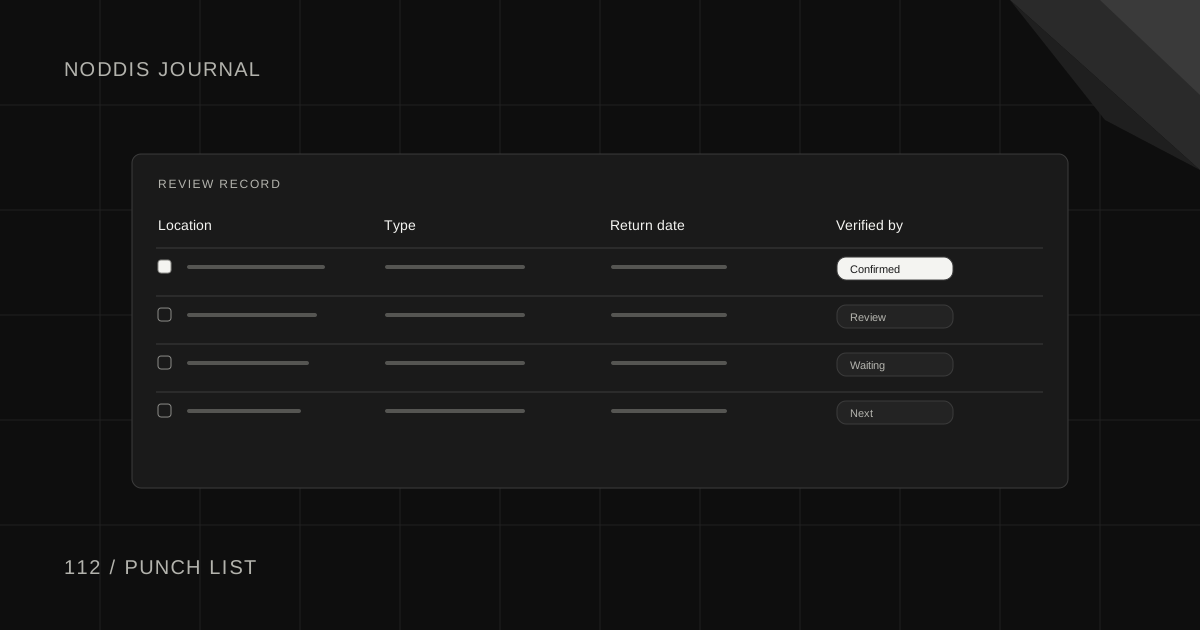
Download the punch list template. The file is a blank CSV for Excel or Google Sheets, with one row per item and columns for the location, the responsible trade, the type, the return date, who verified it and owner acceptance. One example row shows how to fill it in. No account is required.
Why do subcontractors not come back for the punch list?
Subcontractors do not come back for punch list items because the remaining work is small, the remaining money is small and their crew is already on the next job. A return trip for two cover plates loses to a full paid day elsewhere.
A punch list is the list of incomplete or incorrect items found at the end of a job, and the list itself invites deferral. Linda Case, founder of Remodelers Advantage, writing in the Journal of Light Construction, says: "The concept of a punch list attracts work like a magnet." Your own list can add to the problem: a sub called back three times for items that trickle in stops answering.
What belongs on a subcontractor's punch list?
A subcontractor's punch list holds only work that sub left incomplete or did incorrectly. Sort every item into one of four types before you send anything. Take a job, the Hollis Kitchen Remodel:
| Type | Example | Who settles it |
|---|---|---|
| Incomplete | Outlet cover plate missing at the island | Fernhill Electric, at its own cost |
| Deficient | Under-cabinet light flickers | Fernhill Electric, at its own cost |
| Damage by others | Wall scuffed when the refrigerator went in | You, with whoever caused it |
| Owner request | A second towel bar | A change order, not the punch list |
A painter asked to fix another crew's damage for free will dispute the whole list. New requests from the Hollis family go in the change order log.
What makes a subcontractor come back to finish?
Three things make a subcontractor come back at punch list time: the signed subcontract, the money you have not yet paid and the next job.
- The subcontract. Read what it says about correcting work, final payment, retainage and written notice. Under the Federal Acquisition Regulation's inspection clause for construction, when a contractor does not promptly correct rejected work, the government may act: "By contract or otherwise, replace or correct the work and charge the cost to the Contractor". Your subcontract may give you a similar right, or none.
- The unpaid balance. The law firm Stimmel Law describes the owner's side: "Until the punch list is passed, the project is not considered finished, and the final payments will not be made." Whether the same holds between you and your sub depends on your subcontract and your state's payment laws.
- The next job. A sub who wants your next three jobs returns faster. Say plainly that closeout counts when you award the next one.
Be straight about the unpaid balance: a sub paid in full has little reason to hurry, so walk the work before the final check. Hold only what the open items justify, release it the day they are verified, and ask a construction attorney before you withhold or back-charge.
How to get subcontractors to finish punch list items: what is the process?
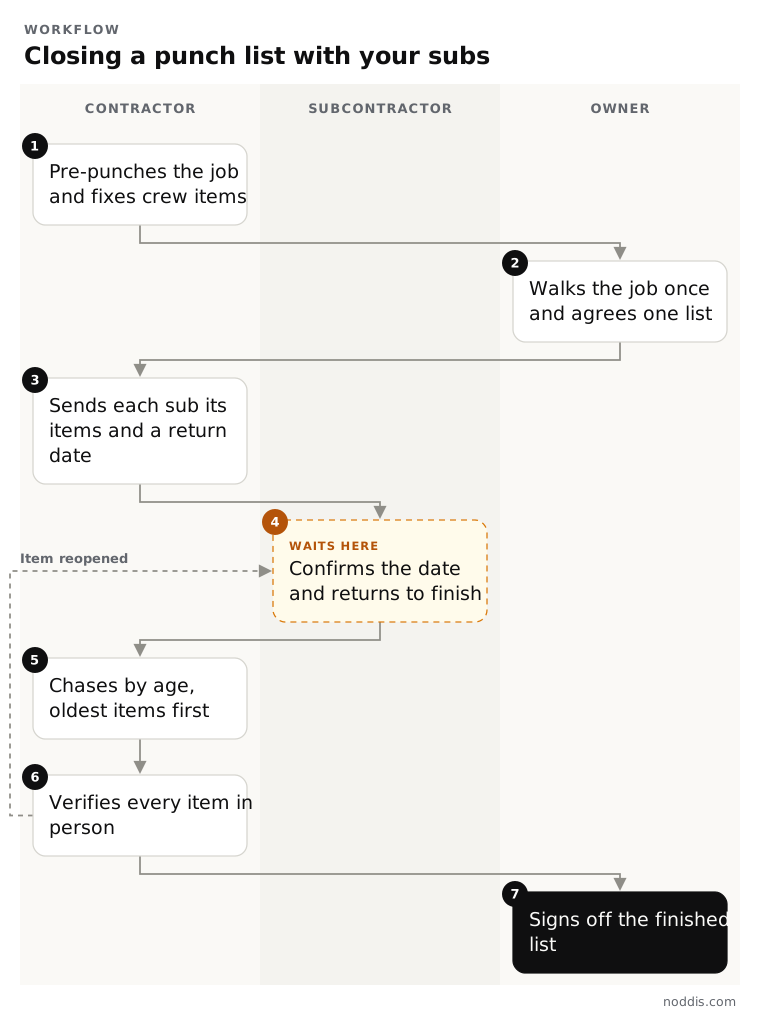
To get subcontractors to finish punch list items, run the same seven steps on every job, from a kitchen remodel to a commercial office fit-out.
- Pre-punch the job yourself. Walk it with your lead before the owner does, and fix what your own crew can.
- Walk it once with the owner or architect. Agree one list in one visit. Every item gets a location, one trade and a photo.
- Send each sub its own items and one return date, with the access it needs.
- The sub confirms the date and returns. The work waits here.
- Chase by age. Confirm the day before. If the date passes, ask in writing for a new one, oldest items first.
- Verify every item in person, against the photo, and reopen what is not right the same day.
- The owner signs off the list. Final payment follows as the subcontract provides.
Case's advice for the return visit: "Treat any items that remain as a small job of the highest priority." She suggests bringing every trade back on the same day, with your carpenter there to inspect.
What should the message to a subcontractor say?
The message to a subcontractor should hold four things: the items with their locations, one return date, the access arrangements and a request to confirm.
Subject: [Job name]: your [number] punch items, return [date]
Hi [Name],
We walked [job name] with the owner on [date]. Your items, with photos attached:
1. [Room and location]: [what is wrong, and what done looks like]
2. [Room and location]: [item]
Please finish them in one visit on [return date]. The site is open from [time], [name] will be there, and [material] is already on site.
Reply today to confirm, or give me another date this week. Final payment follows once these are verified, as our subcontract provides.
Thanks,
[Your name]
Leave out the payment sentence if your subcontract does not tie final payment to finished punch work. For the follow-up rhythm once a date passes, see how to track subcontractor deliverables.
How does Noddis keep punch list items moving?
Noddis is a project management app that keeps tasks, follow-ups, and related project details connected. When we built Stages in Noddis, we showed one project's tasks as columns for not started, in progress and pending, with finished work in its own section.
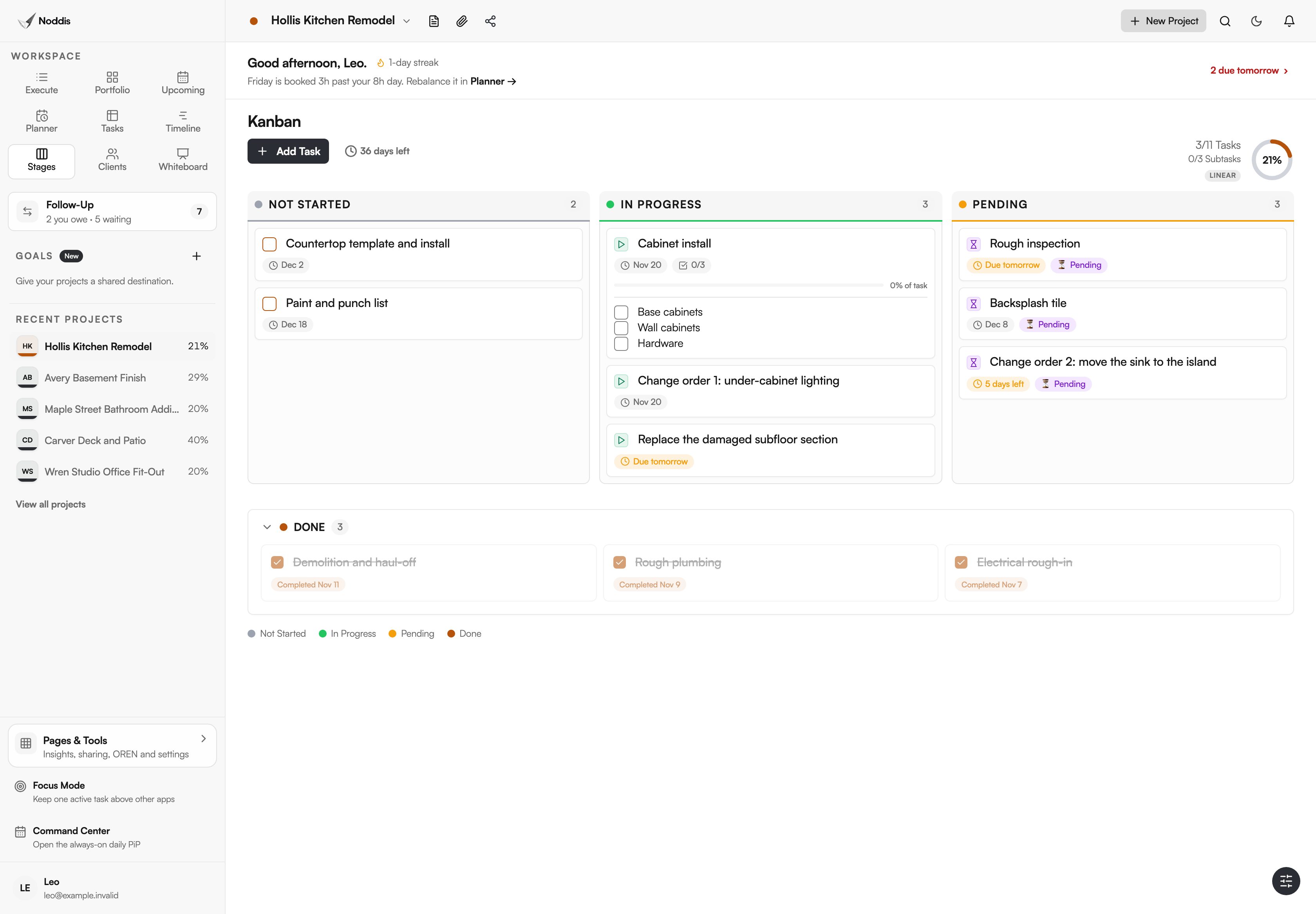
Each punch item becomes a task on the job. In Stages, on Pro, it sits in Pending while a sub owes you a return visit, and you mark it done only after you have verified it. Follow-Up lists what each sub owes with its age in days. As of November 2026, it is free for one project and covers every job on Pro, where a follow-up can go out as an email the sub answers with no account.
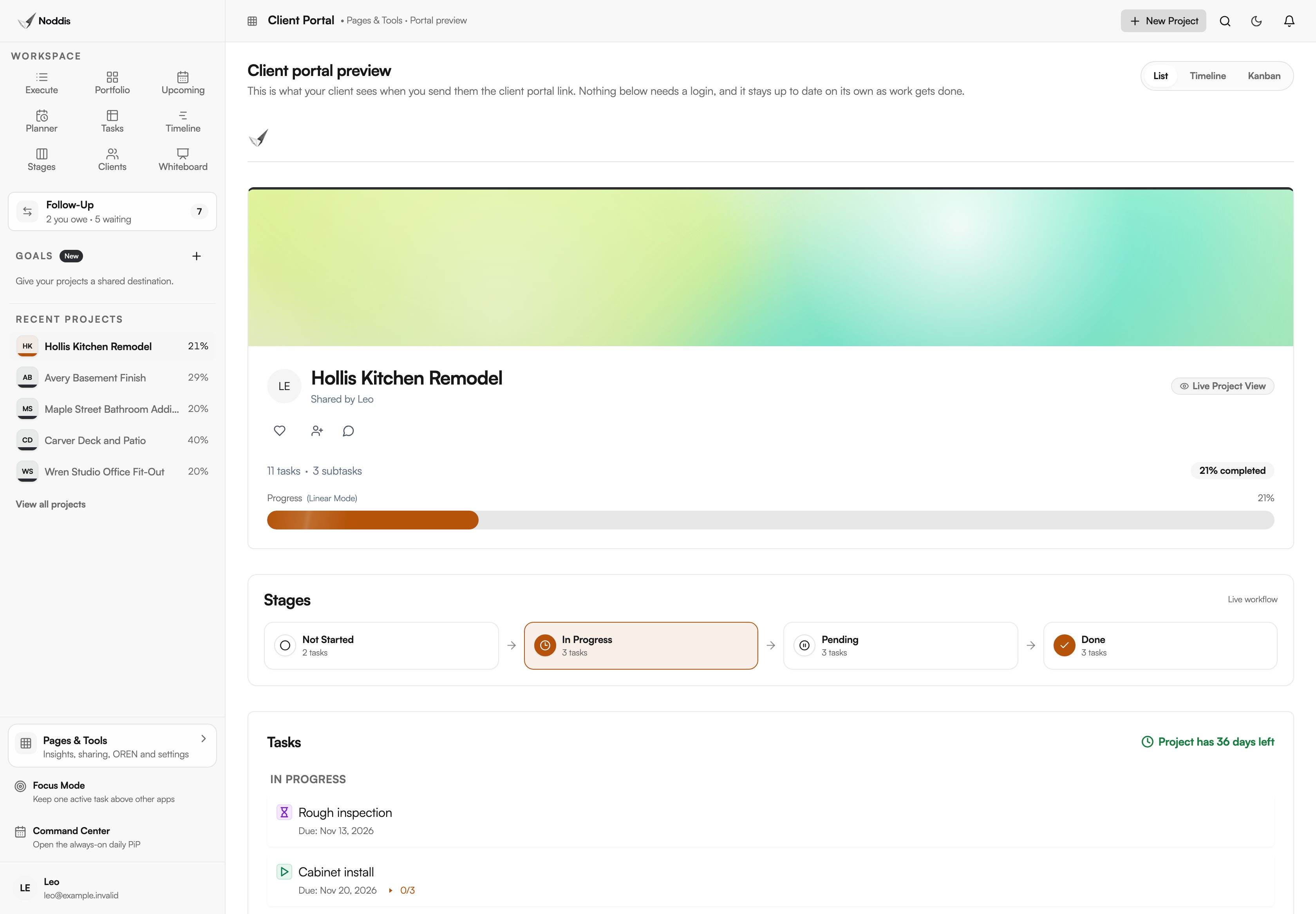
The client portal, on Pro, is a live, read-only page the owner opens from a link. It shows progress and the tasks you choose to share, so the owner can watch the list shrink without calling you. Photo markups, retainage, lien waivers, final payment and signatures stay in the tools built for them. The workflow for contractors walks through the screens.
Your next step
Take the job closest to completion, list every open item with one location and one trade, and send each sub its items with a return date today. To list what each person owes you on a job of your own, open the live demo. No account is needed.
Common questions
What if a subcontractor still does not come back?
Escalate in steps. Call the owner of the firm, then send a dated notice that lists the open items and names the subcontract clause on correcting work. If your subcontract lets you finish the work with others after notice, take legal advice before you use it.
Who writes the punch list?
The contractor writes it. Walk the job first and list what you find, then add what the owner, architect or designer points out at the walk-through. One person on your side should own the list, assign every item to a trade and decide when an item is closed.
Is a problem found after sign-off still a punch list item?
Usually not. An item found after the owner has accepted the job is a warranty call, handled under the warranty terms in your contract and subcontracts. Log it separately with the date it was reported, and send it to the responsible trade the same way.

Katleen is the founder of Noddis. She runs client projects through her app studio, 693 Labs, and builds Noddis around the problems that work creates.
Last reviewed . Feature details reflect Noddis at the time of review.