
Short answer
An RFQ follow up email is a short message, sent the day after your reply-by date, that asks a supplier one thing: whether they will quote, and by when. Send it in the original RFQ thread, restate the item and the deadline, offer to answer questions the same day, and make a one-line no bid an acceptable answer.
Where do these RFQ follow-up examples apply?
These examples are for private-sector purchasing where your sourcing policy permits this follow-up. Public procurement and sealed-bid processes may restrict contact, deadline extensions and late quotations. Follow the solicitation and your procurement rules before asking for a late quote; a reminder does not change those rules.
Why do suppliers go quiet on an RFQ?
Suppliers go quiet on an RFQ (request for quotation) because quoting costs them time, and they have judged that this request is unlikely to pay it back. Silence is usually a decision, not an oversight. A follow-up works when it removes the reason.
Declining is normal on the supplier's side. Lori Beckman, writing in Modern Machine Shop, says: "Having the resolve to no-quote or turn down requests for quotes (RFQs) is a trait shared by successful machine shops."
North Carolina State University's Supply Chain Resource Cooperative describes suppliers walking away from requests where they are only the extra quote used to pressure an incumbent, and concludes: "There is a need for both parties to better understand when, why, and how an RFQ should be run, and the reasons behind it."
| Likely reason for silence | What your follow-up should do |
|---|---|
| The RFQ sits in a shared sales inbox | Phone and ask who quotes this work |
| A drawing, quantity or date is unclear | Answer the same day, and copy every bidder |
| The volume looks small or the date tight | State the annual volume and whether the date can move |
| They think they are a price check | Say how many suppliers were asked and how you will decide |
What should an RFQ follow up email say?
An RFQ follow up email should say which RFQ it is, that the deadline has passed, and what you need back: a quote, a date or a no bid. Keep it short enough to answer from a phone.
The day after the deadline. Reply in the original RFQ thread, so the attachments travel with it.
Subject: RFQ [number]: [item], quote was due [date]
Hi [Name],
Our RFQ [number] for [quantity] of [item] closed on [date], and I do not have your quote.
Are you planning to quote? If yes, which date can you send it? If anything in the RFQ is unclear or missing, tell me and I will answer today.
If this one is not a fit, a one-line "no bid" is a useful answer.
Thanks,
[Your name]
The second nudge, two working days later. One question only.
Subject: Re: RFQ [number]: [item]
Hi [Name],
One question on RFQ [number]: will you quote, yes or no?
I am comparing quotes on [date], so I need your answer by [date].
Thanks,
[Your name]
The closing message. It gives fair warning and keeps the door open.
Subject: RFQ [number]: closing on [date]
Hi [Name],
I have not received a quote or a reply on RFQ [number]. We will close it at [time] on [date] and treat no reply as a no bid.
This does not affect future requests. If the quantity, timing or specification was the problem, please tell me for next time.
Thanks,
[Your name]
When should you phone instead of emailing?
Phone instead of emailing when a missing quote would change the award, or when email has already failed twice. A call finds the right person and the real reason faster than a third message.
- You need this supplier. It is the incumbent, the only qualified source, or the quote that makes the comparison real.
- The RFQ went to a general address. Ask who prepares quotes, usually inside sales or an estimator.
- The need-by date has no slack.
After the call, send two lines that confirm what was said, so the promised date exists in writing.
How do you run RFQ follow-ups from send to award?
Run RFQ follow-ups as one open item per supplier, with the date you asked and the date a reply is due. Take a rebid: Noor, a buyer, sends a fastener RFQ to Brightwell Fasteners, Corran Supply and Ostley Industrial.
- Send the RFQ with a reply-by date. Noor states the date and time, and says that no reply will be treated as a no bid.
- Log one open item per supplier. Three items, each with a contact, the date sent and the reply-by date.
- Wait for the quotes. The work sits with the suppliers. Questions are answered the same day, to all three.
- Email the day after the deadline. Ostley has quoted. Brightwell and Corran get the first message.
- Wait for a quote, a date or a no bid. Each open item shows its age in days.
- Nudge once, then phone. Corran's RFQ had gone to a shared inbox. The call finds the estimator.
- Close the RFQ and award. Brightwell gets the closing message and is logged as "no reply". Noor awards from the quotes in hand.
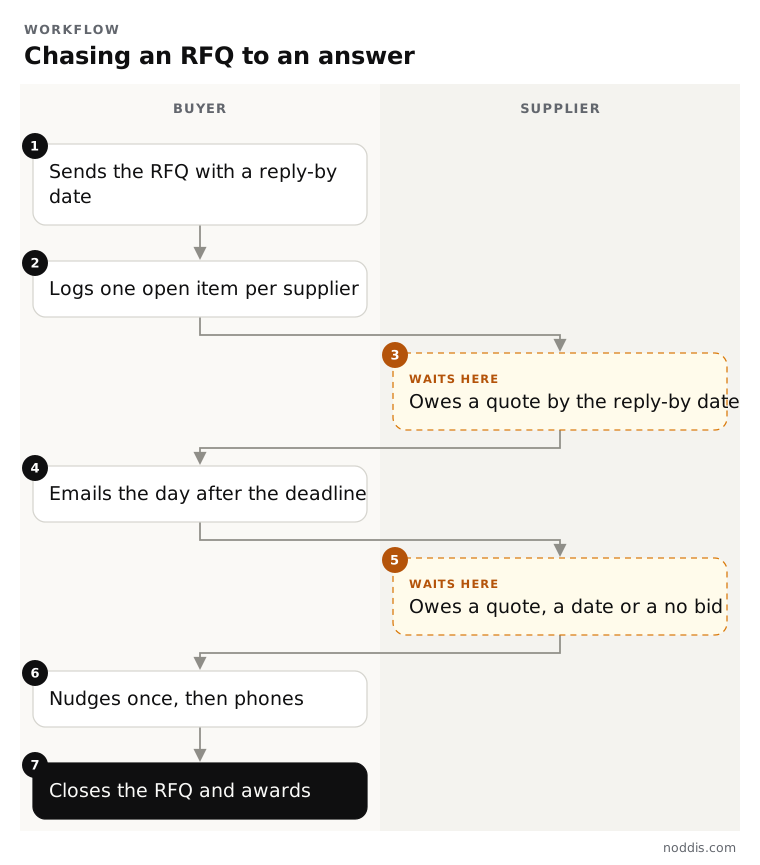
Step 7 protects the next RFQ: a prompt no bid keeps a supplier on the bidder list, and repeated silence does not. A waiting list like this is the core of a general follow-up system, and the same list carries into following up on a late delivery once the order is placed.
How does Noddis track the quotes you are waiting on?
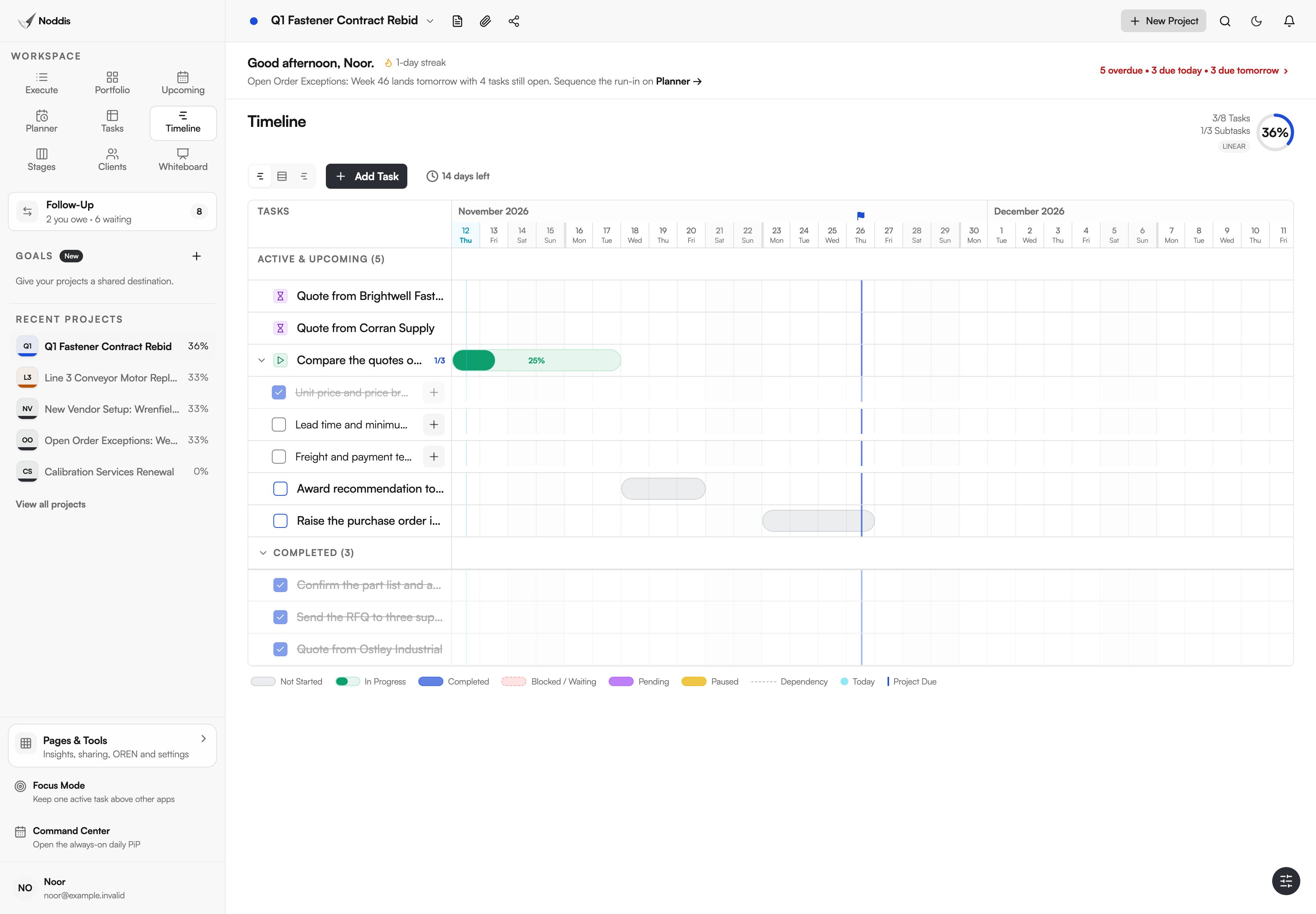
Noddis is a project management app that keeps tasks, follow-ups, and related project details connected. When we built Follow-Up in Noddis, we split it into two lists, Needs From You and Waiting on Others, and gave every open item an age in days.
Each quote you are owed sits under Waiting on Others with the supplier's name and its age in days, and a Longest wait counter shows the oldest silence. Follow-Up covers one project on Free and every project on Pro. On Pro you can email the follow-up from Noddis, and the supplier's reply comes back into the thread without the supplier needing an account.
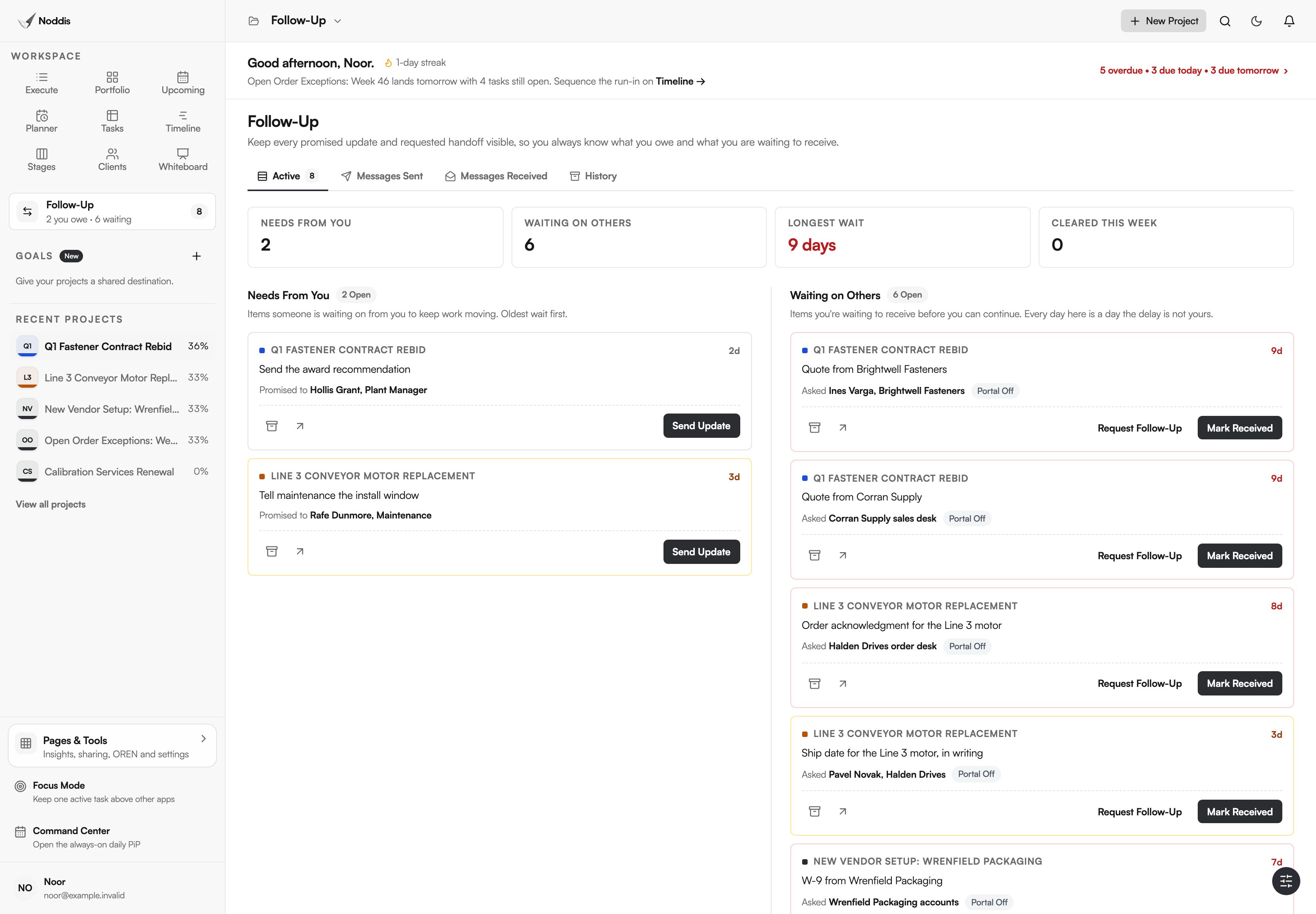
Timeline (Pro) draws the sourcing project as bars by date with a flag on its due date, so you can see the days a late quote takes from the comparison.
The RFQ documents, the quote comparison and the purchase order stay in your purchasing system. As of November 2026, Noddis does not connect to Outlook, Teams or SharePoint, so messages you send from Outlook stay there. The procurement follow-up workflow shows each screen, and how procurement managers use Noddis is the longer walk-through.
Your next step
Open the oldest RFQ that still has a quote missing and send the first message from this guide today. To start a Waiting on Others list with your own open quotes, open the live demo. No account is needed.
Common questions
How long should suppliers get to answer an RFQ?
Give suppliers long enough to price material and check capacity, which depends on the item. A catalog part can be quoted quickly. A custom part may need quotes from the supplier's own vendors first. Ask a supplier you trust what is realistic, then state the date and time in the RFQ.
Is it fair to extend the deadline for one supplier?
Extend the deadline for every bidder or for none. If one supplier asks for more time and you agree, tell all of them the new date in writing the same day. An answer that changes the quantity, specification or delivery date goes to everyone too.
Should you keep sending RFQs to a supplier that never replies?
Ask once why, by phone, before you remove them. Some suppliers are a poor fit for the category and will say so. After two silent RFQs, take them off that category's bidder list and keep a note. A supplier that sends a prompt no bid is worth keeping.

Katleen is the founder of Noddis. She runs client projects through her app studio, 693 Labs, and builds Noddis around the problems that work creates.
Last reviewed . Feature details reflect Noddis at the time of review.