
Short answer
An RFP response timeline is a schedule built backward from the submission deadline: the upload, production, final review, revisions, first review, drafts and kickoff, each with a date and an owner. Building it backward shows on day one whether the reviews and the production day actually fit, while there is still time to change the plan.
Free resource
Download the RFP response timeline worksheet. The file is a blank CSV that opens in Excel, Google Sheets or Numbers, with one row per milestone and columns for days before the deadline, the date, the owner and the status. No account is required.
What is an RFP response timeline?
An RFP response timeline is the list of dated milestones between receiving a request for proposals and submitting the response. Each milestone has one owner and one output: a decision, a draft, a set of review comments, a finished file.
The timeline matters because the deadline does not bend. Under the Federal Acquisition Regulation, a proposal received "after the exact time specified for receipt of proposals" is late and will not be considered, and other owners publish their own cut-off rules. Timeliness is also a known weak point: in the QorusDocs 2026 benchmark of AEC proposal teams, "44% report difficulty responding in a timely manner". That is a vendor's survey of its own market, so treat it as a signal that the problem is common, not as a measured rate.
How do you build the timeline backward from the due date?
Build the timeline backward by placing the last step first and giving each earlier step only the time that remains. Follow this order:
- Submission. Plan to upload or deliver one working day early. Portals fail and couriers run late.
- Production. Reserve one or two days for layout, forms, page checks and the final file.
- Final review. One day for a principal to read the finished response.
- Revisions. Two to four days to fix what the main review found.
- Main review. One day, on a complete draft.
- Drafts and inputs. Everything contributors owe, due two working days before the main review.
- Kickoff. Within two days of the decision to pursue.
- Go or no-go. Within two days of receiving the RFP.
If the steps do not fit, you learn it now. The choice is then to cut a review, shorten the response or decline.
What does a 30-day RFP response timeline look like?
A 30-day RFP response timeline gives roughly a third of the window to planning and inputs, a third to drafting and a third to review and production. The days below are calendar days counted back from the due date, and they are a working pattern to adjust, not a standard.
| Days before due | Milestone | Owner | Output |
|---|---|---|---|
| 30 | RFP received and read | Proposal manager | Compliance checklist, questions for the owner |
| 28 | Go or no-go | Principal | A recorded decision |
| 26 | Kickoff | Proposal manager | Every section assigned with a date |
| 14 | Inputs and first drafts due | Each contributor | Narratives, resumes, project sheets, fee inputs |
| 12 | Main review | Reviewers who did not write | Comments with owners |
| 7 | Revisions complete | Writers | A full second draft |
| 5 | Final review | Principal | Sign-off or last changes |
| 3 | Production | Marketing | Final layout, forms, page count check |
| 1 | Submit | Proposal manager | Confirmation of receipt |
Twelve days sit between kickoff and the first drafts. That stretch is where a timeline is easiest to lose, because nothing looks late until day 14.
What changes when you only have 10 days?
With only 10 days, cut steps from the RFP response timeline instead of squeezing every step. A compressed schedule keeps one review, protects the production day and holds the one-day submission buffer.
| Days before due | Milestone | What is different |
|---|---|---|
| 10 | RFP read, go or no-go the same day | One sitting, one principal |
| 9 | Kickoff | Reuse past answers wherever they fit |
| 5 | Inputs and drafts due | Interview contributors instead of waiting for writing |
| 4 | Single review | Compliance and accuracy only |
| 2 | Production | Starts while last edits come in |
| 1 | Submit | Same one-day buffer |
The buffer day is the last thing to give up. A short window is also a reason to revisit the go or no-go honestly, since a weak response costs the same hours as a strong one.
Where do RFP timelines usually slip?
RFP timelines usually slip in three places, and each has a specific fix.
- Inputs arrive late. Track every request with the date you asked, and follow up the morning after a promised date. See how to get proposal input from subject matter experts.
- The review has no recovery time. Comments that arrive two days before submission cannot be acted on. Move the review earlier, even if the draft is rougher.
- Production gets squeezed. Writers borrow from the production days. Protect them by naming the production start as a deadline for writers.
When several pursuits run at once, their reviews and production days also collide. The guide to managing multiple RFPs covers how to stagger them.
How does Noddis lay out a proposal schedule?
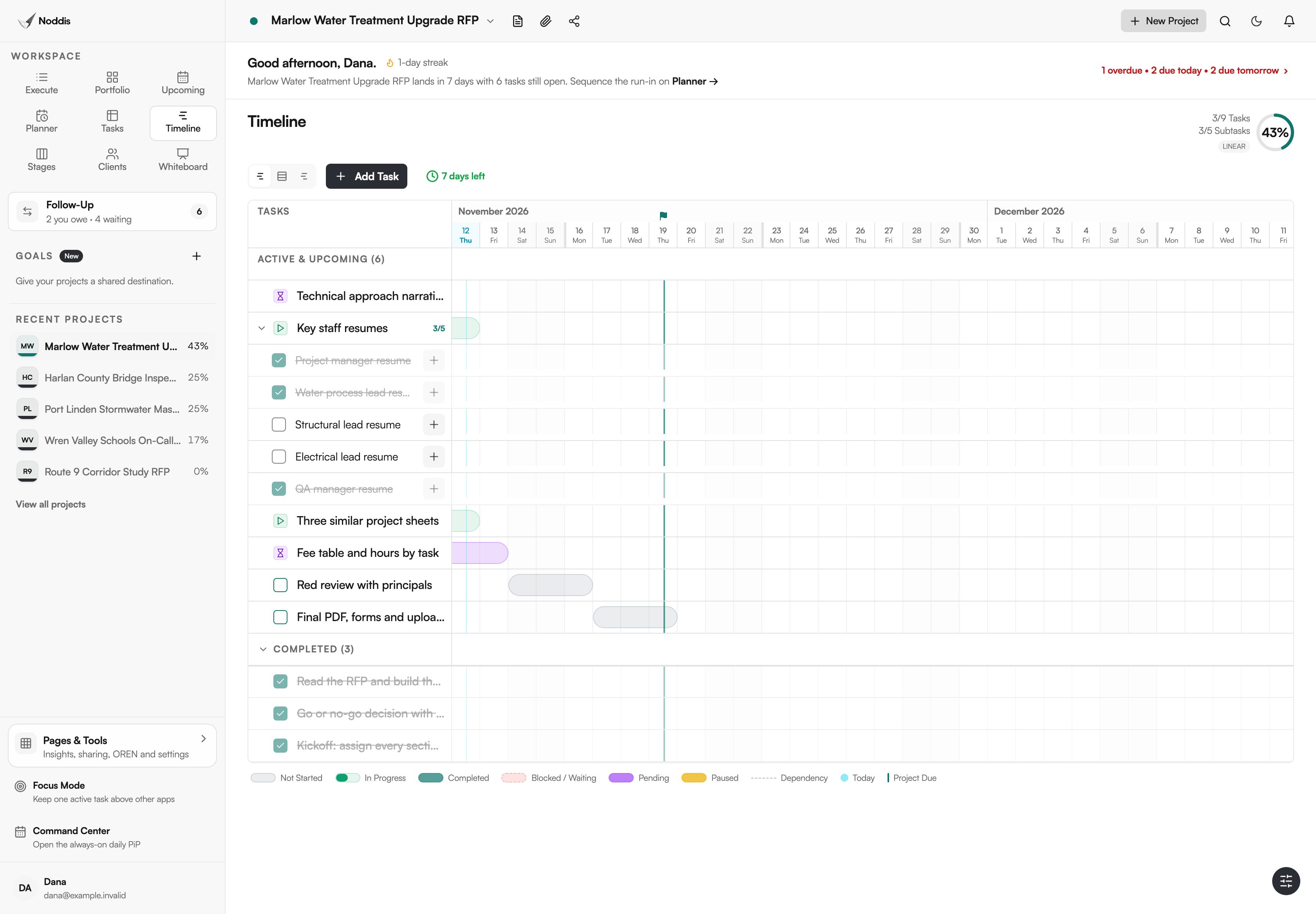
Noddis is a project management app that keeps tasks, follow-ups, and related project details connected. When we built Timeline in Noddis, we drew each task as a bar from its start date to its due date and marked the project's due date with a flag.
Enter the milestones above as tasks with start and due dates, and Timeline shows whether the review and production bars still sit before the flag. Tasks waiting on someone else are marked, so a late input is visible against the review it feeds. Timeline is part of Pro. The AEC proposal management workflow shows a proposal schedule in the real app.
Your next step
Take your next RFP's due date and fill in the worksheet from the bottom row up. To draw your own proposal schedule against its deadline, open the live demo.
Common questions
How long should an RFP response take?
As long as the window allows, planned from the deadline backward. The effort depends on the size of the response and how much approved content you can reuse. What matters more than the total is the split: if drafting takes all but the last three days, there is no time left to review or produce.
How many reviews does a proposal need?
At least one review by someone who did not write the response, with time afterward to make changes. Larger responses often use two: an early check of structure and a later check of the near-final draft. More reviews only help when each one has days set aside for fixes. The color team review checklist explains the formal version.
What should you do when the owner extends the deadline?
Move every internal date the same day, and announce the new dates to contributors in one message. An extension that is not rescheduled turns into slack, and the extra days disappear from the front of the schedule while the last-week crush stays the same.

Katleen is the founder of Noddis. She runs client projects through her app studio, 693 Labs, and builds Noddis around the problems that work creates.
Last reviewed . Feature details reflect Noddis at the time of review.