
Short answer
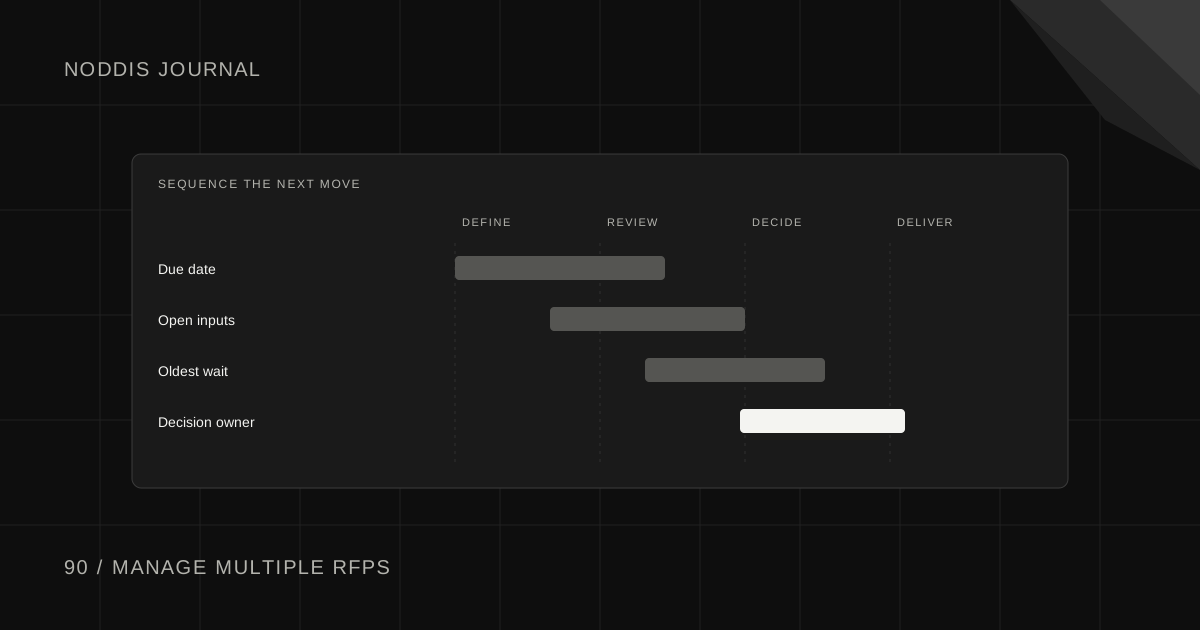
To manage multiple RFPs at once, treat each one as its own small project and track all of them on a single list that shows the due date, the next internal deadline, the inputs still owed and how long you have waited for each. The proposals rarely fail on writing. They fail on a late input nobody was watching.
Free resource
Download the RFP pursuit tracker. The file is a blank CSV that opens in Excel, Google Sheets or Numbers, with one row per pursuit and columns for the due date, stage, next internal deadline, open inputs and oldest wait. One example row shows how to fill it in. No account is required.
Why is managing multiple RFPs harder than managing one?
Managing multiple RFPs is harder than managing one because the same few people feed all of them. A proposal manager can run three schedules. The water lead who owes a narrative for each cannot write three at once.
The scale of the dependency is easy to underestimate. In the QorusDocs 2026 benchmark, among AEC proposal teams, "Seventy-four percent involve 11 or more contributors" in a response. That figure comes from a software vendor's survey of its own market, so read it as a signal. Eleven contributors across three live pursuits is more than thirty promises to keep track of.
The other pressure is the deadline itself. For federal work the rule is plain: under the Federal Acquisition Regulation, a proposal received "after the exact time specified for receipt of proposals" is late and will not be considered. State and local owners set their own rules, so read the submission instructions in every solicitation.
How do you manage multiple RFPs with one tracker?
You manage multiple RFPs with one tracker that shows, for every pursuit, the facts that tell you where to spend today: when it is due, what stage it is in, what is owed and who decides. Keep the same columns for every pursuit so you can read down the list.
| Column | What goes in it | Why it matters |
|---|---|---|
| Pursuit and client | Short name of the RFP or RFQ | One row per pursuit |
| Due date and time | The submission deadline, with the time and time zone | Late means not considered |
| Stage | Go or no-go, kickoff, drafting, review, production, submitted | Shows which pursuits need you this week |
| Next internal deadline | The next date someone owes something | The date you actually manage |
| Open inputs | How many pieces are still owed by others | A count you can compare across pursuits |
| Oldest wait | Days since the oldest unanswered request | The early warning |
| Decision owner | The principal who signs off | One name, not a committee |
Open inputs and oldest wait are the two columns a plain status tracker leaves out, and they are the first place a slipping pursuit shows up.
How do you decide which RFPs to pursue?
Decide with a short go or no-go check before any writing starts. The surest way to manage many RFPs is to manage fewer of them well. Answer these questions in one sitting with the principal who would lead the work:
- Does the client know the firm, or would this be a cold response?
- Does the team have three similar projects it can show?
- Are the key staff available for the work if you win?
- Can every required form and section be produced by the deadline?
- Is there a reason this pursuit matters beyond the fee?
Two or more weak answers is a reason to decline. Record the decision and its date, so the pursuit leaves the active list instead of lingering.
How do you stagger deadlines across several proposals?
Stagger deadlines by planning each pursuit backward from its due date, then moving the internal dates until no two pursuits need the same people on the same day. Take three pursuits at an engineering firm:
| Pursuit | Due | Inputs due | Review | Production day |
|---|---|---|---|---|
| Marlow water treatment RFP | Nov 19 | Nov 12 | Nov 16 | Nov 18 |
| Harlan County bridge SOQ | Nov 24 | Nov 17 | Nov 19 | Nov 23 |
| Port Linden stormwater RFP | Dec 3 | Nov 24 | Nov 30 | Dec 2 |
No two reviews share a day, and each pursuit gets its own production day. When two due dates collide, pull the earlier pursuit's review forward. Do not push the later one back.
For a full day-by-day schedule, see the RFP response timeline.
How do you keep one expert from holding up three proposals?
Keep one expert from holding up three proposals by counting requests per person, not per pursuit. Before you send a new request, check what that person already owes you. If the answer is two narratives due the same week, change a date now.
Then make each request small. Ask for edits to last year's narrative, or book a 20-minute interview and write the draft yourself. The guide to getting proposal input from subject matter experts has the wording.
How does Noddis show every pursuit at once?
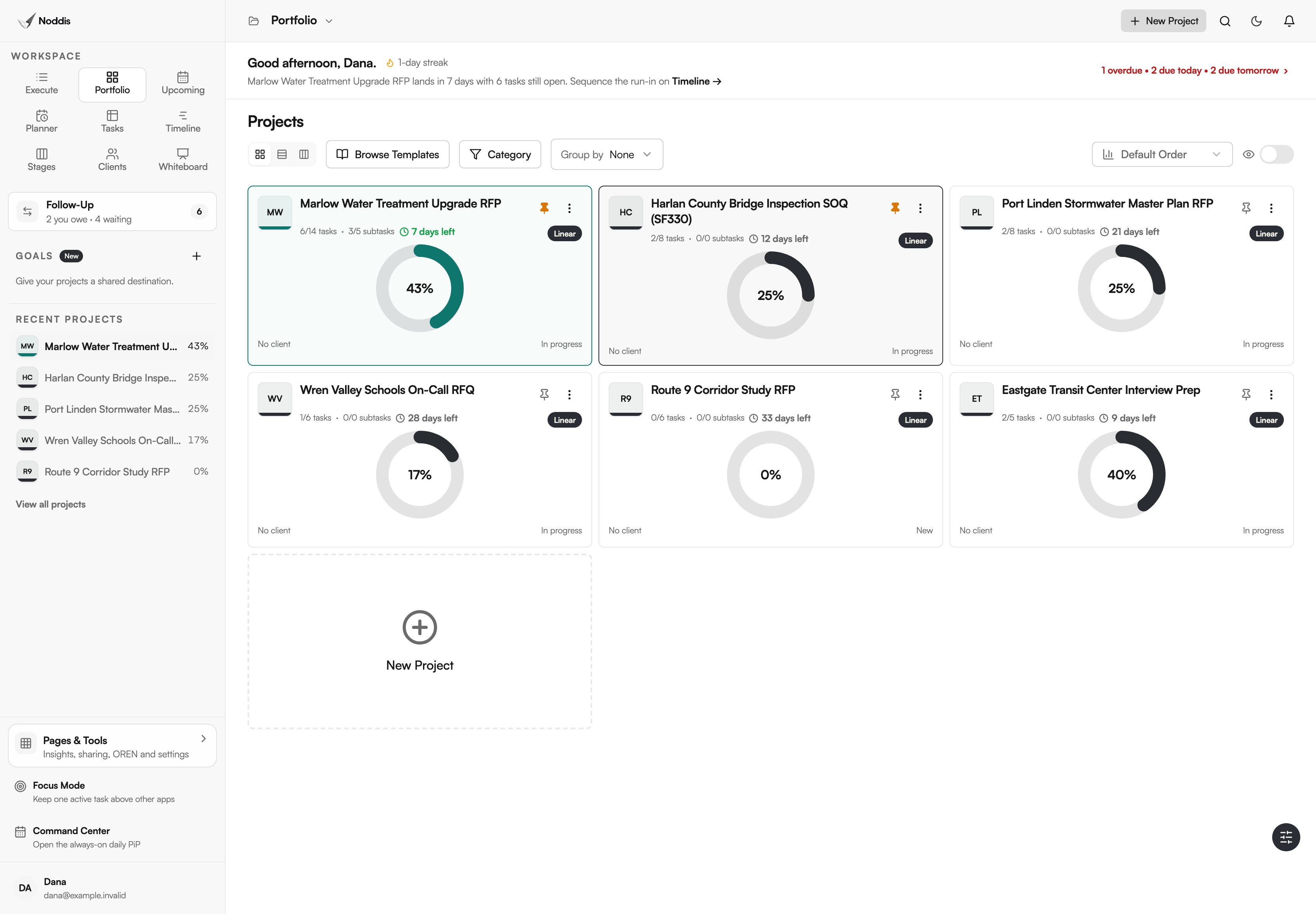
Noddis is a project management app that keeps tasks, follow-ups, and related project details connected. When we built Portfolio in Noddis, we put every active project and its progress in one view, so a weekly review can start from one screen instead of one tab per client.
For a proposal team, each pursuit is a project with its due date. Portfolio shows them side by side with days left, and Follow-Up lists every input you are waiting on with its age in days. The AEC proposal management workflow walks through the full sequence with screenshots. Portfolio is part of the Free plan, which includes three active projects.
Your next step
List every live pursuit in one tracker today and fill in the oldest wait for each. To try this with your own live pursuits, open the live demo.
Common questions
How many RFPs can one proposal manager handle at once?
There is no fixed number. The limit depends on how many contributors each response needs and how much content can be reused. A better measure than the count of RFPs is the count of open inputs: if you are waiting on more requests than you can follow up in a day, you have too many live pursuits.
Should each RFP be its own project?
Yes. A pursuit has its own deadline, team, checklist and decision, which is what a project is. Keeping each one separate lets you close it cleanly when it is submitted or declined, and keeps a slow pursuit from hiding inside a busy one. The single tracker then sits across all of them.
What do you do when two RFPs are due on the same day?
Treat the day before as the real deadline for one of them. Finish and submit the simpler response a day early, so production and upload for the two never overlap. Tell contributors the earlier date from the start. Moving a date forward in the final week costs far more goodwill than setting it early.

Katleen is the founder of Noddis. She runs client projects through her app studio, 693 Labs, and builds Noddis around the problems that work creates.
Last reviewed . Feature details reflect Noddis at the time of review.