
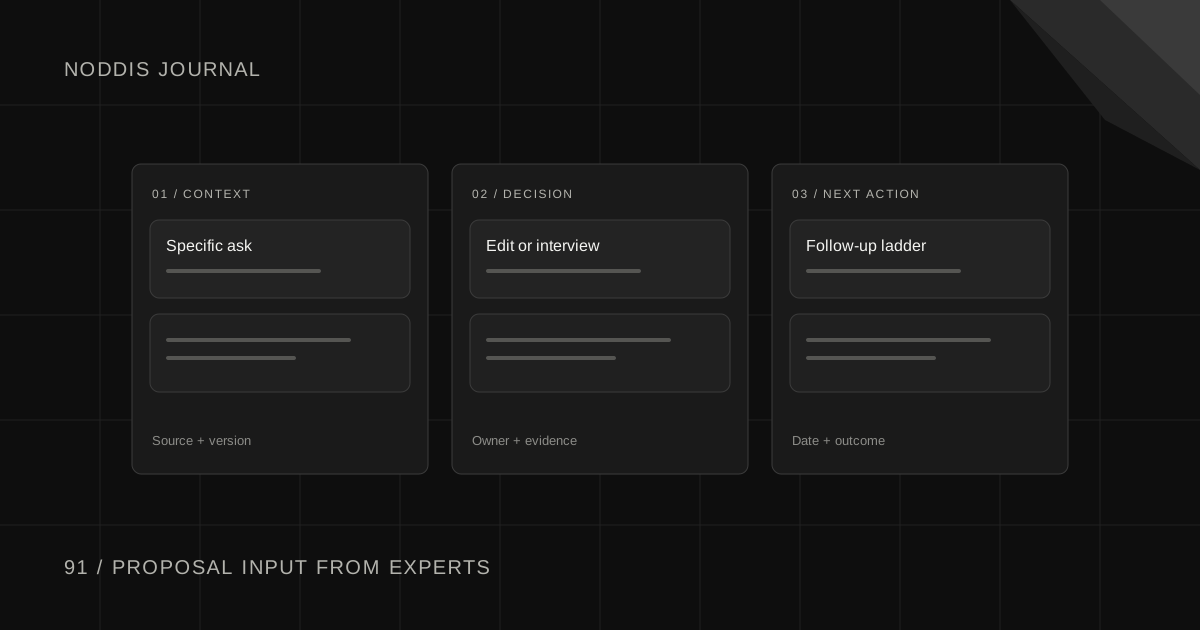
Short answer
To get proposal input from subject matter experts on time, shrink the request and make the date visible. Ask one named person for one specific piece, show them what a good answer looks like, tell them how long it will take, and record the request so that a missed date is noticed the next morning, not on review day.
Why are subject matter experts late with proposal input?
Subject matter experts are late with proposal input because the proposal is nobody's billable work. An engineer with a client deadline will do the client's work first, every time, and that is the right call for the firm on most days.
The pattern is widespread. In the QorusDocs 2026 benchmark, among AEC proposal teams, "64% cite delays from subject matter experts" as a challenge. The figure comes from a software vendor's survey, so treat it as a signal.
Three things make a late answer more likely:
- The request was vague. "Need your section by Friday" does not say how long, how detailed or in what form.
- The page was blank. Starting from nothing takes an hour. Editing takes ten minutes.
- Nothing visible happens when the date passes. The expert assumes there is slack.
Each one is in your control.
How should you ask an expert for proposal content?
Ask an expert for proposal content with five facts in the first three lines: the pursuit, the exact piece, the length, the date and the time it should take. Then attach something to edit.
Subject: Marlow water RFP: your 300 words on the treatment approach, by Wednesday
Hi [Name],
For the Marlow proposal I need one piece from you: the treatment process approach, about 300 words, by end of day Wednesday the 11th. It should take 30 minutes.
Last year's Harlan narrative is attached as a starting point. Change what is different for Marlow.
If writing is the slow part, give me 20 minutes on a call and I will draft it from your answers.
Thanks,
[Your name]
A short request is easier to act on. The U.S. government's plain language guide on Digital.gov tells writers to "Consider whether you need every word", and a request to a busy engineer is the test case.
What makes it easier for an expert to say yes?
Make it easier for an expert to say yes by removing the writing. Most experts know the answer and dislike producing the prose. Offer them a choice of three ways to deliver:
| Option | What the expert does | Time for them | Best for |
|---|---|---|---|
| Edit | Marks up a previous answer | 10 to 15 minutes | Sections that repeat across pursuits |
| Interview | Answers your questions on a short call | 20 minutes | New or technical approaches |
| Bullets | Sends five rough points | 10 minutes | Experts who hate writing |
Whichever they pick, you write the draft and send it back for a yes or a correction. The interview option also gives you their own phrases, which read better than marketing language.
Build a small library as you go. Every answer an expert approves is a starting point for the next pursuit.
When should you follow up, and how?
Follow up the morning after a promised date passes, and change something each time. A second copy of the same email teaches the expert that your dates move.
| When | What you do | What changes |
|---|---|---|
| Promised date plus 1 day | Short reminder with the piece and the review date it feeds | The stakes |
| Plus 2 days | Offer the interview: "15 minutes today and I will write it" | The effort |
| Plus 3 days | Tell the principal which section is open and what it blocks | The audience |
The third step is not a complaint. The principal who decided to pursue the work needs to know that a section is at risk while there is still time to reassign it.
For pursuits running in parallel, the guide to managing multiple RFPs covers how to keep one expert from being asked for three things in the same week.
How do you keep track of who owes what?
Keep track of who owes what with one list across all pursuits, not a column inside each proposal's spreadsheet. The list needs five things per request: the piece, the person, the date you asked, the date they promised and the pursuit it belongs to.
| Piece | Owner | Asked | Promised | Days waiting |
|---|---|---|---|---|
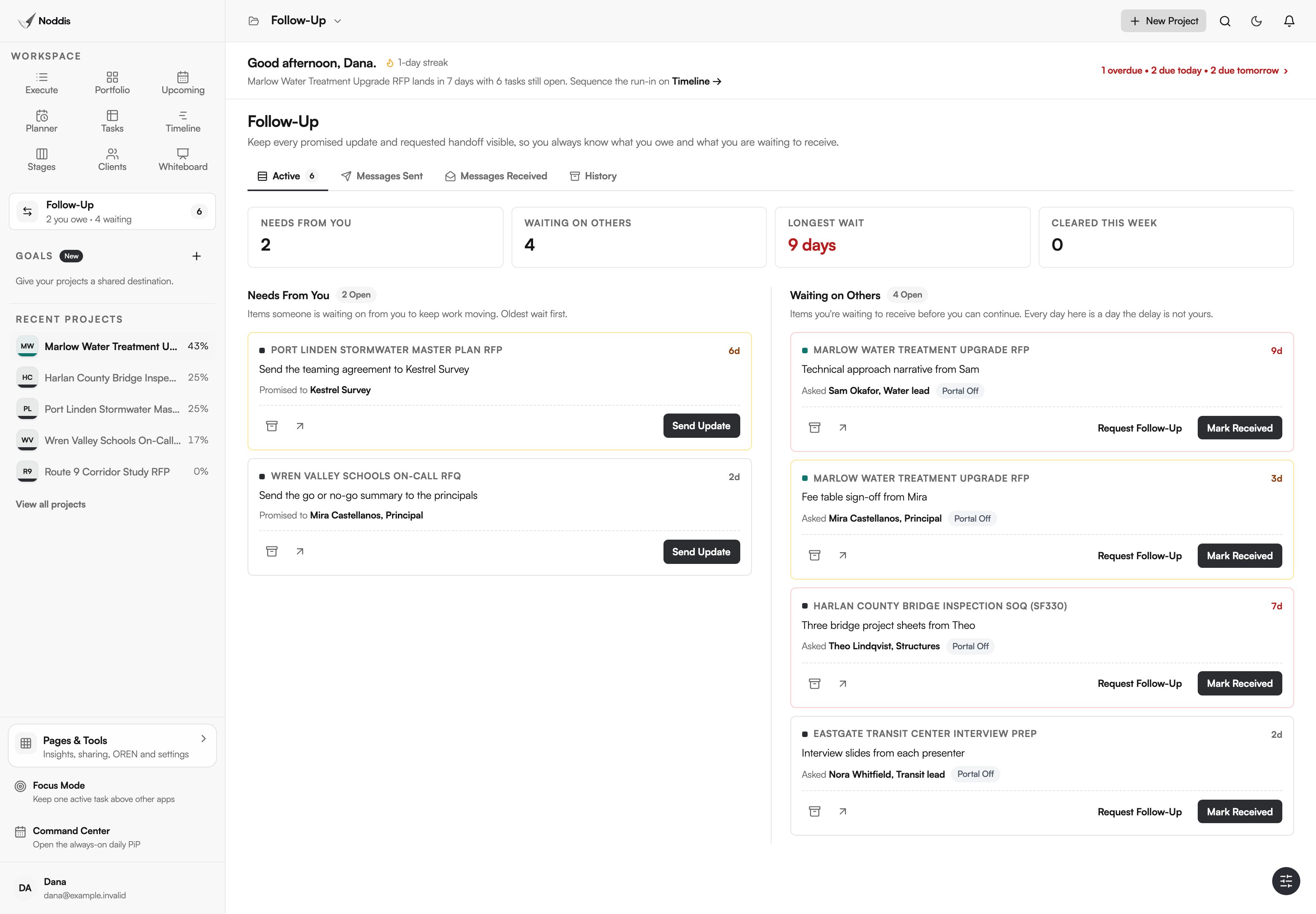
| Technical approach narrative | Sam, water lead | Nov 3 | Nov 11 | 9 |
| Three bridge project sheets | Theo, structures | Nov 5 | Nov 17 | 7 |
| Fee table sign-off | Mira, principal | Nov 9 | Nov 13 | 3 |
The names here are made up. The last column is the one that matters. A request you can describe as "nine days" gets a different response from one you describe as "still waiting".
How does Noddis track proposal contributions?
Noddis is a project management app that keeps tasks, follow-ups, and related project details connected. When we built Follow-Up in Noddis, we split it into two lists, Needs From You and Waiting on Others, and gave every open item an age in days.
Each request to an expert becomes a Waiting on Others item on the proposal task it blocks, with the person's name. On Pro, a follow-up can go out as an email and the reply returns to the same item, so the expert needs no account. The AEC proposal management workflow shows the list in use. Follow-Up works on one selected project on the Free plan and on every project on Pro.
Your next step
Rewrite your next request so the piece, the length, the date and the time needed are in the first three lines. To build a waiting list from your own open requests, open the live demo.
Common questions
How far ahead should you ask an expert for input?
Ask on the day of the kickoff, and set the due date at least two working days before the review. The request itself should take the expert under an hour. A long lead time with a small ask works better than a short lead time with a large one, because the expert can fit it between billable tasks.
What if the expert's draft is not usable?
Thank them and rewrite it yourself, then send it back for a factual check only. Asking an engineer to revise prose usually costs more time than it saves. Keep their technical points and their terms, fix the structure, and ask one question: "Is anything here wrong?"
Should principals be on the follow-up list too?
Yes. A principal's fee sign-off or go or no-go decision is an input like any other, and it is often the latest one. Record it with a date in the same list. A short, specific ask that names the deadline it protects works for principals too.

Katleen is the founder of Noddis. She runs client projects through her app studio, 693 Labs, and builds Noddis around the problems that work creates.
Last reviewed . Feature details reflect Noddis at the time of review.