
Short answer
A proposal data call template is the list of everything each outside firm on your team must send for the submission: forms, resumes, project sheets, certifications and signatures, each with a format, a limit and a due date. Send one request per firm on the day the team is confirmed, then chase the oldest open item first.
Free resource
Download the proposal data call template. The file is a blank CSV that opens in Excel, Google Sheets or Numbers. It has one row per item, with columns for the firm, the contact, the item, the format and limit, the dates and the status. One example row shows how to fill it in. No account is required.
What is a proposal data call?
A proposal data call is the prime firm's written request to each subconsultant or teaming partner for everything the submission needs from that firm, sent once, with formats and dates. The term comes from government contracting, and it fits any submission that shows another firm's people and projects.
A data call is organized by firm. A section checklist is organized by the parts of the form, and the SF330 checklist covers that side.
On federal architect-engineer work, the list starts with a form. The General Services Administration's instructions on the current SF330, the July 2021 edition, tell the prime to "Prepare a separate Part II for each firm that will be part of the team proposed for a specific contract and submitted with Part I."
What goes in a proposal data call template?
A data call template has one row per item per firm, and each row states the format, the limit and the section the item feeds. Most pursuits need the eight rows below, minus any your solicitation does not ask for.
| Ask each firm for | Say exactly | Common fault |
|---|---|---|
| Legal name, office and role | As registered, for the office doing the work | A brand name on no form |
| Qualifications form or profile | Current edition, signed and dated | Old edition, wrong office |
| Resumes of key people | Your template, editable file, page limit, role title | A marketing resume as a PDF |
| Project sheets | Owner, year, the firm's role, a reachable reference | A reference who has left |
| Who worked on which project | Each person marked against each project | Left blank |
| Licenses and registrations | State and discipline per person | Wrong state |
| Business certifications | Certificate and expiry date | Lapsed certificate |
| Signed forms | Each form by name, and who may sign | Signed without authority |
An SF330 resume has room for only a few relevant projects, so say which ones matter to this client. Past performance is asked of the whole team because evaluators use it to judge the team. The Federal Acquisition Regulation says: "Past performance information is one indicator of an offeror’s ability to perform the contract successfully." On federal bids that require questionnaires, add a past performance row and start it first: getting a past performance questionnaire completed depends on a client outside both firms.
Each row becomes one line of the request. Take a pursuit, the Port Linden Stormwater Master Plan RFP, with a survey subconsultant called Kestrel Survey:
Subject: Port Linden RFP: 4 items from Kestrel Survey by Wed, Nov 18
Hi [Name],
To include Kestrel Survey in the Port Linden proposal, we need four items by end of day Wednesday, Nov 18:
1. Firm name, office and role, as registered.
2. Two resumes in the attached template, one page each, editable.
3. Two survey project sheets, each with an owner reference and phone number.
4. The attached non-collusion form, signed. Please tell me who will sign.
Items 1 and 4 already exist, so please send those first.
Thanks,
[Your name]
How do you run a data call from request to return?
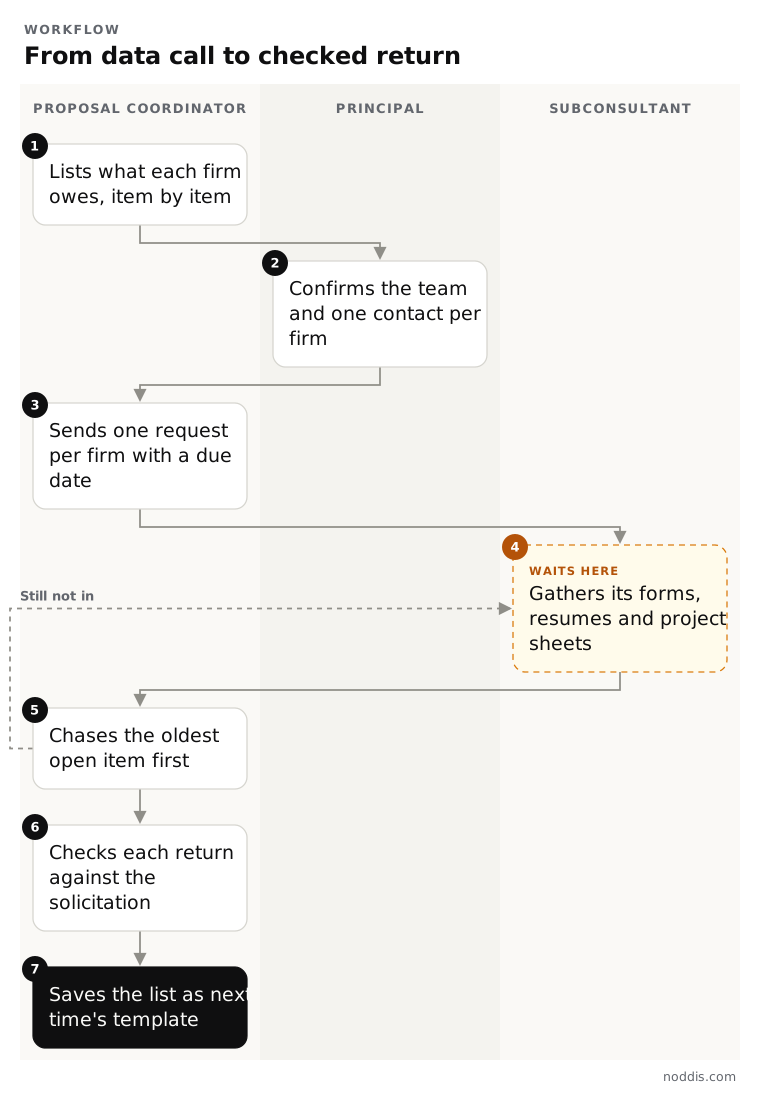
Run a data call as seven steps, with the proposal coordinator holding the list throughout. The long part is the wait in step 4.
- List what each firm owes. The coordinator writes one row per item per firm from the solicitation.
- Confirm the team and one contact per firm. The principal does this.
- Send one request per firm. Every item, format, limit and date goes in one message.
- Each firm gathers its items. The work waits here. Acknowledge partial returns the day they arrive.
- Chase the oldest open item first. Sort by days waiting, across all firms.
- Check each return against the solicitation. Do it on arrival, while it can still go back.
- Save the list as next time's template. Keep the rows and clear the dates.
How do you chase a subconsultant without straining the team?
Chase a subconsultant by age and by item, and change something in every message. A second copy of the first email teaches the firm that your date was soft.
Segue Technologies, a federal contractor, wrote in 2013 about its own teaming practice: "As the prime, it is important to have a clear view of outstanding sections and status of your subs contributions." Here is the same pursuit seven days after the request and two days after the due date:
| Open item | What it blocks | Next move |
|---|---|---|
| Second resume | Key staff section | Ask for it alone, by Monday |
| Two project sheets | Similar projects section | Offer to draft them from last year's |
| Signed form | The forms package | Your principal calls theirs |
Those are the three moves: shrink the ask, offer to draft, and go principal to principal. The guide to tracking subcontractor deliverables has a fuller escalation ladder.
What should you check when the items come back?
Check each returned item against the solicitation the day it arrives, because a returned item is not yet a usable one. Rachelle Ray, director of industry innovation at OpenAsset, describes the scale of the job: "A single pursuit can involve multiple subconsultants, dozens of resumes, and ten project sheets that all have to agree with each other."
On an SF330, the authorized representative's signature attests that the information is current and factual for the whole team. Run five checks first:
- Names agree on the form, the team list, the organizational chart and every resume.
- Forms are current, signed and dated by someone with authority.
- Resumes fit the template, the page limit and the proposed role.
- People and projects match: a person marked on a project shows it on the resume.
- References are reachable, and nothing expires before the due date.
Send problems back the same day with the exact fix.
How does Noddis track a proposal data call?
Noddis is a project management app that keeps tasks, follow-ups, and related project details connected. When we built importing in Noddis, we made it read a spreadsheet or a pasted scope, show the tasks it found, and wait for you to review them before anything is created.
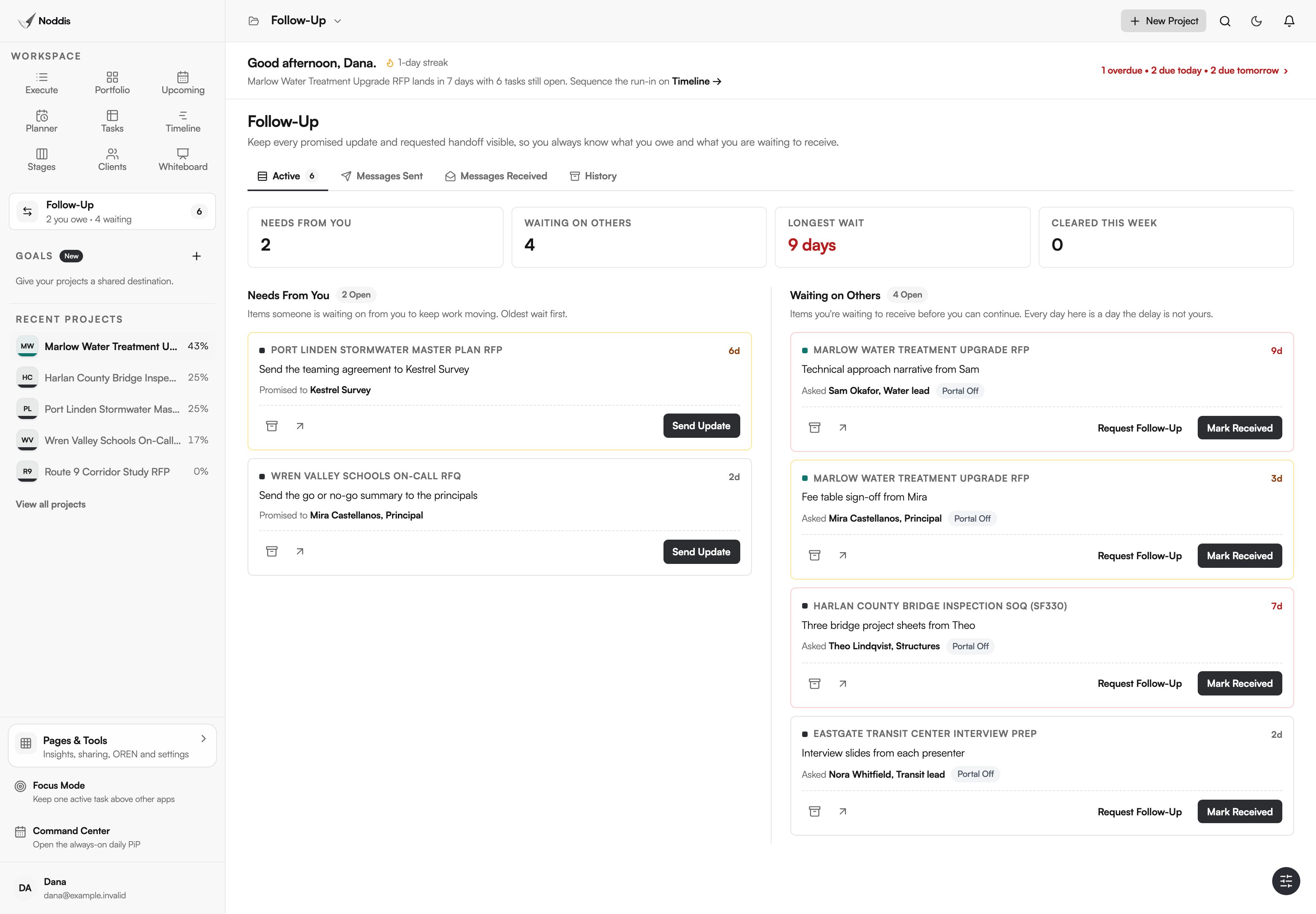
The data call list imports as it is, on any plan. Choose Sheets / Excel in the Import dialog, pick the header row and review the tasks Noddis found, one per requested item. People are not recreated, so a contact column arrives as a note.
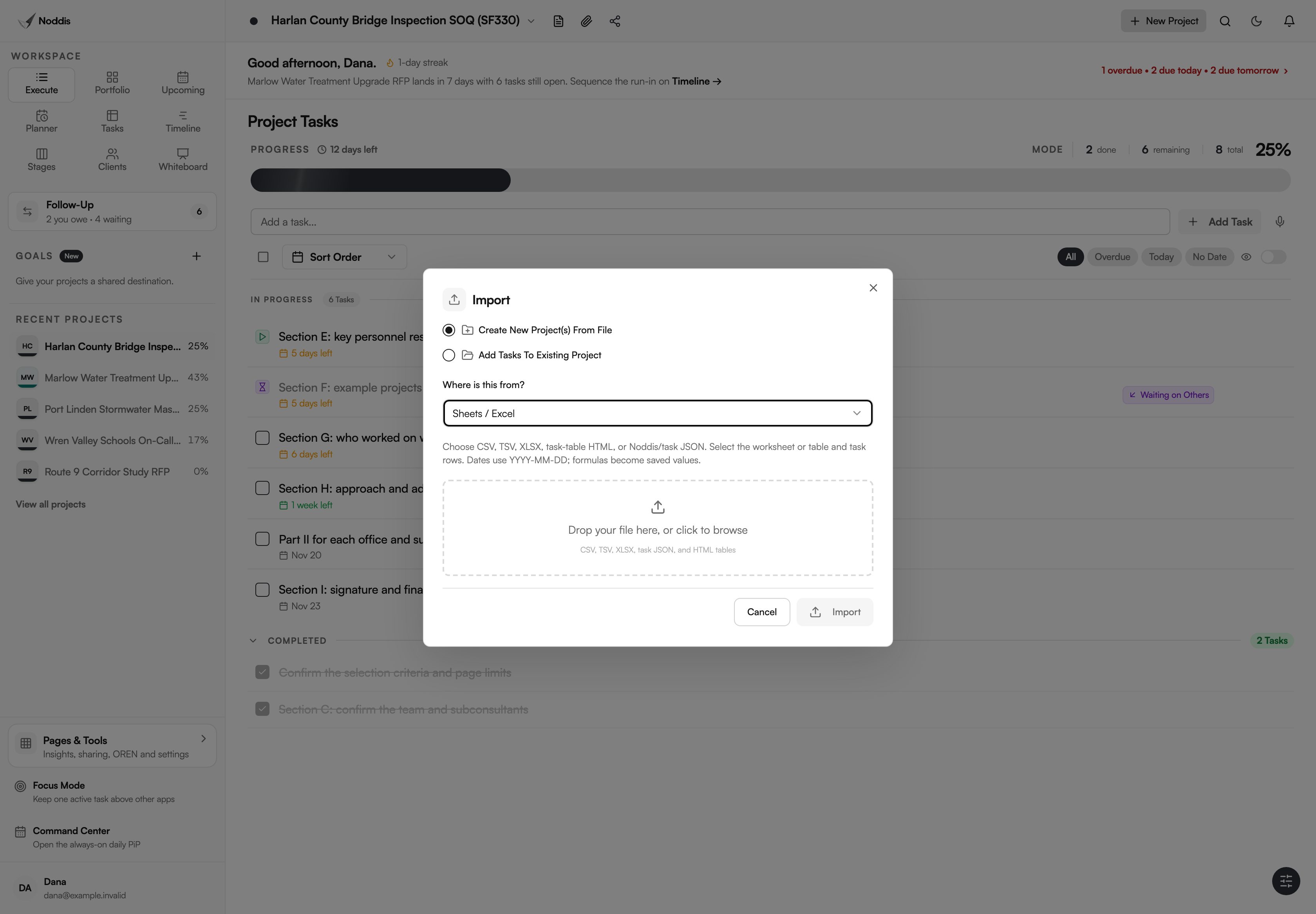
Log each item you are owed in Follow-Up, where it sits under Waiting on Others with its age in days. Follow-Up covers one project on Free and every project on Pro, where a follow-up can also go out by email and the subconsultant replies with no account. Next time, duplicate the project on Pro, or start from a template on Free.
Form filling, layout, teaming agreements, signatures and any file marked as controlled stay outside Noddis. The AEC proposal management workflow shows the setup with screenshots.
Your next step
Download the template, write one row for every item each firm owes on your next pursuit, and send the requests the day the team is confirmed. To start a waiting list for your own data call, with each ask's age in days, open the live demo. No account is needed.
Common questions
How much time should you give subconsultants to respond?
Give subconsultants a due date several working days before your own first full draft, so there is time to send things back. On a short response window, split the request: documents that already exist first, tailored resumes and project sheets a few days later.
Should subconsultants use your templates or send their own material?
Use your templates for anything in the body of the submission, such as resumes and project sheets. Accept the firm's own files for evidence: licenses, certificates and signed forms. Retyping a PDF resume is how errors in names and license numbers get in.
What if a subconsultant is on more than one team?
Ask before you send the data call, because the answer changes what you share. An exclusive firm can see the outline and the win themes. A firm that is also on a competing team gets the item list and formats, and nothing about strategy.

Katleen is the founder of Noddis. She runs client projects through her app studio, 693 Labs, and builds Noddis around the problems that work creates.
Last reviewed . Feature details reflect Noddis at the time of review.