
Short answer
On a federal bid, how to get a past performance questionnaire completed comes down to four moves. Start the day the solicitation lands, and have the project manager who knows the client ask personally. Send the form with your part filled in, then chase by age until the reference confirms it was sent. This guide covers federal work only.
What is a past performance questionnaire?
A past performance questionnaire, or PPQ, is a form in a federal solicitation that one of your past clients completes to rate your work on a named project. The client returns it to you for the proposal or sends it straight to the agency, as the solicitation directs.
Agencies ask because the Federal Acquisition Regulation (FAR) treats history as evidence. FAR 15.305, as published in November 2026, states: "Past performance information is one indicator of an offeror’s ability to perform the contract successfully." Architect-engineer selections weigh past performance too.
Bob Lohfeld, writing in Washington Technology in 2012, tells offerors what to plan for: "Expect the government evaluator to ask your customers how well you did performing each contract."
Read the instructions before you count. Some solicitations want a questionnaire only for projects with no completed evaluation in the Contractor Performance Assessment Reporting System (CPARS), which can shorten your list. The guide to proposal management for small government contractors covers the rest of the bid.
Why do past performance questionnaires come back late?
Past performance questionnaires come back late because completing one is nobody's job at the client. Your reference has no deadline of their own, the form can run to many pages, and the person who knew your work may have changed posts.
Nothing compels a reply. SmallGovCon, the legal blog published by Koprince McCall Pottroff LLC, covered the problem in a 2017 article on unreturned questionnaires. It noted that the FAR does not require a contracting official to answer a questionnaire request within any period, or at all.
The same article reports a protest from that year. An offeror submitted questionnaires that held only its clients' contact details, expecting the agency to make the calls. The agency rejected the proposal, and the Government Accountability Office denied the protest. SmallGovCon concluded: "Instead, it is up to the offeror to obtain completed PPQs."
How to get a past performance questionnaire completed: what are the steps?
To get a past performance questionnaire completed, split the work between two people: the project manager who knows the client makes the ask, and the proposal coordinator runs everything else. Start on the day the solicitation is released, not the week the proposal is due.
- Read the instructions. The coordinator notes how many questionnaires, for which projects, who may complete them, where they go and by when.
- Ask personally. The project manager calls the client before any form arrives.
- Send the form the same day. The coordinator fills in the firm's blocks and adds the project facts.
- The reference completes and sends it. The work waits here.
- Chase the oldest ask first. Change the channel or the person each time.
- Line up a backup reference. Do it before your cut date, not after.
- Confirm each questionnaire was sent. Many go straight to the agency, so ask the reference to tell you.
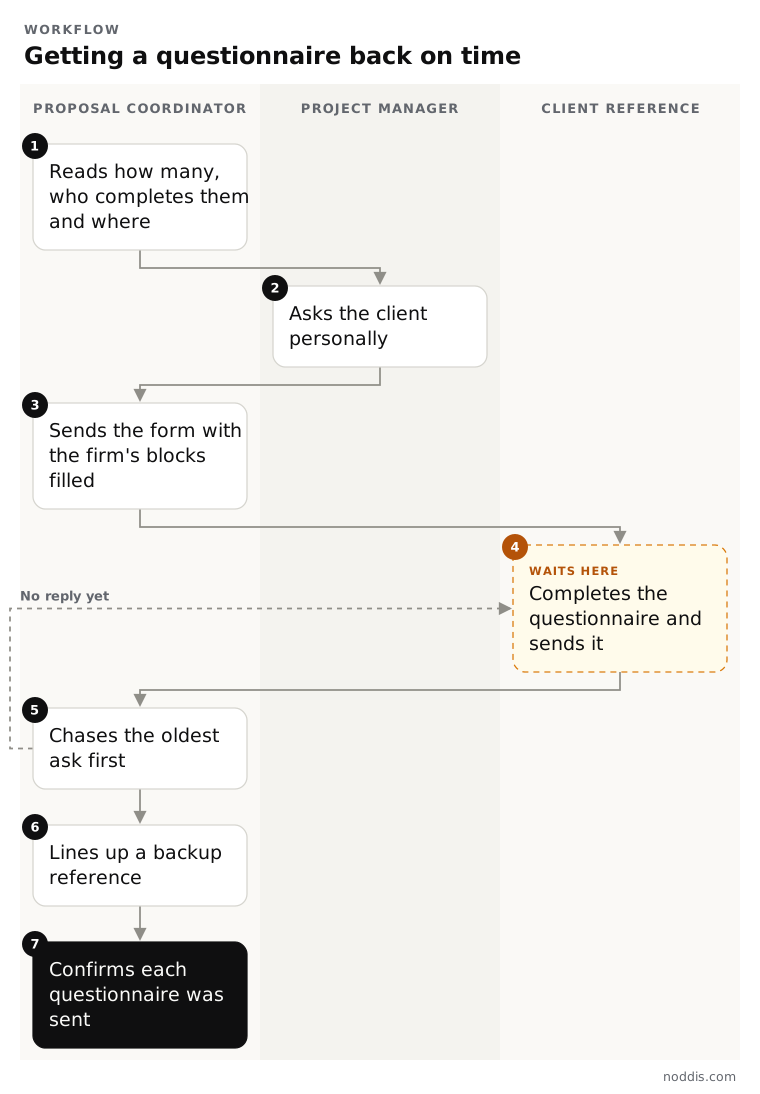
Ask one or two more references than the solicitation requires, unless it caps the number. A subconsultant's references are asked by that firm's own project manager, and you track the ask as a line on your proposal data call.
What should you send with the request?
Send the reference a package that is quick to finish: the form with your blocks filled in, a short reminder of the project, the exact return instructions and the date. Every blank you leave is a reason to put the form down.
- Your blocks, completed. Contract number, title, dates, value, your role and a description, as the form asks.
- A project reminder. Five lines on what you delivered and who was involved.
- Return instructions. The address, any required subject line, and the date and time with the time zone.
Take a federal bridge inspection pursuit. Theo Lindqvist, who led the reference project, calls the client on Monday. Dana, the proposal manager, sends this the same afternoon:
Subject: Past performance questionnaire for [project], due Wed, Nov 18
Hi [Name],
Thank you for agreeing with Theo to be a reference. We are proposing on [solicitation number], and the agency asks our past clients to complete the attached questionnaire.
I have filled in the contract details on page 1. Your part is the ratings and a signature.
Please email it directly to [address in the solicitation] by Wednesday, Nov 18. A one-line reply to me when it is sent would help, because we cannot see what the agency receives.
A short reminder of the project is below.
Thanks,
[Your name]
Never fill in the ratings for a reference or suggest what they should be. If the form goes straight to the agency, do not ask for a copy.
How do you chase a reference who has gone quiet?
Chase a quiet reference by the age of the ask, and change who asks or how at each step. The ladder below is a working pattern, not a rule, so shorten the gaps when the response window is short.
| Age of the ask | Who acts | What changes |
|---|---|---|
| 3 working days | Coordinator | A short reminder with the form attached again |
| 6 working days | Project manager | A phone call, and an offer to walk through the form |
| 9 working days | Principal | A call to a second person at the same client |
| Your cut date | Coordinator | The backup reference gets the package |
Government references sometimes say they are not allowed to complete the form. Ask who is, which is often the contracting officer, and whether a CPARS evaluation exists for the project.
How does Noddis track questionnaire requests?
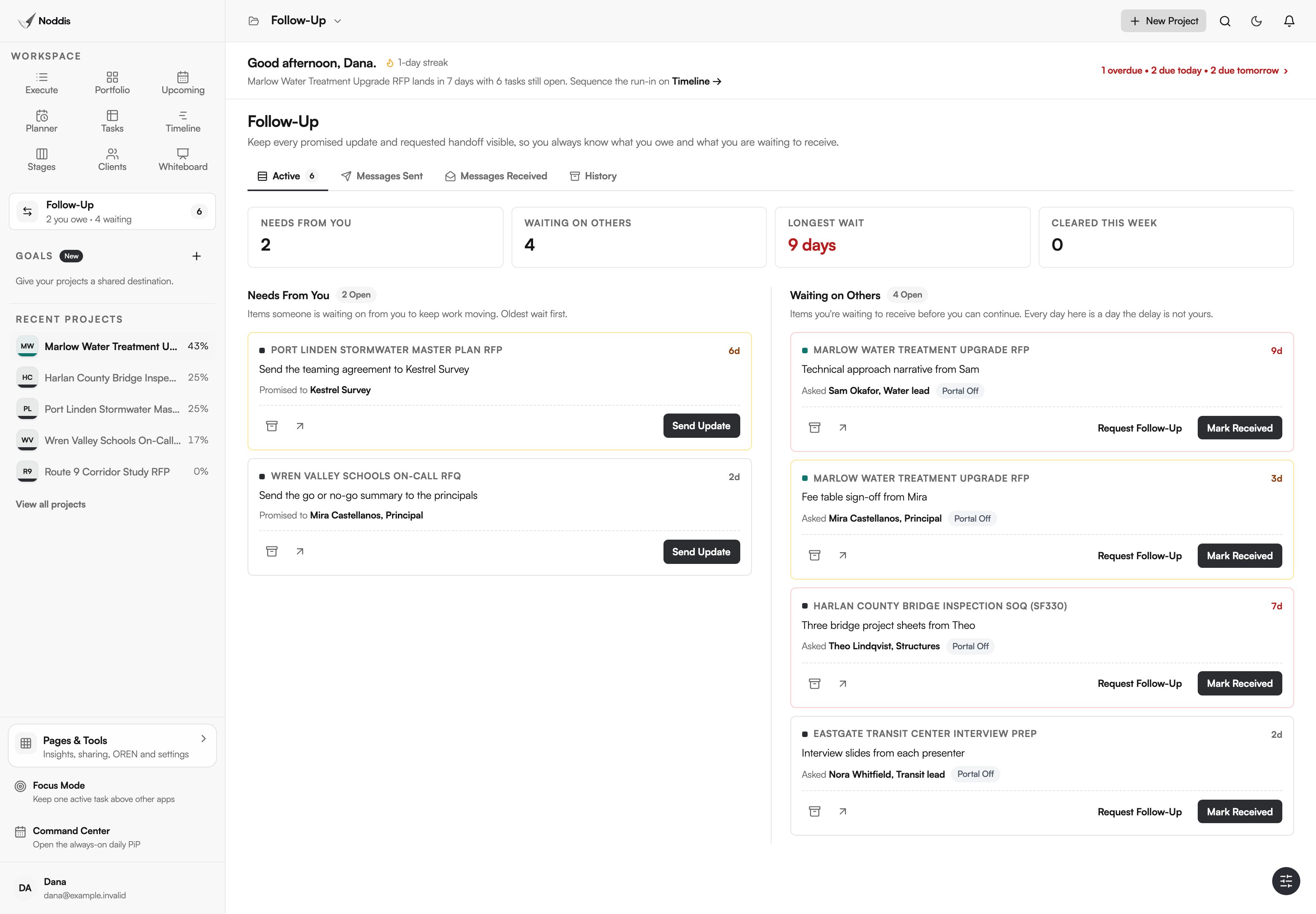
Noddis is a project management app that keeps tasks, follow-ups, and related project details connected. When we built Follow-Up in Noddis, we split it into two lists, Needs From You and Waiting on Others, and gave every open item an age in days.
Give the pursuit one task per questionnaire, and log each ask as a Waiting on Others item with the reference's name. The age in days is your chase list, and the Longest wait counter is the number to show your principal. Follow-Up covers one project on the Free plan and every project on Pro.
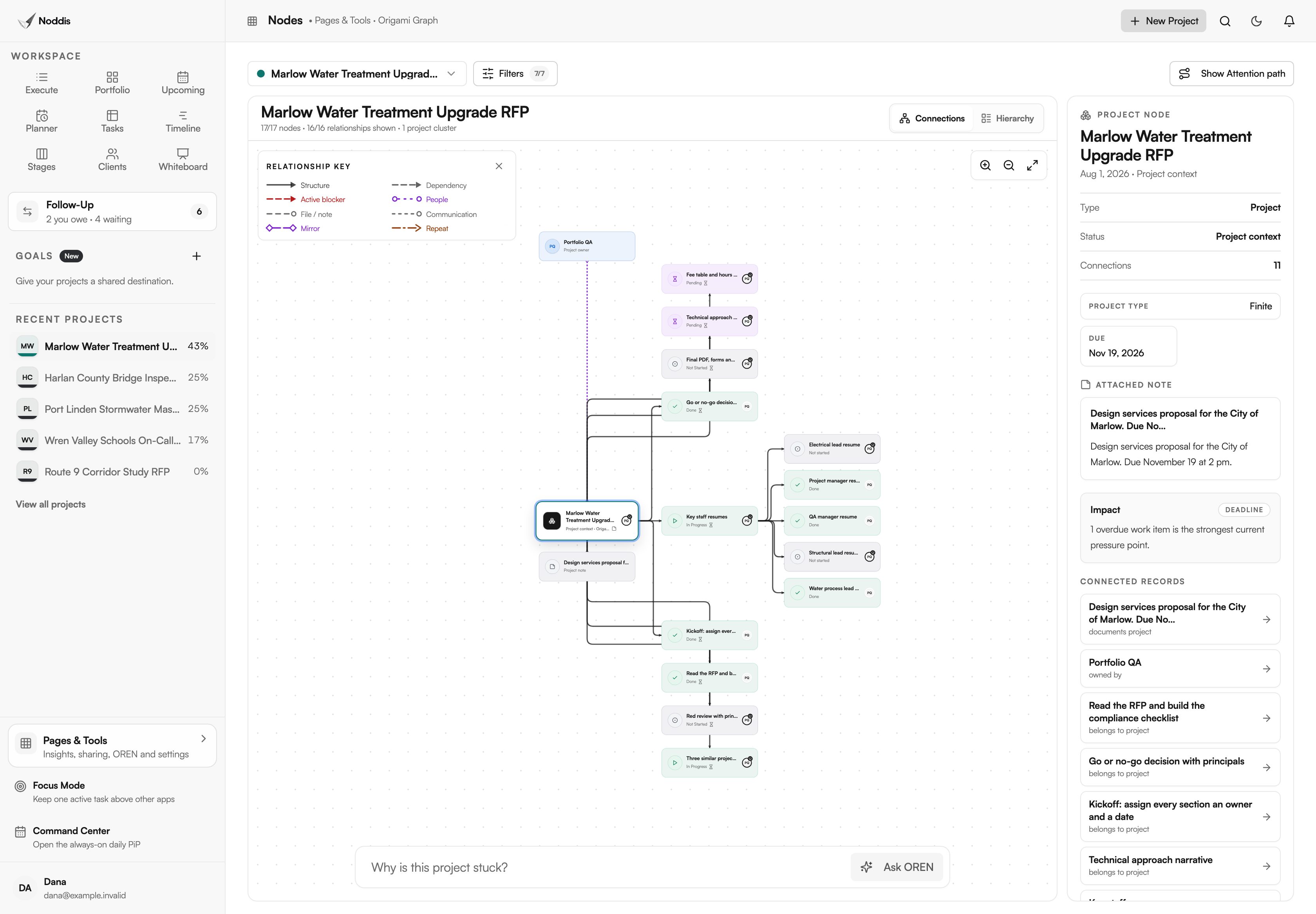
Nodes draws the pursuit's tasks, people and follow-ups as one graph, and its attention path highlights what is open, overdue, blocked or waiting. That answers a principal who asks why the past performance volume is not final. Nodes covers one project on Free, and Upcoming (Free) lists each questionnaire's due date beside every other pursuit's deadlines. The walk-through of how proposal managers use Noddis shows these screens across a full week.
Noddis is not FedRAMP authorized and holds no CMMC certification. Solicitation documents marked as controlled stay out of it, the questionnaire form included. Noddis tracks the ask, not the form. The AEC proposal management workflow shows the setup with screenshots.
Your next step
Open your next federal solicitation, count the questionnaires it requires, and have each project manager call the client today. To list your own open asks with their age in days, open the live demo. No account is needed.
Common questions
Can you reuse a questionnaire completed for an earlier bid?
Only if the solicitation allows it. Some agencies accept a questionnaire completed for an earlier solicitation when it covers the same project, and others require their own form with a current signature. Ask the contracting officer in writing before the questions deadline. Keep completed questionnaires, with the client's permission, so the option exists next time.
What if a reference never returns the questionnaire?
Switch to your backup reference at the cut date you set. Do not submit a blank form with contact details and expect the agency to call. In the 2017 protest described above, that ended with a rejected proposal. If no backup exists, ask the contracting officer in writing how to proceed, and take advice from your contracts counsel.
Should the questionnaire come back to you or go to the agency?
Follow the solicitation, which decides it. If the questionnaire goes directly to the agency, you will not see the ratings, and the only thing to ask the reference for is confirmation that it was sent. If it returns to you for inclusion, check that every page is complete and signed, and submit it exactly as received.

Katleen is the founder of Noddis. She runs client projects through her app studio, 693 Labs, and builds Noddis around the problems that work creates.
Last reviewed . Feature details reflect Noddis at the time of review.