
Short answer
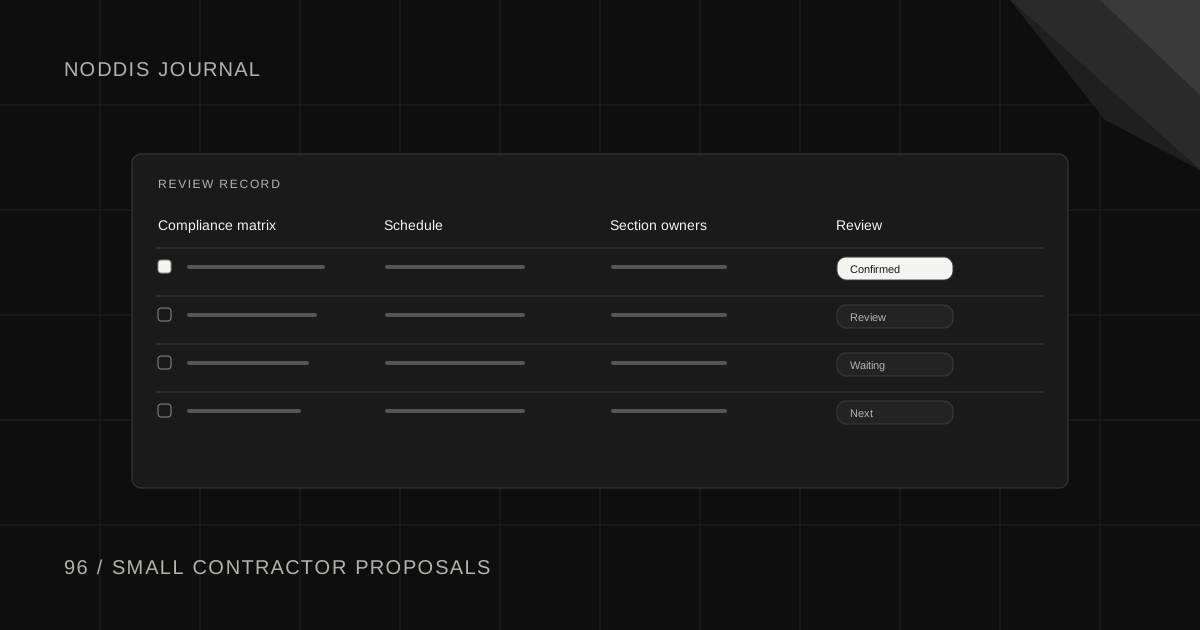
Proposal management for small government contractors comes down to five things a team of three can actually run: a compliance matrix built from the solicitation, a schedule worked backward from the due date, one owner for every section, at least one independent review, and a submission plan with a day to spare. Everything else is optional until those five are steady.
What is proposal management in government contracting?
Proposal management in government contracting is the work of turning a solicitation into a compliant response on time. It covers reading the requirements, planning the schedule, assigning the writing, running reviews and delivering the final files. It is separate from capture, which is deciding what to pursue and how to win, and from the writing itself.
Large contractors staff each of those jobs. A small business has the same deadlines with a handful of people, so the process has to be light enough to finish. The deadline is strict: under the Federal Acquisition Regulation, a proposal received "after the exact time specified for receipt of proposals" is late and will not be considered.
What does proposal management for small government contractors actually need?
A small team needs a minimum process it can repeat on every bid. These five pieces are enough.
| Piece | What it is | Who holds it | Done when |
|---|---|---|---|
| Compliance matrix | Every instruction and evaluation factor, mapped to a section of your response | Proposal manager | Each row has a section and an owner |
| Schedule | Milestones worked backward from the due date | Proposal manager | Reviews and production fit before the deadline |
| Section owners | One named person per section and form | Proposal manager | No section is shared or unassigned |
| Independent review | A read by someone who did not write it | A colleague or adviser | Comments have owners and dates |
| Submission plan | Who uploads what, where, and when | Proposal manager | A test upload or delivery check is done |
Add more only when these run without drama. A second review or a formal kickoff package helps a team that already meets its dates. It does not rescue one that does not.
How do you build a compliance matrix from Sections L and M?
Build a compliance matrix by listing every instruction and every evaluation factor in the solicitation, one per row, and writing next to each where your response answers it. In the federal uniform contract format, two sections carry most of this.
Section L holds the instructions to offerors. The Federal Acquisition Regulation describes its content as "solicitation provisions and other information and instructions not required elsewhere". Section M states how the response will be judged: agencies use it to "Identify all significant factors and any significant subfactors that will be considered in awarding the contract".
A working matrix has five columns:
- The requirement, quoted from the solicitation.
- Where it comes from, such as L.4.2 or M.2.
- The section of your response that answers it.
- The owner.
- The status.
Read the statement of work as well, since requirements appear there too. The matrix becomes the outline for the response, the checklist for the review and the last check before upload.
Who owns what when three people do everything?
When three people do everything, name the roles anyway and write down who holds each. A role with no name is a task nobody does.
| Role | What it decides or produces | In a three-person team |
|---|---|---|
| Capture or business development lead | Whether to bid, the win themes, the teaming partners | Owner or BD lead |
| Proposal manager | Matrix, schedule, assignments, reviews, submission | Operations or BD lead |
| Writers | Technical and management sections, past performance | The people who will do the work |
| Pricing lead | Cost or price volume, rates, assumptions | Finance or owner |
| Reviewer | An independent read against the matrix | Anyone who did not write |
One person may hold two or three of these. The rule that cannot bend is one owner per section. For the review step, the color team review checklist explains pink, red and gold reviews and which ones a small bid can skip.
How do you keep teaming partners on schedule?
Keep teaming partners on schedule by sending one data call at kickoff with every item they owe, the format and the date, then tracking each item as a commitment. Partners have their own bids. Your request competes with them.
The stakes sit with the prime. The U.S. Small Business Administration says of prime contractors: "They manage any subcontractors and are responsible for ensuring that the work is completed as defined in the contract." Federal regulation states that "The prime contractor is responsible for managing its subcontracts." The same holds before award: an evaluator sees one response, and a missing past performance write-up is the prime's gap.
A data call usually asks for past performance summaries, key personnel resumes, rates or pricing inputs, and representations. Give each a date at least three working days before your review. The guide to tracking subcontractor deliverables has a tracker and a follow-up cadence.
What should stay out of ordinary business software?
Controlled Unclassified Information, export-controlled technical data and classified information should stay out of ordinary business software, including general project management tools. Proposal work can touch all three.
The rule for defense contractors is specific. The clause on safeguarding covered defense information requires a contractor that uses an outside cloud service for that information to ensure the provider meets security requirements equivalent to the "Federal Risk and Authorization Management Program (FedRAMP) Moderate baseline". Check each solicitation for markings and your own security policy before you decide where a file or a note may live.
In practice, keep the schedule, the assignments and the follow-ups in a coordination tool, and keep controlled content in the system approved for it. A task can say "past performance volume, section 3" without containing the section.
How does Noddis fit a small contractor's proposal process?
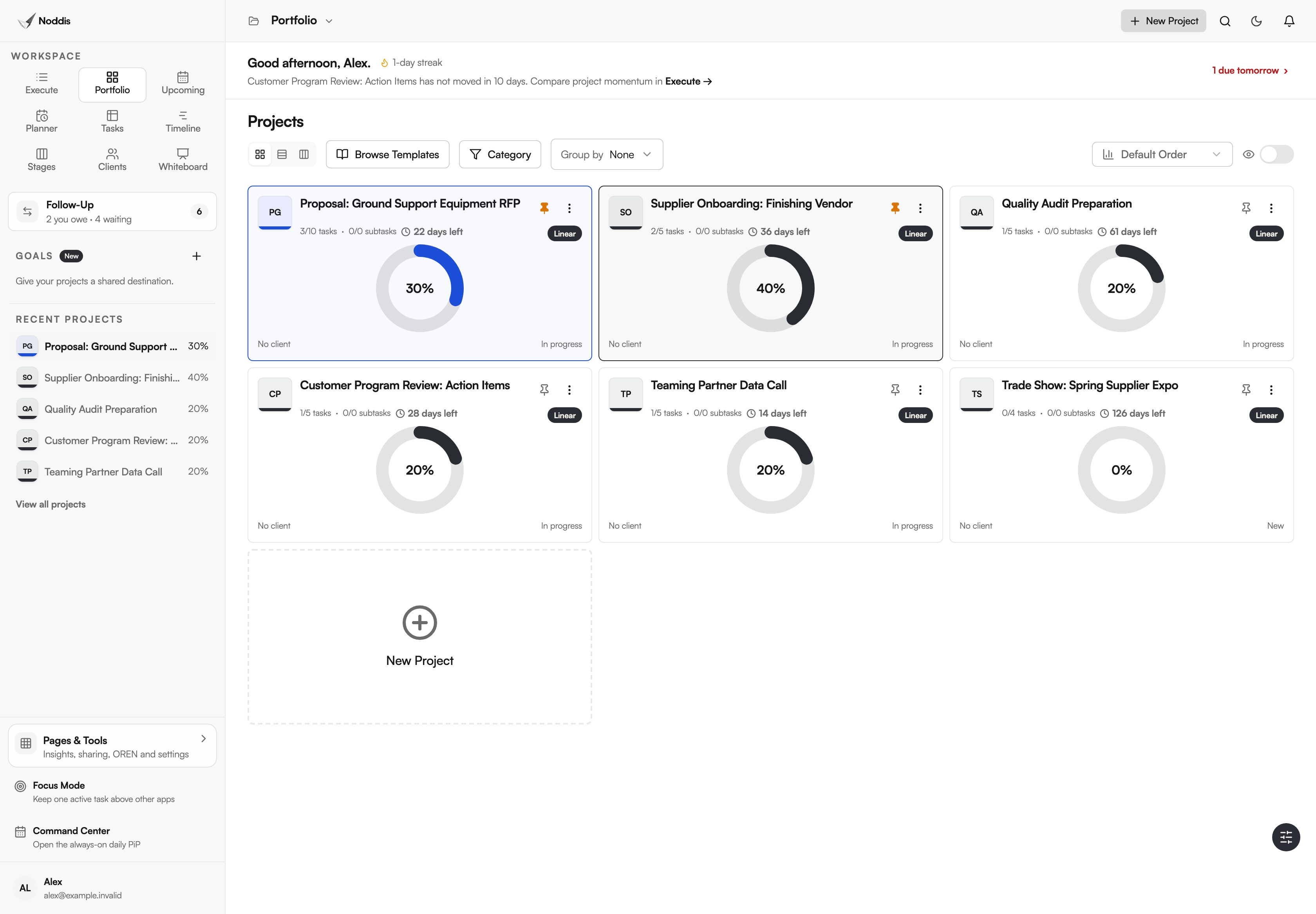
Noddis is a project management app that keeps tasks, follow-ups, and related project details connected. When we built Follow-Up in Noddis, we split it into two lists, Needs From You and Waiting on Others, and gave every open item an age in days.
Each bid is a project, each section a task with an owner and a date, and each partner input a Waiting on Others item. Noddis is not FedRAMP authorized and holds no CMMC certification, so use it for coordination only and keep controlled information out of it. The aerospace and defense coordination workflow shows the setup and its limits.
Your next step
Take your next solicitation and build the five-column matrix before anyone writes a sentence. To track your own bid as sections, owners and waiting items, open the live demo.
Common questions
Does a small business need proposal software?
Not to start. A compliance matrix in a spreadsheet, a shared schedule and a list of open requests cover the minimum process. Dedicated proposal software earns its cost when you bid often enough that reusing content and automating the matrix saves real hours. Fix the process first, because software speeds up whatever process you already have.
How early should a small contractor start on a proposal?
Before the solicitation is released, if you can. The decision to bid, the teaming partners and the past performance examples can all be settled from a draft solicitation or a forecast. Once the final version arrives, the response window is for writing and review, and a team that starts from zero loses the first days to getting organized.
How many reviews does a small bid need?
At least one independent review with time afterward to make changes. If the window allows two, make the first an early check of the outline against the matrix and the second a read of the near-final draft. Skip a review before you skip the recovery time after it.

Katleen is the founder of Noddis. She runs client projects through her app studio, 693 Labs, and builds Noddis around the problems that work creates.
Last reviewed . Feature details reflect Noddis at the time of review.