
Short answer
The best questions to ask in a debrief after losing a proposal are open ones about your own submission: where it scored lowest, what was unclear, and which people or projects raised doubts. Request the debrief promptly in writing under the applicable deadline, listen without arguing, and turn each answer into a dated change.
Are you owed a debrief after losing a proposal?
A debrief is the client's explanation of how your submission was evaluated. Federal debriefing rights depend on the procurement procedure and a timely request. On other work, check the client's rules or ask whether it offers one.
| Client | Is a debrief owed? | How to ask |
|---|---|---|
| Federal, architect-engineer selection | Yes, to the extent practicable | In writing, to the contracting officer |
| Federal, negotiated procurement under FAR Part 15 | Under FAR 15.506, on a timely written request | Send it the day the award notice arrives; the agency must receive it within 3 days |
| State or local agency | It depends on the agency's rules | The procurement contact named in the RFP |
| Private client | No, it is a courtesy | A short personal note from the principal |
For architect-engineer contracts, the Federal Acquisition Regulation (FAR), as published in November 2026, says: "Debriefings of successful and unsuccessful firms will be held after final selection has taken place and will be conducted, to the extent practicable, in accordance with 15.503, 15.506(b) through (f), and 15.507(c)." For postaward debriefings under FAR 15.506(a)(1), the agency must receive the written request within 3 days after you receive the contract award notification. Do not treat "within days" as an open-ended window. Architect-engineer selections follow the separate provisions above; other procedures and agency rules can differ. Check the solicitation and notice immediately. If a protest is possible, call your contracts counsel first.
How do you request a debrief?
Have the principal who led the pursuit request a debrief in writing as soon as the notice arrives, using the contact and deadline in the notice. Keep it to five sentences: thanks, the request, the purpose, your availability and who will attend.
Rich Friedman, writing in Architect Magazine in 2014, gives the reason to ask at all: "Conducting a debrief sends a strong message to clients that you care." He lists letting too much time pass as the first mistake firms make.
Subject: Debrief request: [solicitation number], [project name]
Dear [Name],
Thank you for the notice of [date] and for the selection committee's time. [Firm] requests a debriefing on our submission for [project name].
We would like to understand how our submission was evaluated, so that the next one is better. A 30-minute call would be enough, and we are available on [three dates]. A written debrief works equally well.
Two of us would attend: [principal] and [proposal manager].
Thanks,
[Your name]
Before the call, write down your own guess at why you lost. Comparing it with the client's answers shows how well your team reads its own work.
What are the best questions to ask in a debrief after losing a proposal?
The best debrief questions are open, specific to your submission and ordered so the most useful come first. Take this list into the call.
Scoring
- On which criteria did our submission score lowest?
- Was anything missing, non-compliant or hard to find?
- Where did we rank, if you are able to say?
Team and experience
- Did any proposed person or subconsultant raise a concern?
- Which example projects seemed least relevant, and what would have been more relevant?
Approach
- Did our approach show that we understood your main concern? What did we miss?
- What did you want to see more of, and less of?
Interview and fee, where they applied
- How did the interview change the panel's view of us?
- How did our fee or hours compare with the range you received?
Next time
- What one change would most improve our next submission to you?
- What upcoming work would suit our qualifications?
Do not ask who scored you low or how the winner answered. On federal work the rule is explicit. FAR 15.506 states: "The debriefing shall not include point-by-point comparisons of the debriefed offeror’s proposal with those of other offerors." On architect-engineer contracts, FAR 36.607 adds that the overall ranking and the summary of the rationale for award are among the items that do not apply, so put the questions about your own weaknesses first.
How do you run a debrief from the result to the next proposal?
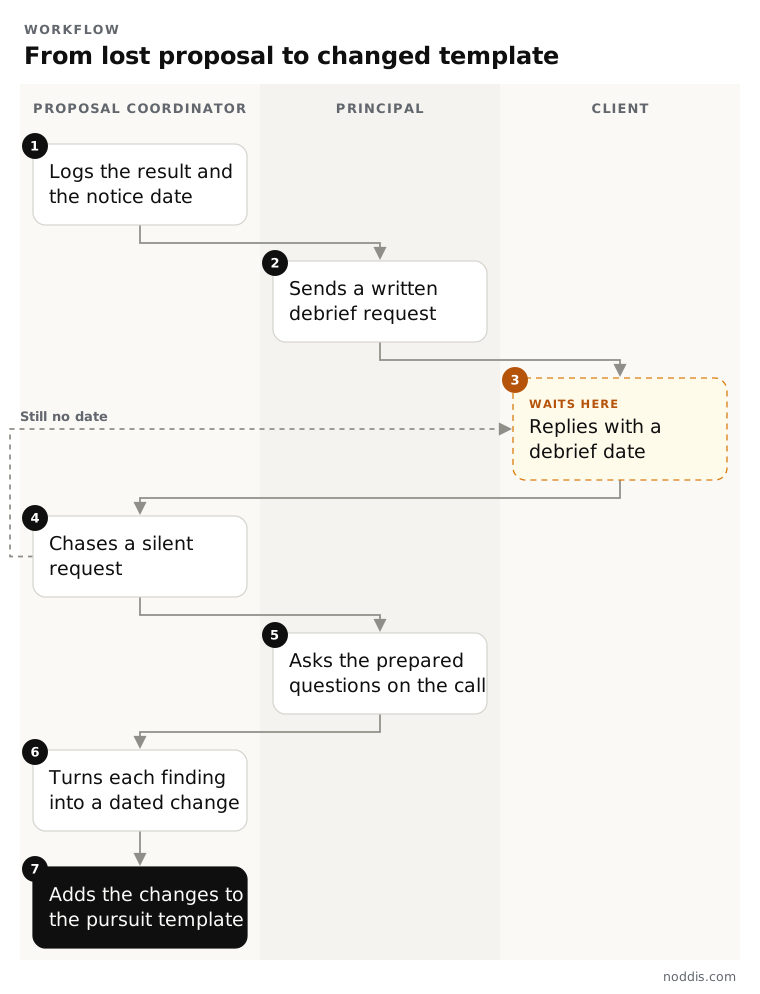
Run a debrief as seven steps shared by the proposal coordinator and the principal, with one wait in the middle while the client finds a date.
- Log the result. The coordinator records the outcome and the notice date the day it arrives.
- Send a written request. The principal sends the request immediately and records the applicable receipt deadline.
- The client replies with a date. The work waits here.
- Chase a silent request. The coordinator follows up, once by email and once by phone.
- Hold the debrief. The principal asks the prepared questions while a second person takes notes.
- Turn each finding into a change. Every change gets one owner and one date.
- Add the changes to the template. The next pursuit starts with them built in.
In the call, do not defend the submission. Thank the client for each answer, ask what else they noticed, and keep to the time you asked for.
How do you turn debrief answers into changes?
Turn debrief answers into changes by writing one row per finding: the finding, what you will change, who owns it and by when. Take a loss, the Ridgeview Reservoir Rehabilitation RFP:
| Finding from the client | Change | Owner | Due |
|---|---|---|---|
| The approach repeated the scope back | Open every approach with the client's main risk | Sam Okafor | Jan 8 |
| It was unclear who would be on site | Show each key person's availability on the organizational chart | Mira Castellanos | Jan 15 |
| Two project sheets were not stormwater work | Add a relevance line to every project sheet | Dana | Jan 22 |
A finding that repeats across two debriefs goes to the top of the list. Findings about clarity or compliance belong in your color team review checklist. Findings about the client belong in the next go or no-go decision, covered in the guide to managing multiple RFPs. Read the open changes aloud at the next proposal kickoff meeting.
How does Noddis keep debrief changes from being forgotten?
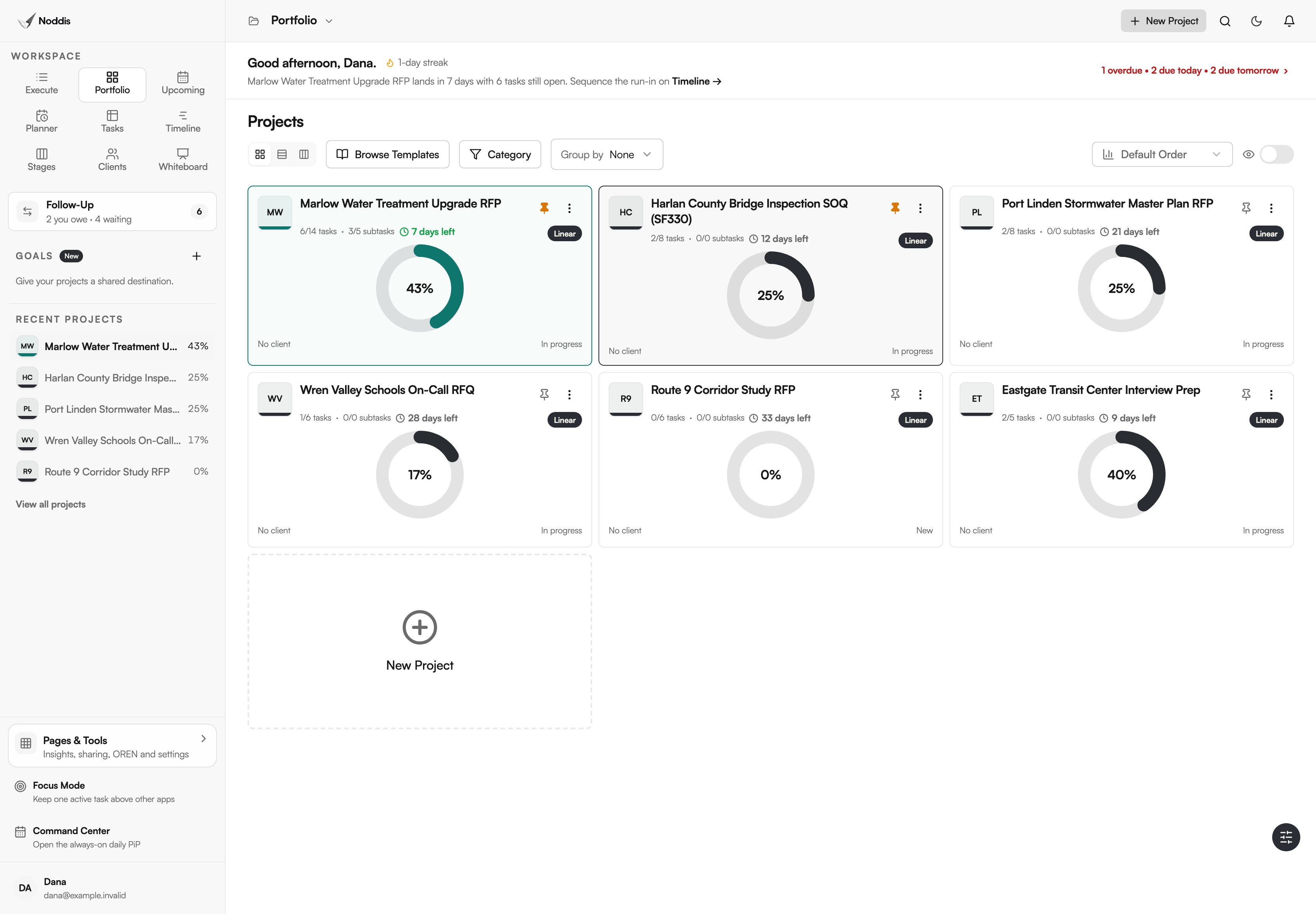
Noddis is a project management app that keeps tasks, follow-ups, and related project details connected. When we built Upcoming in Noddis, we put the deadlines from every project in one list, so nothing has to be opened to see what is due.
Debrief changes get lost because the pursuit they came from is over. Add each change as a dated task, and Upcoming (Free) lists it beside the deadlines of every live pursuit. The debrief request itself can wait in Follow-Up as a Waiting on Others item, with its age in days, until the client replies.
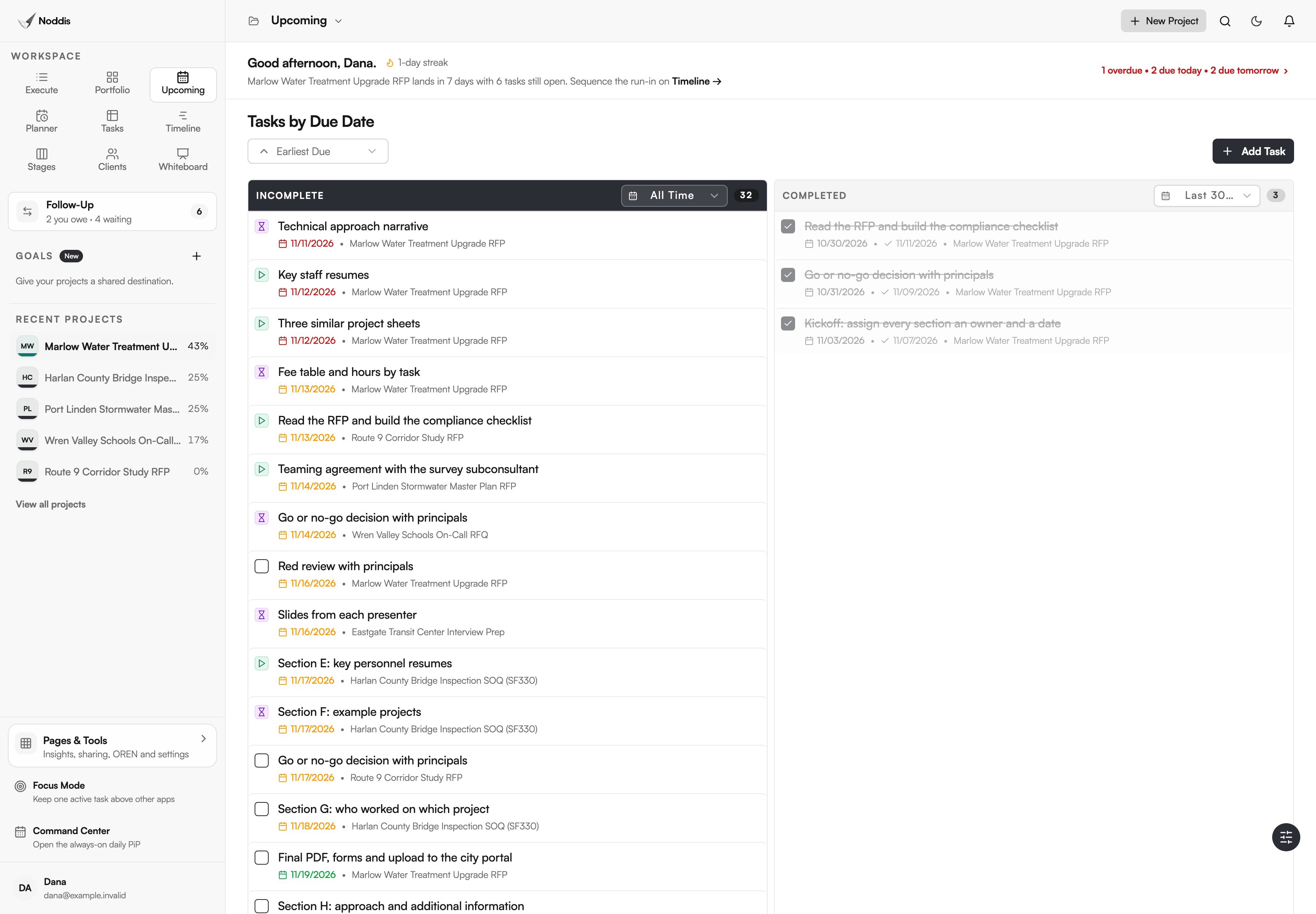
Portfolio (Free) shows every pursuit on one screen with its progress and days left. The Free plan holds three active projects, so on Free keep the changes as tasks inside your next pursuit. On Pro, duplicate the last similar pursuit as the starting point for the next one, and its tasks come with it.
The notes from the call, the score sheets and the client relationship stay outside Noddis, which has no CRM pipeline or content library. The AEC proposal management workflow shows the setup with screenshots.
Your next step
Find your most recent loss and send the written debrief request today, using the wording above. To put your own follow-through tasks beside your live pursuit deadlines, open the live demo. No account is needed.
Common questions
Should you ask for a debrief after a win?
Yes. The federal rule for architect-engineer selections covers successful firms as well as unsuccessful ones, and most clients are glad to talk to the team they chose. Ask which parts of the submission carried the decision and which nearly cost you the work. A win debrief tells you what to keep, which a loss debrief cannot.
Can you see the winning proposal or the score sheets?
Often, on public work. Many public agencies release score sheets and the winning submission after the contract is awarded, on request or through their public records process, with confidential business information removed. The rules differ by agency and state, so ask the procurement contact what is available and when.
Who should lead the debrief call?
The principal or pursuit lead who can hear criticism without defending the work should lead, with the proposal manager taking notes. Avoid sending the person whose section is most likely to be criticized. For a client that matters a great deal, some firms use an independent third party, because clients can be more candid with an outsider.

Katleen is the founder of Noddis. She runs client projects through her app studio, 693 Labs, and builds Noddis around the problems that work creates.
Last reviewed . Feature details reflect Noddis at the time of review.