
Short answer
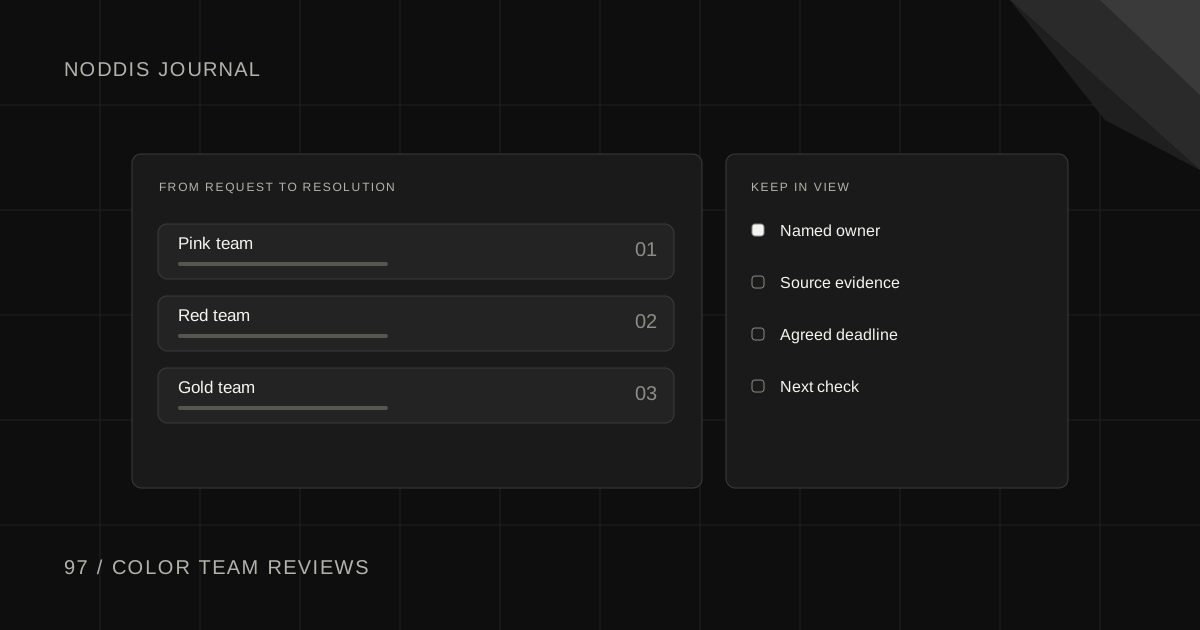
A color team review checklist names what each proposal review is for, so reviewers answer one question at a time. Pink team asks whether the plan and outline are right. Red team reads the near-final draft the way an evaluator would. Gold team confirms the response is complete, compliant and approved to submit.
What does a color team review checklist cover?
A color team review checklist covers each scheduled, independent read of a proposal and the one question that read should answer. A color team review happens at a set stage of the proposal's development. The colors are a convention from government contracting, and firms differ on the names and on how many reviews they hold. Pink, red and gold are the three most teams mean when they use the term.
The reviews exist because writers cannot see their own gaps. A reviewer who comes to the draft cold reads it the way an evaluator will.
| Review | When | State of the draft | The question it answers | Output |
|---|---|---|---|---|
| Pink team | Early, after the outline and first drafts | Outline, key points, rough text | Is this the right response, in the right structure? | Changes to structure, themes and gaps |
| Red team | Late, with time left to revise | Near-final, complete draft | Would an evaluator score this well? | Scored findings by section |
| Gold team | Final days | Finished response | Is it complete, compliant and approved? | Sign-off, or a short list of fixes |
Some firms add a pricing review, often called green team, on its own track.
Pink team checklist: is this the right response?
The pink team checks the plan before the team spends two weeks writing it. Reviewers get the compliance matrix, the outline and whatever draft exists. Ask them to answer:
- Does every instruction and evaluation factor in the matrix have a home in the outline?
- Is the solution clear enough that a stranger could explain it back?
- Are the main reasons to choose this team stated, and backed by a past project or a named person?
- Which sections are thin or missing an owner?
- Is anything promised that the team cannot price or staff?
Pink team is the cheapest place to find a structural problem. Reviewers should not edit sentences, because most of those sentences will change.
Red team checklist: would an evaluator score this well?
The red team reads the complete draft as the customer's evaluators would, against the factors the solicitation says it will use. In the federal format those are in Section M, which the Federal Acquisition Regulation says is where agencies "Identify all significant factors and any significant subfactors that will be considered in awarding the contract".
Give each reviewer one or two sections and the matching factors. Ask them to:
- Score each section against its evaluation factor, with a one-line reason.
- Mark every requirement in the matrix as answered, partly answered or missing.
- Flag claims with no proof, such as a result with no project named.
- Note where the answer is hard to find. Evaluators do not hunt.
- List the three changes that would raise the score most.
A red team's value is its ranking of problems. A long unranked list gets fixed at random. A short ranked one gets fixed.
Gold team checklist: is it ready to submit?
The gold team is the final check before submission, by the person with authority to approve the bid. It is not another full review. The checklist is short:
- Every red team finding is closed or consciously accepted.
- The compliance matrix has no open rows.
- Page limits, fonts, file names and formats match the instructions.
- Forms, representations and signatures are complete.
- Pricing matches the technical response.
- The submission method has been tested, and the upload is planned with a day to spare.
The buffer matters because the cut-off is absolute. Under the Federal Acquisition Regulation, a proposal received "after the exact time specified for receipt of proposals" is late and will not be considered.
How do you schedule color team reviews?
Schedule color team reviews backward from the due date, and put recovery time after each one before you place the next. A working rule is to allow at least twice as long to fix the findings as the review itself took.
| Milestone | Days before due, on a 30-day window | Why there |
|---|---|---|
| Pink team | 18 to 20 | Outline and first drafts exist, most writing is still ahead |
| Red team | 8 to 10 | A complete draft, with a week left to revise |
| Gold team | 2 to 3 | Finished response, before production closes |
| Submit | 1 | One day of buffer |
Timeliness is a known weak point. In the QorusDocs 2026 benchmark of AEC proposal teams, "44% report difficulty responding in a timely manner", which is a vendor's survey and a signal, not a measured rate. Reviews are the first thing a late schedule squeezes, so book reviewers at kickoff. A review with no reviewers available is a common reason a red team slides into the final week. For the full schedule around the reviews, see the RFP response timeline.
How do you track review comments to closure?
Track review comments by turning each accepted finding into a task with one owner and a date before the next review. Comments left in the margin of a document are easy to agree with and easy to forget.
| Finding | Section | Owner | Due | Status |
|---|---|---|---|---|
| Management approach does not name the deputy | 3.2 | Program lead | Nov 26 | Open |
| Past performance 2 has no measurable result | 4.1 | Teaming partner | Nov 25 | Waiting |
| Staffing table exceeds the page limit | 3.4 | Proposal manager | Nov 24 | Closed |
The example is made up. Decide at the debrief which findings will not be fixed, and record that too. A gold team can only confirm closure if someone kept the list.
How does Noddis help you run the reviews?
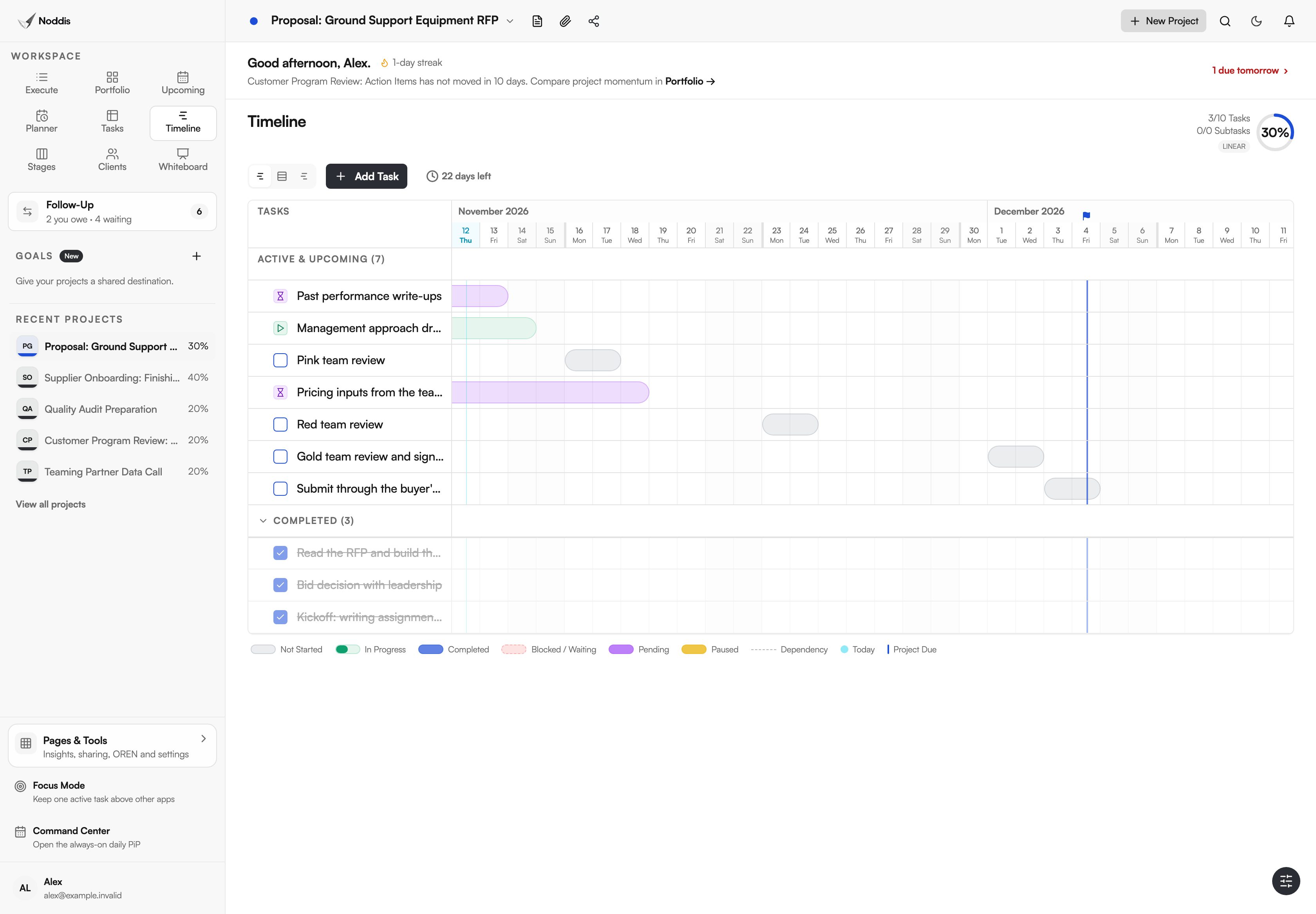
Noddis is a project management app that keeps tasks, follow-ups, and related project details connected. When we built Timeline in Noddis, we drew each task as a bar from its start date to its due date and marked the project's due date with a flag.
Enter each review and its recovery period as tasks, and Timeline shows whether pink, red and gold still fit before the flag. Findings become tasks with owners, and anything owed by a partner sits in Follow-Up with its age in days. Keep controlled information out of task names and notes, because Noddis is not authorized for it. The aerospace and defense coordination workflow shows a proposal with all three reviews on a timeline.
Your next step
Put your next bid's reviews on the calendar today, with the recovery days after each one, and invite the reviewers. To lay out your reviews against a deadline, open the live demo.
Common questions
Does a small proposal need all three color team reviews?
No. A short response with a small team can run one early check of the outline and one final check, which is pink and gold without a separate red team. What a small bid cannot skip is an independent reader and time to act on what they find. Scale the number of reviews to the size and value of the bid.
Who should be on a color team?
People who did not write the sections they review, and who can read as the customer would. Former evaluators, subject experts from another program and a senior manager are common choices. On a small team, one outside adviser or a colleague from another department is enough. Give reviewers the solicitation and the evaluation factors, not only the draft.
What is a green team review?
A green team review is a review of the price or cost volume. It checks that the pricing is complete, consistent with the technical approach and competitive. Many firms run it alongside the red team, since a change in the solution usually changes the price. Small bids often fold it into the gold team.

Katleen is the founder of Noddis. She runs client projects through her app studio, 693 Labs, and builds Noddis around the problems that work creates.
Last reviewed . Feature details reflect Noddis at the time of review.