
Short answer
The practical answer to how to get content from subject matter experts is to stop asking them to write. Ask for 30 minutes and five questions instead, record the conversation, write the article yourself, and give the expert one review for accuracy with a date. A principal's backing and a steady reminder rhythm keep it moving.
Why do subject matter experts avoid writing content?
Subject matter experts, the engineers and specialists who know a topic first-hand, avoid writing content because an article is unbilled work with no deadline. A proposal at least has a submission date. A blog post or thought leadership article has none, so it loses to client work every week, and a careful engineer worries about being wrong in public.
The three usual objections each have a fix. No time to write: ask for 30 minutes of talking. Not my job: have a principal name the topic and the expert. Fear of getting it wrong: promise an accuracy review before anything is published.
Proposal sections are a different problem, with a harder deadline. The guide to proposal input from subject matter experts covers them.
What should you ask an expert for instead of a draft?
Ask an expert for a 30-minute recorded conversation, built on five questions you send in advance. Talking is the part the expert finds easy. Say who writes, what the expert reviews and where the piece will appear.
Manya Chylinski, writing for the Content Marketing Institute, warns: "Failure to set expectations can result in pushback and a lot of wasted time."
Take a request from June, a marketing manager, to Sam, a water engineer, backed by Mira, a principal:
Subject: 30 minutes on lead service line replacement, no writing needed
Hi Sam,
Mira would like the firm to publish an article on lead service line replacement, with you as the author. I will do the writing.
I need 30 minutes on a recorded call, and one review of my draft for accuracy. The article will run under your name in the December newsletter and on the website.
The five questions are below. Would Tuesday at 2:00 or Thursday at 9:00 work?
Thanks,
[Your name]
Five questions that suit most technical topics:
- What question do clients ask you most about this?
- What do people usually get wrong?
- Which recent project shows it, without naming the client?
- What should an owner do before hiring anyone?
- What will change in the next year?
How to get content from subject matter experts: what are the steps?
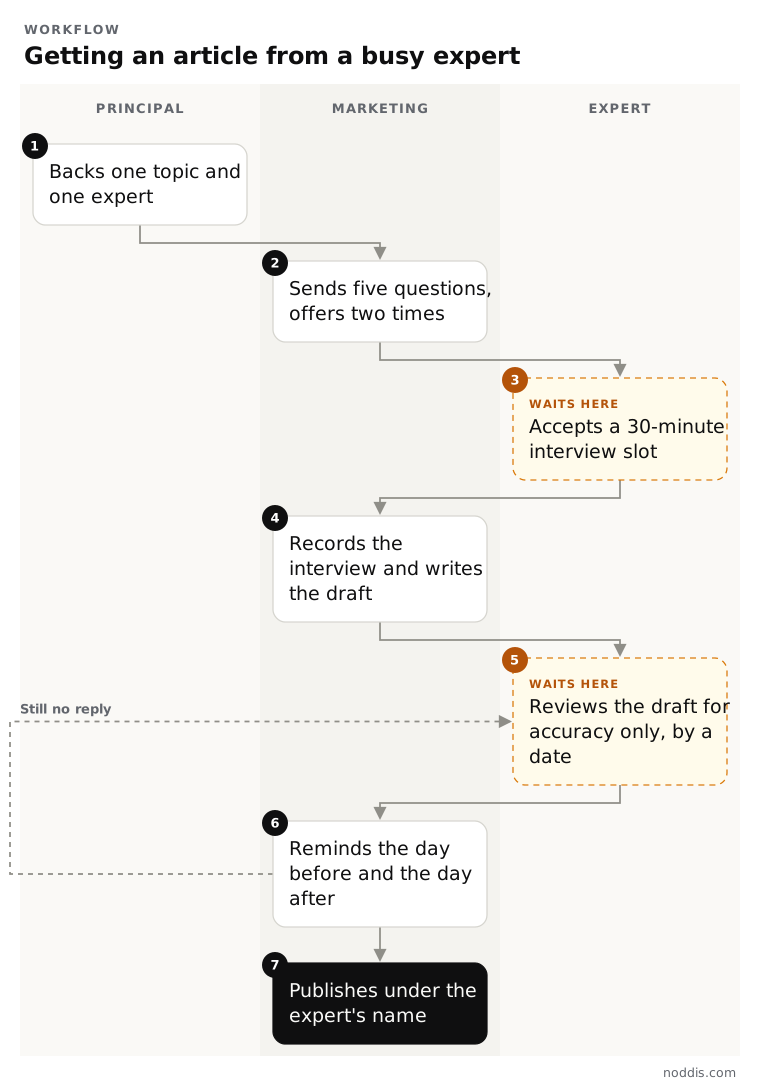
Content from subject matter experts takes seven steps across three people: a principal, marketing and the expert. The work waits with the expert twice, at the booking and at the review, and those are the two places to put a date.
- A principal backs one topic and one expert.
- Marketing sends five questions and offers two interview times.
- The expert accepts a 30-minute interview slot.
- Marketing records the interview and writes the draft.
- The expert reviews the draft for accuracy only, by a date.
- Marketing reminds the day before the date and the day after, and returns to step 5 until the review is back.
- Marketing publishes under the expert's name.
At a firm that tracks billable hours, ask the principal which code the interview time goes to, and say so in the request. Write the draft within a week, while the expert still remembers the conversation.
How should the expert review the draft?
The expert should review the draft once, for accuracy and confidentiality only, against a date. Style, length and headline belong to marketing. Saying so before the draft goes out prevents the rewrite that turns a clear article back into a technical memo.
| The expert checks | Marketing decides |
|---|---|
| Facts, figures and units | Headline and opening |
| Technical terms | Length and structure |
| Whether a client or project can be named | Tone and reading level |
| Anything the firm should not say in public | Where and when it runs |
The split protects the reader. The U.S. government's plain language guide on Digital.gov says: "Readers complain about jargon more than any other writing fault."
Ask two questions and nothing else: is anything wrong, and is there anything we cannot say. A principal's sign-off, if one is needed, follows your marketing approval process. Permission to name a client is a separate track, covered in the guide to client approval for a case study.
What do you do when the expert goes quiet?
When the expert goes quiet, follow a reminder rhythm you announced in advance, and tie the article to a publication slot that will be filled either way.
Hiba Ismeail, an instructional systems designer at RTI International, gives the rule for training content, and it holds for articles: "Provide reminders to your SMEs of upcoming deadlines, meetings, etc. to make sure they are aware of their commitments."
An example rhythm to adjust: the day before the review date, send the link and the two questions. The day after, offer a ten-minute call to walk through the draft. Three working days later, give the slot to a standby piece and move the expert's article to the next slot.
Nothing outside the firm forces an article's date, so the calendar has to. With one finished piece in reserve, a late review costs the expert a slot instead of costing you the newsletter.
How does Noddis keep expert content moving?
Noddis is a project management app that keeps tasks, follow-ups, and related project details connected. When we built importing in Noddis, we made it read a spreadsheet or a pasted scope, show the tasks it found, and wait for you to review them before anything is created.
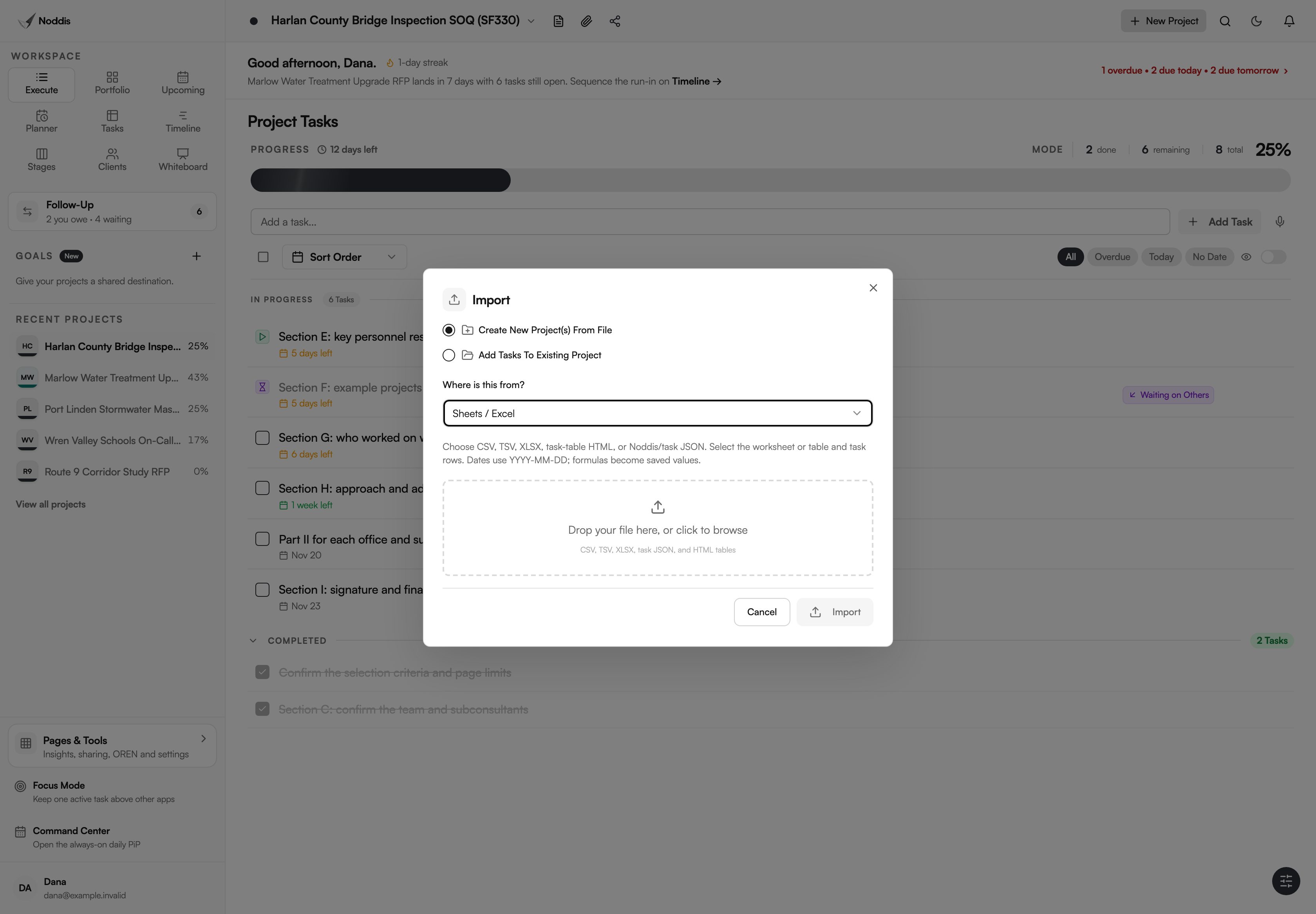
Most content calendars already live in a spreadsheet. Import yours as a CSV or Excel file, on Free or Pro, and preview the tasks before they are created. People and custom fields are kept as notes, not recreated.
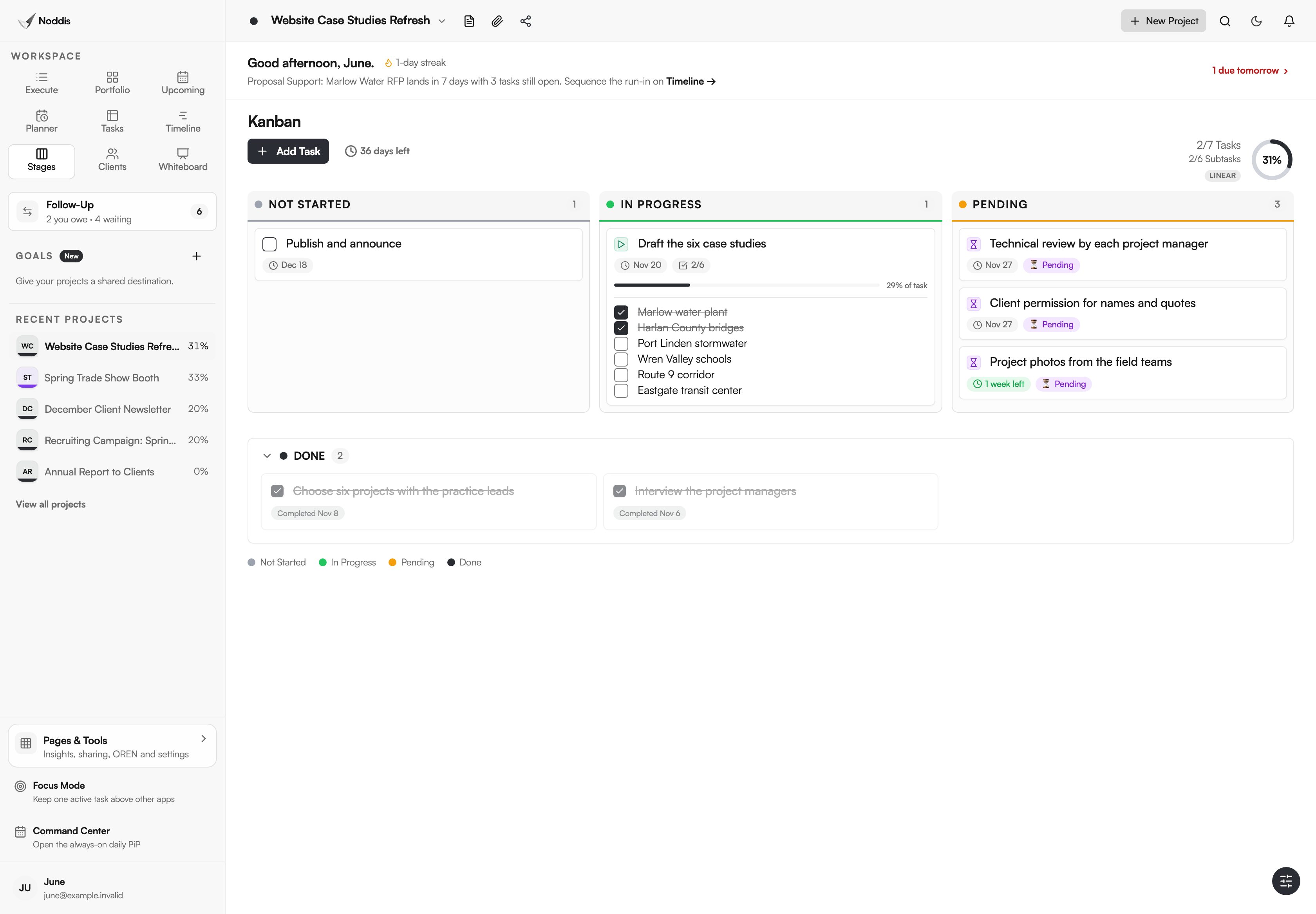
Stages, on Pro as of November 2026, shows one project's tasks as columns for not started, in progress and pending, which is where an article sits during the expert's review. Analytics, also on Pro, groups stale tasks across all your projects by 7 to 14 days, 14 to 30 days and more than 30 days. Noddis does not mark up files, collect signatures or proof designs, so the draft and the expert's edits stay in your own documents. The workflow for in-house marketing teams shows these screens.
Your next step
Choose one expert and one topic, write the five questions, and ask a principal to make the introduction this week. To sort your own tasks into not started, in progress and pending, open the live demo. No account is needed.
Common questions
Should the article carry the expert's name?
The article should carry the expert's name once the expert has approved every word. The byline makes the piece useful to the expert and credible to readers. Agree it in the first request. If the expert prefers not to be named, publish under the practice or the firm.
What if the expert wants to write it themselves?
Let them, with a frame. Agree an outline of five headings, a length and a date, and offer the interview as the fallback if the date passes. Edit their draft for structure and plain words, then send it back with the same two accuracy questions.
How often can you ask the same expert?
Ask the same expert less often than you would like, and use each interview fully. One 30-minute conversation can supply an article, a short post and a newsletter item, all reviewed in one sitting. Keep a list of who was asked and when.

Katleen is the founder of Noddis. She runs client projects through her app studio, 693 Labs, and builds Noddis around the problems that work creates.
Last reviewed . Feature details reflect Noddis at the time of review.