
Short answer
The reliable answer to how to get client approval for a case study is to ask at the start of the project, say exactly what you want to publish, and give one named person at the client a draft and a date. If their legal team stalls, offer a smaller yes: limited use, or a story without their name.
Why do clients stall on case study approval?
Clients stall on case study approval because the person who likes your work is rarely the person who can approve publicity. Your contact has to carry the request to a legal or communications colleague, and nothing in their own job depends on finishing that errand.
Casey Hibbard, author of Stories That Sell, told the writer Gordon Graham: "From startups to global enterprises, every company struggles with getting customers to go on record".
Public clients add a rule of their own. The U.S. ethics regulation for executive branch employees, 5 CFR 2635.702, says they may not use a government position "to endorse any product, service, or enterprise", with listed exceptions. Some agreements also require written consent before you name the client. Read your contract's publicity clause, and ask your contact what their rules allow.
How to get client approval for a case study: what are the steps?
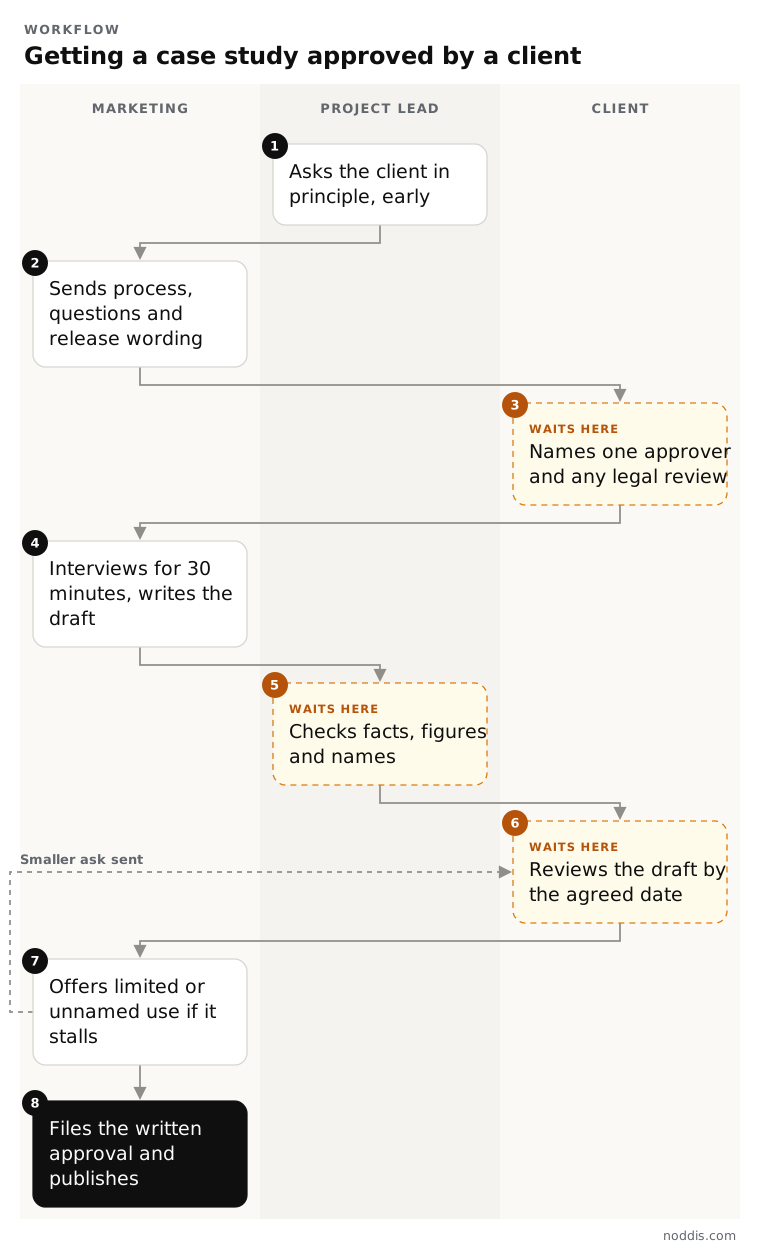
Client approval for a case study is a written yes to one draft and its named uses. Getting it takes eight steps shared by marketing, the project lead and the client's approver. Three of the steps are waits, and each wait needs a date.
Sarah Dillingham, writing in Growth Business, says: "The most effective way to obtain case study buy-in is to ask at the very start of the project, when everyone is excited and enthusiastic."
- The project lead asks the client in principle, early.
- Marketing sends the process, the interview questions and the release wording.
- The client names one approver and any legal review.
- Marketing interviews the contact for 30 minutes and writes the draft.
- The project lead checks facts, figures and names.
- The client reviews the draft by the agreed date.
- Marketing offers limited or unnamed use if it stalls, then returns to step 6.
- Marketing files the written approval and publishes.
Step 1 belongs to the person with the relationship, not to marketing. Give the project manager or principal one line for the kickoff meeting: "If this goes well, we would like to write it up. Who at your organization would need to approve that?" They ask again after a milestone.
Finish your own sign-off before step 6. The marketing approval process covers that order. The times below are an example to adjust, not a rule.
| Wait | Who holds it | Example time to allow |
|---|---|---|
| Reply to the request | Client contact | One week |
| Fact check | Project lead | Three working days |
| Review of the draft | Named approver | Two weeks |
| Legal or communications review | Client's reviewers | Three to six weeks |
What should the case study request say?
The case study request should say what you will publish, where it will appear, how little time the client gives and what they are approving. Attach the questions and the release wording, so their legal team sees everything on day one. The example uses a client, Marlow Public Works.
Subject: Case study on the Marlow treatment upgrade: 30 minutes and one review
Hi [Name],
Thank you for being open to a case study on the upgrade.
We interview you for 30 minutes, using the five questions attached, and we write the draft. You review it once and reply with approved, or with your changes in one list. Nothing is published without your written yes.
We would like to use your organization's name, one quote from you and two site photos, on our website and in our proposals. The release wording is attached.
Could you confirm by [date] who approves this on your side?
Thanks,
[Your name]
Name the uses. "Marketing purposes" invites a legal review of everything you might ever do. "Our website and our proposals" is a question one person can answer.
What do you do when legal stalls the approval?
When legal stalls the approval, make the yes smaller instead of repeating the same request. Ask your contact what the concern is, then offer the option that removes it. If one figure, quote or photo is the problem, take it out. If not, there are three fallbacks.
| Fallback | What you give up | What you can still do |
|---|---|---|
| Limited use | The public website | Use it in proposals and send it to prospects |
| Unnamed story | The client's name and logo | Publish the problem, the method and the result |
| Project description only | The client's voice | List the project with your own scope and role |
Each fallback still needs the required permission. Removing a name does not cancel confidentiality or publicity restrictions, and an identifiable project can reveal the client. Obtain approval for the revised draft and its uses before publishing. For a firm that wins work through proposals, limited use can still be useful to a selection committee. For reminders before this point, the client feedback deadline email templates have wording.
Subject: A smaller option for the Marlow case study
Hi [Name],
I understand the case study is still with your legal team. Would either of these be easier to approve?
1. We use it only in proposals, not on our website.
2. We publish it without naming Marlow Public Works.
If neither works, we will close the request with thanks.
Thanks,
[Your name]
How does Noddis track a case study that is waiting on a client?
Noddis is a project management app that keeps tasks, follow-ups, and related project details connected. When we built Follow-Up in Noddis, we split it into two lists, Needs From You and Waiting on Others, and gave every open item an age in days.
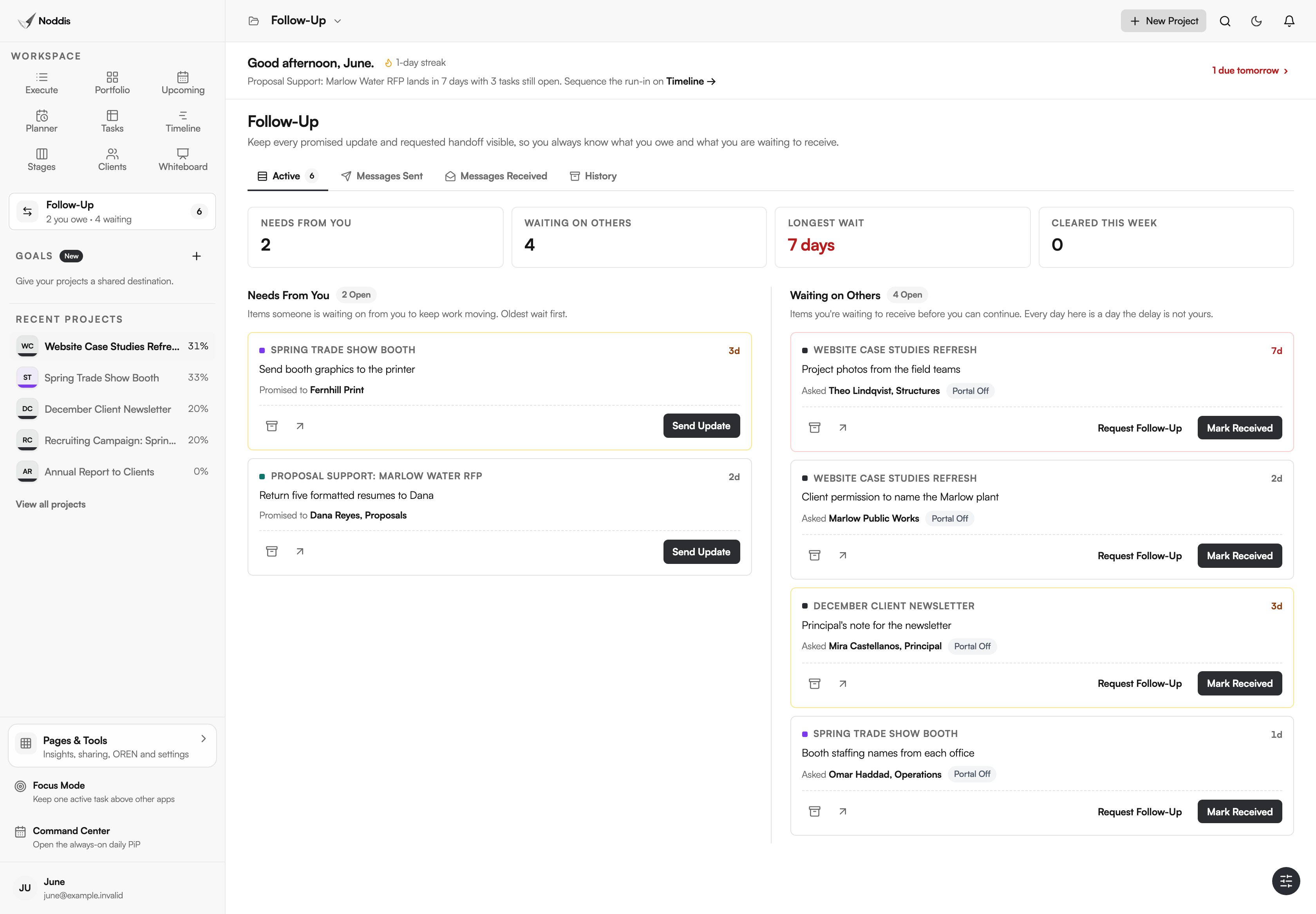
Each request to a client becomes a Waiting on Others item on the case study it blocks, so you can see how many days the client has had the draft. As of November 2026, Follow-Up covers one project on Free and every project on Pro. On Pro, a reminder can go out as an email, and the client replies by email with no account.
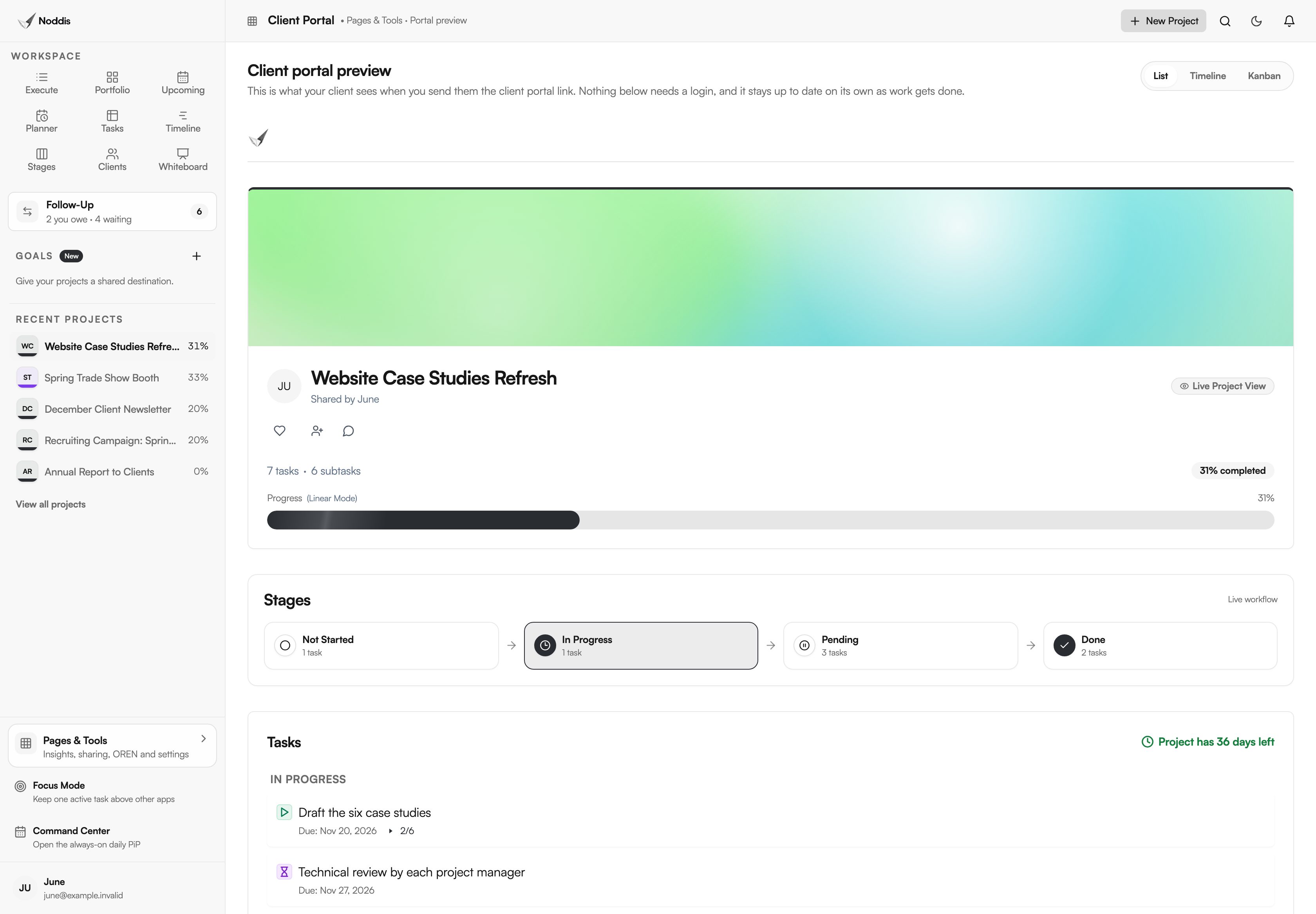
A principal who keeps asking for status can open the client portal: a live, read-only page for the project, which is Pro to share. Noddis does not mark up files, collect signatures or proof designs, so the draft and the release stay in your documents and email. The workflow for in-house marketing teams shows these screens.
Your next step
Pick one project that is going well, and give its project lead the approver question for the next client meeting. To track an approval of your own with the days it has waited, open the live demo. No account is needed.
Common questions
Is an email enough, or do you need a signed release?
A clear email from someone with authority to approve may be enough, but that decision belongs to your own legal counsel. Ask once and write the rule down. If the client has its own release form, use it, because their legal team already accepts it.
What if the client wants heavy edits to the draft?
Accept edits to facts, figures and the client's own quotes, because their name is on the page. Push back only where an edit makes a claim untrue or removes the point of the story. If the edits strip out every specific, propose the unnamed version.
How long does a client's approval last?
Treat a client's approval as covering the version and the uses you named, for as long as the facts stay true. Ask again before a new use, such as an advertisement or an award entry, and when your contact leaves. A yearly check catches the rest.

Katleen is the founder of Noddis. She runs client projects through her app studio, 693 Labs, and builds Noddis around the problems that work creates.
Last reviewed . Feature details reflect Noddis at the time of review.