
Short answer
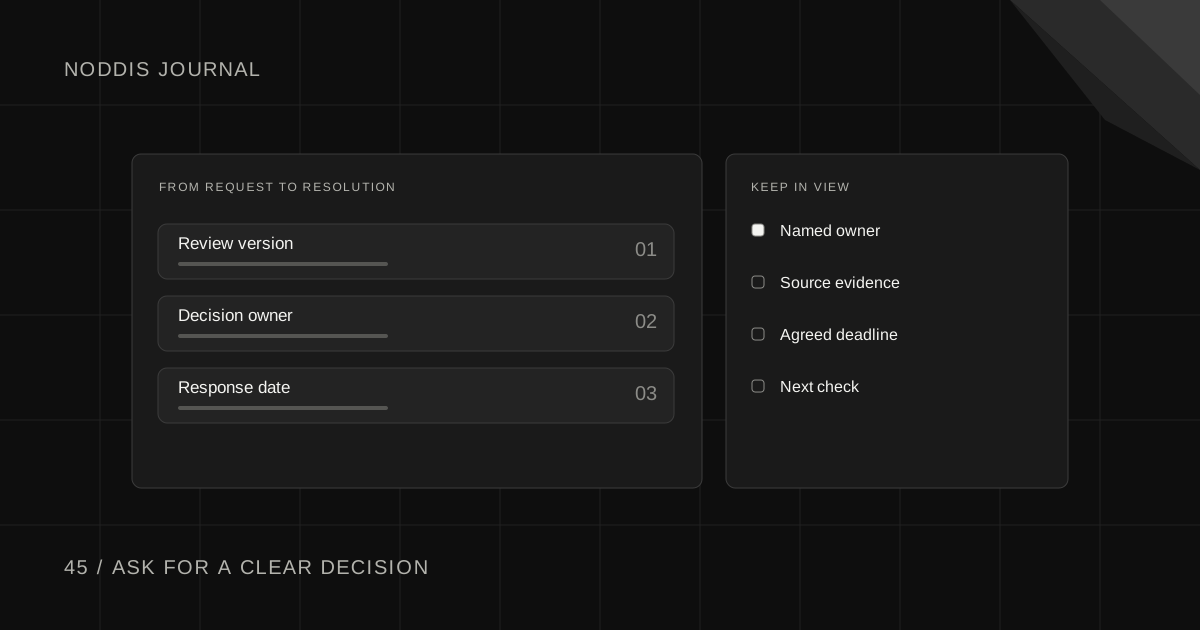
A client feedback deadline email should identify the exact deliverable, the response you need, the date you need it, and which next milestone depends on the decision. Keep the tone collaborative. The goal is to make review easy, not to pressure someone into approving work they have not assessed.
Free resource
Download the editable client feedback email scripts. No account is required. Save a copy before adding your project details.
What makes a client feedback request effective?
An effective client feedback request eliminates five questions before the recipient has to ask them: What am I reviewing? Where is it? What should I look for? What response do you want? When is it needed? If even one is missing, a short email can produce a long clarification thread.
Include a link to the file with appropriate access, the deliverable's version, a small list of review priorities, and the name of the person who should send the consolidated response. The Noddis client approval guide explains why a file being sent and a file being approved must remain separate events.
Where review comments live matters too. Google Docs documentation shows how reviewers can leave comments and assign action items next to source material, although the final decision still needs to be recorded explicitly.
The following templates are original examples. Replace every bracketed field, and ensure the review timing matches your actual agreement.
Template 1: First request for client feedback
Use this when a deliverable is ready for a normal scheduled review. Lead with the decision and link, then make the requested deadline easy to find.
Subject: Feedback requested: [Deliverable] v[Number] by [Day, Date]
Hi [Name],
[Deliverable] v[Number] is ready to review: [Link].
For this round, please focus on [specific areas, such as copy accuracy, layout, and mobile presentation]. Could you send one consolidated list of changes or confirm approval by [Day, Date]?
We have [next milestone] scheduled after this review. If your team needs more time, let me know and we can adjust that date together.
Thank you, [Your name]
A useful variation for multiple reviewers is: “Please collect feedback from your team and send one combined response.” That makes ownership explicit without forbidding stakeholders from contributing.
Template 2: Gentle reminder before the response date
A reminder works best when it reduces the effort needed to respond. Do not resend the entire conversation or imply the client has done something wrong. Point directly to the pending decision.
Subject: Quick check: [Deliverable] review by [Date]
Hi [Name],
Just checking that you could access [Deliverable] v[Number]: [Link]. We are aiming to receive your approval or consolidated edits by [Day] so we can begin [next step].
If that timing no longer works, send me a date that does and I will review the project schedule.
Thanks, [Your name]
This message is appropriate when the file was actually delivered and the agreed review window is still open. First check the link's permissions. A reminder about an inaccessible file is not useful.
Template 3: Feedback is overdue and affects delivery
When client feedback is late, explain the dependency rather than issuing a threat. Describe what work is waiting, which date may change, and the options for proceeding.
Subject: Decision needed to confirm [Project] timeline
Hi [Name],
We are still waiting on the review of [Deliverable] v[Number]: [Link]. That decision is needed before we can start [dependent task].
The original plan assumed feedback by [Date]. If we receive the decision by [new proposed date], we can assess whether [original milestone] remains realistic. Otherwise, I suggest we agree on an updated delivery date.
Would you prefer to review this week or schedule a short decision call?
Thank you, [Your name]
Avoid “No response means approved” unless a properly agreed process specifically establishes that rule and the relevant professional advice confirms its suitability. As a general working practice, record actual approval.
Template 4: Request one decision when comments conflict
When two stakeholders disagree, do not bury the conflict inside a revision list. Put the choice in front of the authorized decision-maker with both options and their consequences.
Subject: One decision needed: [Design element]
Hi [Name],
We received two different directions on [specific element]: [Option A] and [Option B]. Before we revise, could you confirm which approach is approved for [Deliverable] v[Number]?
We will hold this item until the direction is clear so we do not spend a revision round on the wrong option.
Thanks, [Your name]
Keep the conflict factual. Do not identify a stakeholder as the problem. Record the final decision alongside the reviewed version in a client decision log.
What should happen after the email is sent?
Track the open decision and the date on which you will follow up, separately from the project's final delivery date. When the response arrives, record whether it is approved, needs changes, or introduces new scope. Close the reminder only when the exchange is actually resolved.
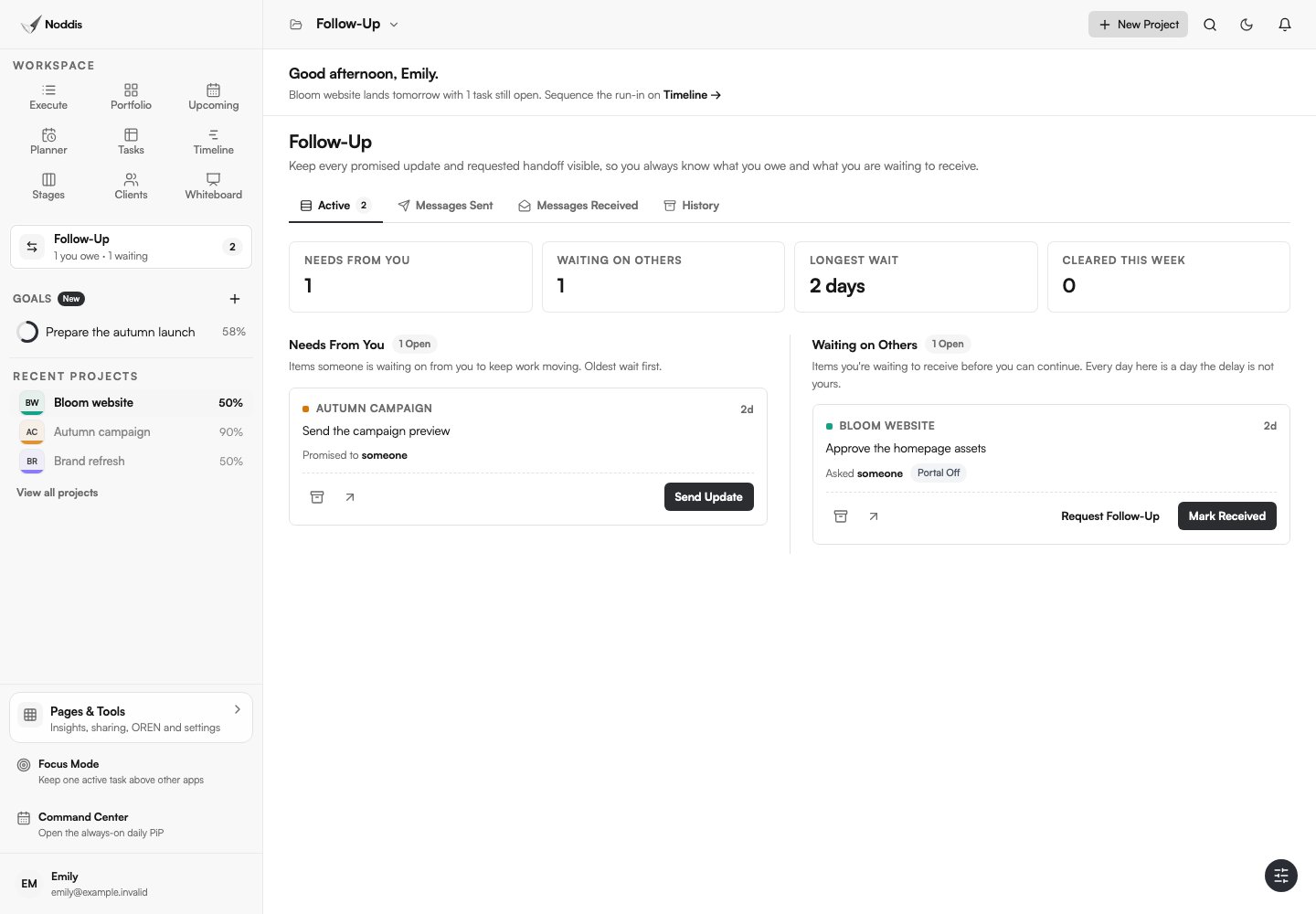
Noddis is a project management app that keeps tasks, follow-ups, and related project details connected. Its Follow-Up workspace distinguishes work your team owes from responses you are waiting to receive. That helps record a waiting commitment without treating an unanswered email as a completed deliverable. See the client follow-up workflow or try the live demo.
Your next step
Save these messages as templates, then personalize the deliverable, version, reviewer, and next milestone every time. Clear specificity beats a clever subject line.
Common questions
How long should I give clients to review a deliverable?
Choose a realistic review period based on complexity, the number of decision-makers, and the agreed schedule. A five-page website review may need a different window from a short social graphic. Set the date before sending the file so both parties understand the dependency. Leave room for clarification and rework after feedback.
Should I send a follow-up on the deadline or the day after?
Use the timing stated in your working agreement, or agree on a routine at kickoff. A reminder just before the deadline may be appropriate when the next milestone is imminent. After the deadline, explain the schedule impact rather than sending a sequence of increasingly urgent messages with no decision path.
Can a reminder automatically change the delivery date?
No. A reminder communicates a possible consequence; a revised schedule should be explicitly agreed when material. Document the new date and the decision that caused it. This protects both the client's expectations and the team's plan.

Katleen is the founder of Noddis. She runs client projects through her app studio, 693 Labs, and builds Noddis around the problems that work creates.
Last reviewed . Feature details reflect Noddis at the time of review.