
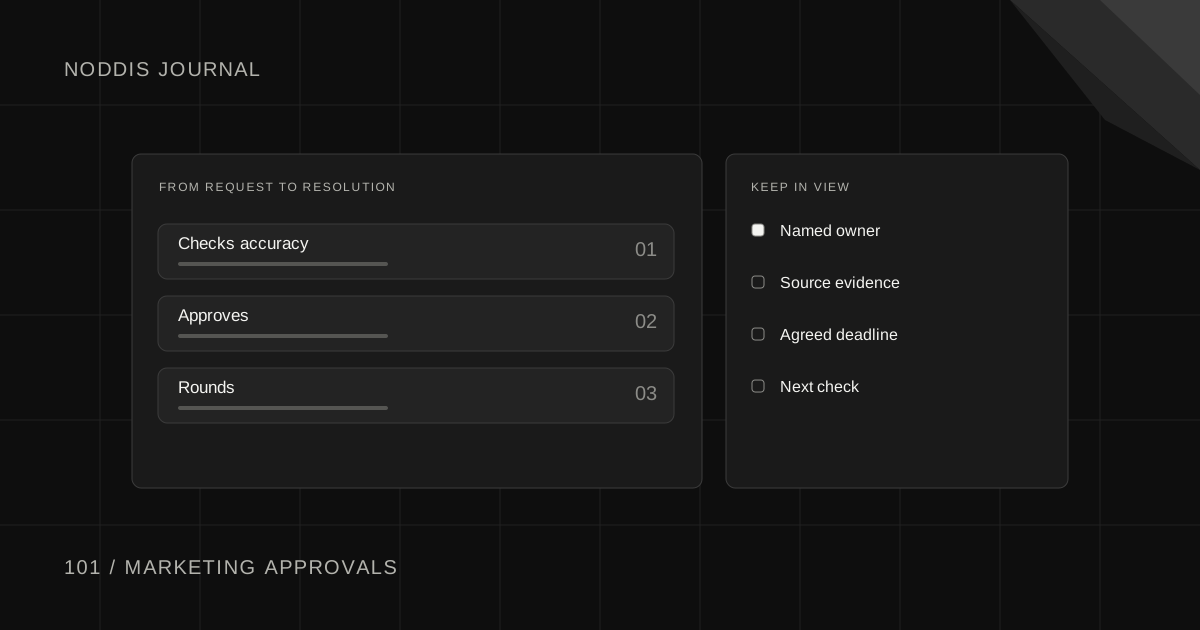
Short answer
A marketing approval process is the agreed route a piece of marketing takes from draft to published: who checks it for accuracy, who approves it, in what order and within how many days. Writing that route down for each type of work replaces the open-ended "can you take a look?" with a named person, a single question and a date.
What is a marketing approval process?
The process is the set of steps and people a piece of work passes through before it is released. Katie Oberthaler, writing for G2, defines it this way: "A marketing approval process is an oversight of all creative and marketing assets from initial conception to campaign launch."
For an in-house team at a professional services or engineering firm, the people involved are rarely marketers. They are principals, project managers and sometimes a client, and each has billable work that outranks your case study. The process exists so their time is used once and at the right moment.
A good process answers four questions for every piece: who must check it, who can approve it, in what order and how fast.
Who should approve what?
Decide who approves what by type of work, once, in a table everyone can see. The table is called an approval matrix, and it ends the habit of sending everything to everyone.
| Type of work | Checks for accuracy | Approves | Rounds | Response time |
|---|---|---|---|---|
| Social post | Nobody, or the project manager if a project is named | Marketing lead | 1 | 1 working day |
| Newsletter | Authors of each item | Marketing lead | 1 | 2 working days |
| Project case study | Project manager | Principal in charge, then the client | 2 | 5 working days |
| Proposal graphics | Technical lead | Proposal manager | 2 | 1 working day |
| Website page | Practice lead | Marketing lead | 2 | 3 working days |
| Press release | Project manager and principal | Managing principal, then the client if named | 2 | 3 working days |
The roles and times are an example for a mid-sized firm, so set your own. Two rules carry over. A reviewer checks facts and can request changes, but only the approver decides. And every row has exactly one name in the Approves column for each stage.
In what order should reviews happen?
Reviews should happen in order of who can change the most: accuracy first, then the internal approver, then anyone outside the firm. Oberthaler's advice on this is direct: "To ensure clarity in the process, separate your internal review steps from the external ones."
A typical order for a case study:
- Draft by marketing, from an interview with the project manager.
- Accuracy check by the project manager. Facts, numbers, names.
- Internal approval by the principal in charge.
- Client permission to use the name, the quotes and the photos.
- Final proof by marketing, then publish.
Start step 4 early. Client permission is often the slowest step and the one you control least, and nothing stops you from asking for permission in principle while the draft is still being written.
How long should an approval take?
An approval should take as long as you agreed in advance, which is why the matrix has a response time column. Without one, every request is a favour with no date.
Published processes show what a stated time looks like. The University of Alabama at Birmingham tells departments that submit marketing work for approval: "Once you have submitted your proposal, you will receive notification from our office within one business day." One business day is that office's commitment for its own step. The useful part is that the number exists and the requester knows it.
Put the date in the request itself:
Subject: For approval by Thursday: Marlow case study, final draft
Hi [Name],
The Marlow case study is ready for your approval: [Link]. Sam has checked the technical details.
I need one of two replies by Thursday: approved, or your changes in one list. It goes to the client for permission on Friday.
Thanks,
[Your name]
What do you do when an approval stalls?
When an approval stalls, follow up the day after the response time passes, and change one thing each time: the channel, the size of the ask, or who knows about it.
- Day 1 after the date: a short reminder with the link and what is waiting on it.
- Day 3: make it smaller. "If you only have five minutes, the one thing I need is whether the project value can be stated."
- Day 5: tell the person who asked for the work that it is held, and why.
Never treat silence as approval unless the firm has agreed to that rule in writing. It is tempting on a newsletter and dangerous on anything that names a client. The client approval tracking workflow covers approvals that involve people outside the firm.
Requests that arrive without warning cause the same pile-up at the other end. See how to manage marketing requests from other departments.
How does Noddis track open approvals?
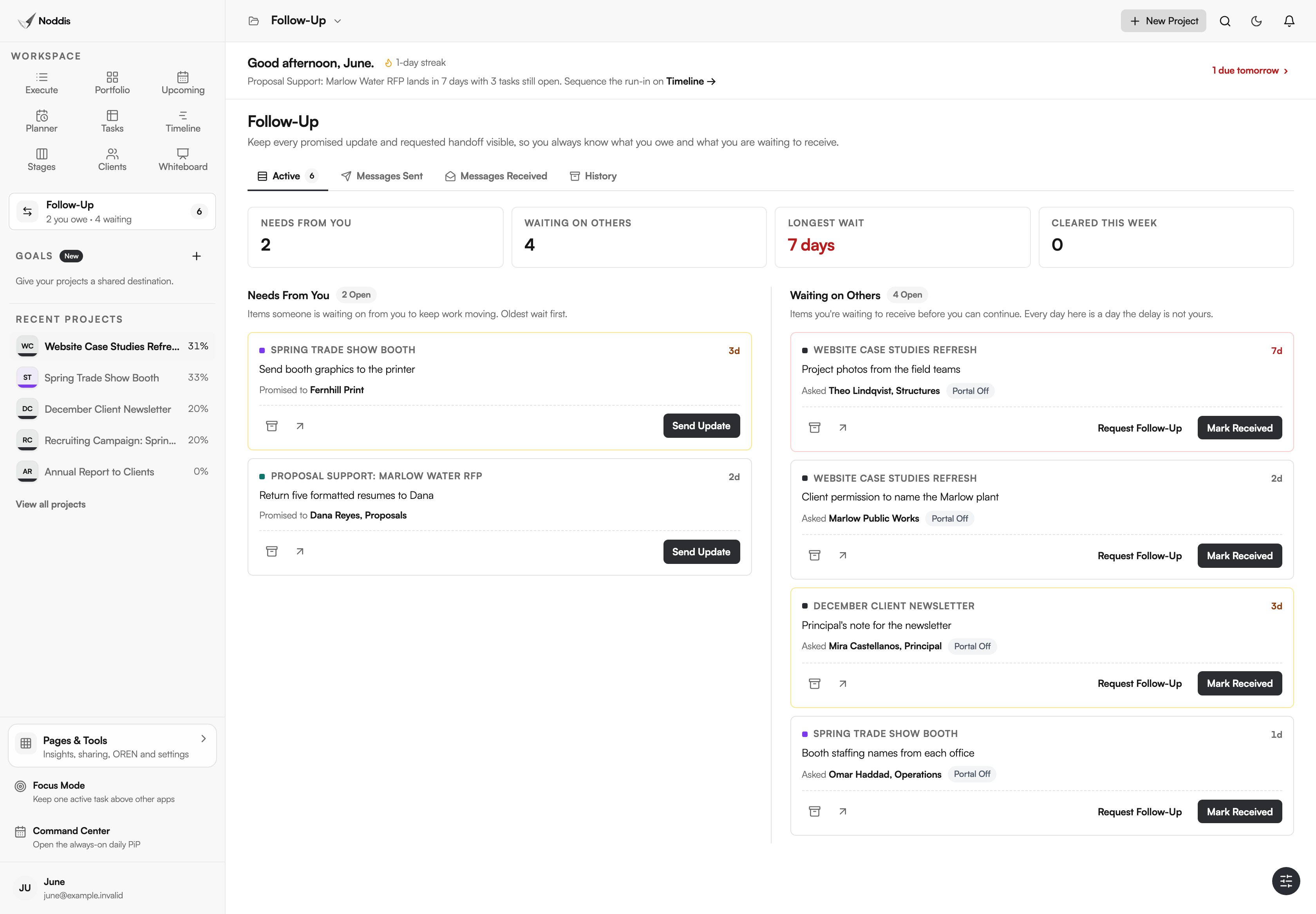
Noddis is a project management app that keeps tasks, follow-ups, and related project details connected. When we built Follow-Up in Noddis, we split it into two lists, Needs From You and Waiting on Others, and gave every open item an age in days.
Each approval you request becomes a Waiting on Others item on the task it blocks, with the approver's name and the date you were promised. One list then shows every sign-off you are waiting for across every campaign. Noddis records that an approval is open and for how long. It does not mark up files or collect signatures. The workflow for in-house marketing teams shows the list in the real app.
Your next step
Draft your approval matrix for the three types of work you produce most, and send it to the principals for one round of comments. To track your approvals with the days each has waited, open the live demo.
Common questions
How many people should approve a piece of marketing?
One per stage. Several people can review for accuracy, but a single named approver decides. When two people must both approve, put them in sequence, not in parallel, so the second sees the first one's changes. Committees approving at once produce conflicting edits and no decision.
How many rounds of review are reasonable?
Two for most work: one round of changes and one confirmation. One is enough for short items like social posts. If a piece regularly needs a third round, the brief was unclear or the wrong person reviewed first. Fix that at the start of the next piece instead of adding rounds.
Do you need approval software?
Not to begin with. A written matrix, a request that states the date, and one list of open approvals solve most of the delay. Software for proofing and sign-off helps when you produce a high volume of visual work or have compliance rules to prove. Agree the process first, because a tool cannot settle who has the final say.

Katleen is the founder of Noddis. She runs client projects through her app studio, 693 Labs, and builds Noddis around the problems that work creates.
Last reviewed . Feature details reflect Noddis at the time of review.