
Short answer
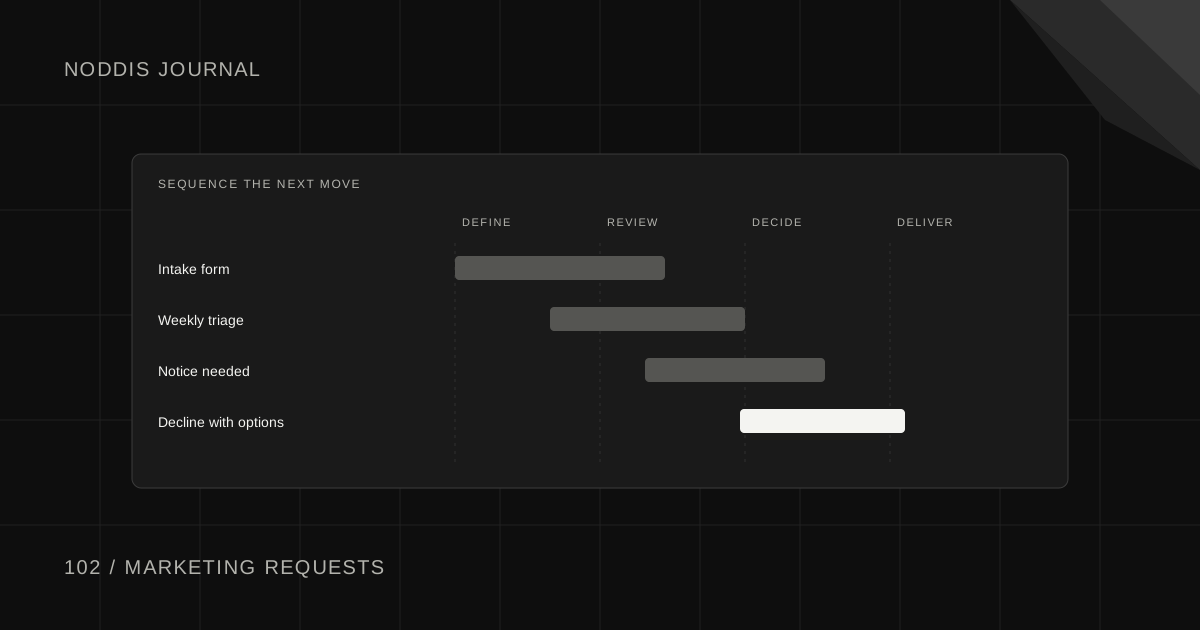
To manage marketing requests from other departments, give everyone one door, a short form, and review what comes through it once a week against a few fixed rules. Each request is then accepted with a date, scheduled for later or declined with a reason. The work does not shrink, but it stops arriving as hallway favours with no deadline and no owner.
Why do marketing requests pile up?
Marketing requests pile up because every department can ask and nobody can see the queue. To a project manager, a one-page flyer is a small favour. To a two-person marketing team it is the ninth small favour this week, on top of a proposal due Thursday.
Three conditions make it worse:
- Requests arrive by every channel. Email, chat, a comment after a meeting.
- Deadlines come without reasons. "ASAP" could mean a conference on Friday or a vague preference.
- Nothing is ever declined. Without a way to say no, every request is implicitly a yes.
The fix is not working faster. It is making the queue visible, to you and to the people asking.
What should a marketing request form ask?
A marketing request form should ask only what you need to decide whether, when and how to do the work. Emily Kramer and her co-authors at the MKT1 newsletter give the right standard: "Make a simple (but not too simple) form to fill out."
A required form is normal practice in larger organizations. The University of Alabama at Birmingham, for example, has departments submit a form to its marketing office and promises a fast first answer: "Once you have submitted your proposal, you will receive notification from our office within one business day."
Seven fields are enough for most in-house teams:
| Field | Why you ask |
|---|---|
| What do you need? | The deliverable, in the requester's words |
| What is it for? | The goal, so you can suggest a better format |
| Who is the audience? | Clients, recruits, a selection committee |
| When do you need it, and what happens on that date? | Separates real deadlines from preferences |
| Who approves it? | One name, so review does not stall |
| What do you already have? | Text, photos, last year's version |
| Is there a budget or project code? | For printing and outside costs |
The fourth field does the most work. "December 4, because the conference is December 9 and printing takes three days" is a deadline. "As soon as possible" is a conversation.
A form also adds a small cost to asking, which filters out requests the asker does not really need.
How do you manage marketing requests in a weekly triage?
Manage marketing requests in a weekly triage: one sitting, with each request sorted into one of three outcomes. Reviewing them as they arrive hands your schedule to whoever asked most recently.
| Question | If yes | If no |
|---|---|---|
| Does it support a firm goal or a live pursuit? | Keep going | Decline, or offer a self-serve template |
| Is the deadline real? | Keep going | Schedule for a later week |
| Is the notice long enough for this type of work? | Accept with a date | Offer a smaller version by the date |
Every request leaves the meeting with an answer: accepted with a delivery date, scheduled with a start date, or declined with a reason. Reply to the requester the same day. A clear "not until January" is easier to accept than silence.
Requests from principals and for proposals will jump the queue. Let them, openly. Write the rule down, so the exception is a policy and not a negotiation each time.
How do you say no to a marketing request?
Say no by naming what you are doing instead and offering the nearest thing that is possible. The MKT1 authors note that a clear process "also makes it easier to say no to random, low-priority requests." The form and the weekly review give you something to point to besides your own judgment.
Subject: Your flyer request
Hi [Name],
Thanks for sending this through the form. We cannot take on a new flyer before the 4th, because the Marlow proposal and the newsletter are both due that week.
Two options: we update last year's flyer with the new project photo by the 3rd, or we produce the new design for the spring conference. Which would you prefer?
Thanks,
[Your name]
The message declines the request as asked and still leaves the colleague with a choice. That is the difference between a no that ends the conversation and one that ends the pressure.
How much notice should each type of request need?
Each type of request should need a published minimum notice, so colleagues can plan before they ask. A short table on the intranet or pinned in chat is enough.
| Type of work | Minimum notice |
|---|---|
| Edit to an existing document | 2 working days |
| Social post or news item | 3 working days |
| One-page flyer or handout | 5 working days |
| Project case study | 3 weeks |
| Conference booth or printed brochure | 6 weeks |
These numbers are an example to adjust. Build yours from how long the last three of each actually took, including the approvals. Then hold to them, with one exception you name in advance: a live proposal.
Approvals are the other half of the timeline. A request accepted on time can still stall with a reviewer, which is why the marketing approval process belongs next to this one.
How does Noddis handle a marketing request queue?
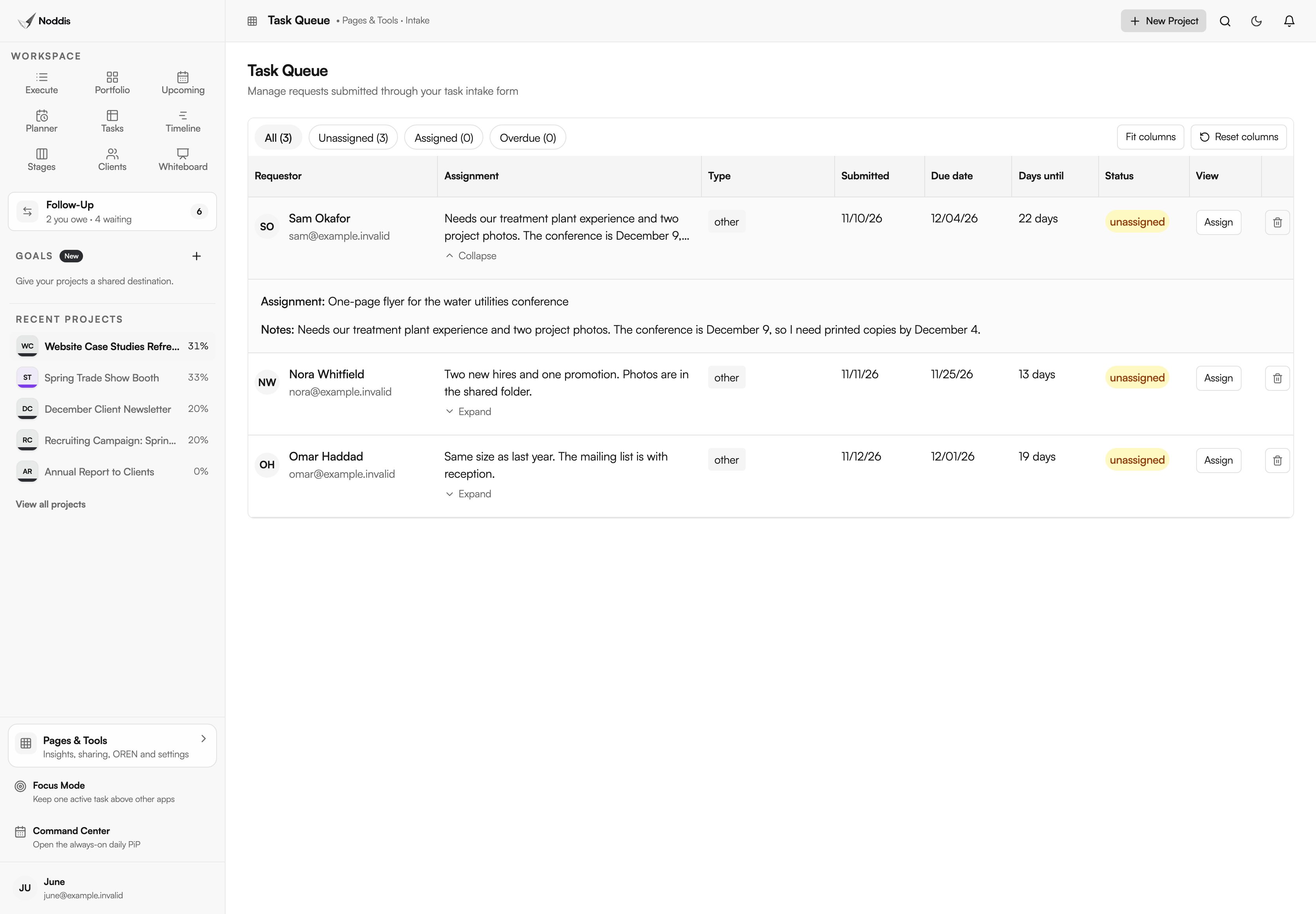
Noddis is a project management app that keeps tasks, follow-ups, and related project details connected. When we built the Task Queue in Noddis, we kept every request unassigned until someone chooses a project for it.
Colleagues fill in a shareable intake form without an account. Each submission appears in the Task Queue with the requester, the details, the due date and the days remaining, and stays unassigned until you decide where it goes. Accepted requests become tasks in a project, and anything you are waiting on moves to Follow-Up. Intake forms and the Task Queue are part of Pro. The workflow for in-house marketing teams shows the queue with sample requests.
Your next step
Write your seven-field form today, share the link with one department, and book 30 minutes each week to triage. To try the weekly triage on a project of your own, open the live demo.
Common questions
What if people ignore the form and keep asking in person?
Answer warmly and send the link every time: "Happy to look at it. Can you put it in the form so it gets a date?" Then act only on what arrives through the form. The habit takes time to form, and it helps when leadership uses the form too, so ask a principal to submit the first request.
Should a team of one bother with an intake process?
Yes, and a team of one needs it most. With nobody to share the load, a visible queue is the only protection against ten simultaneous favours. The form can be five fields and the weekly triage fifteen minutes. The point is that requests wait in a list instead of in your memory.
How do you handle urgent requests that are real?
Take them, and move something else in the open. Tell the owner of the displaced work the same day, with its new date. A real emergency can be absorbed. If "urgent" arrives every week from the same source, the cause is late planning, and the fix is to be in their planning meeting.

Katleen is the founder of Noddis. She runs client projects through her app studio, 693 Labs, and builds Noddis around the problems that work creates.
Last reviewed . Feature details reflect Noddis at the time of review.