
Short answer
Marketing request turnaround times are the working days your team needs to deliver each type of request, counted from the day a complete request arrives. To set them, split each number into your days and the requester's review days, write one rush rule, have a principal agree to it, and publish the table beside the request form.
Free resource
Download the marketing turnaround times table. The file is a blank CSV that opens in Excel, Google Sheets or Numbers, with one row per type of request and columns for marketing working days, requester review days, rounds, total turnaround, the clock rule and the rush rule. One example row shows how to fill it in. No account is required.
What do marketing request turnaround times look like?
Marketing request turnaround times look like a short table: one row per type of request, the working days marketing needs, the working days the requester has to review, and their sum. The numbers below are an example for a small team at a professional services firm. Adjust every one.
| Type of request | Marketing days | Review days | Rounds | Turnaround |
|---|---|---|---|---|
| Edit to an existing document | 1 | 1 | 1 | 2 working days |
| Social post or news item | 2 | 1 | 1 | 3 working days |
| One-page flyer or handout | 3 | 2 | 2 | 5 working days |
| Email newsletter | 6 | 4 | 2 | 10 working days |
| Project case study | 8 | 7 | 2 | 15 working days, plus client approval |
| Brochure or booth graphics | 15 | 5 | 2 | 20 working days, plus printing |
Printing, outside vendors and approvals outside the firm are not in the numbers, so name them beside the row. Proposals are left out because the solicitation sets their deadline. Publish the number you hit in a normal week, not your best one.
Label the table a guideline. The Marketing and Communications Department at Fleming College calls its table a service level agreement and says of the times in it: "These are guidelines only, as the actual time for project completion will depend on current workflow."
Turnaround is not minimum notice, which tells a requester how early to ask. The guide on how to manage marketing requests covers notice, the intake form and the weekly triage.
What starts the clock on a request?
The clock starts on the first working day after a complete request arrives through the form. Complete means the brief is filled in, the source material is attached and one approver is named. A request mentioned in a meeting, or a form that says "photos to follow", has not started.
| Event | What happens to the clock |
|---|---|
| A complete request arrives | It starts the next working day |
| Something is missing | It does not start. Reply the same day with what is missing |
| The draft goes to the requester | Their review days begin |
| The review runs past its days | Delivery moves by the same number of days |
| The request changes | It restarts on the day the new brief is complete |
The ULife Marketing and Communications office at George Mason University tells its requesters: "Please note that delayed responses and feedback from the requester may impact the deadline for the final deliverable(s)." The review days should match the response times in your marketing approval process.
How do you set the numbers and get them agreed?
Set the numbers from your own delivery history, then have the people who ask and a principal agree to them before you publish. A table that marketing wrote alone is an opinion. A table a principal signed is a rule.
- Marketing lists the request types from last quarter.
- Marketing counts real days for the last three of each type.
- Marketing writes the clock rule and the rush rule.
- Two frequent requesters check the draft against their own deadlines.
- A principal signs off the table and the rush rule.
- Marketing publishes the table beside the request form.
- Marketing compares promised and actual days each quarter, and returns to step 2 for any row that is off.
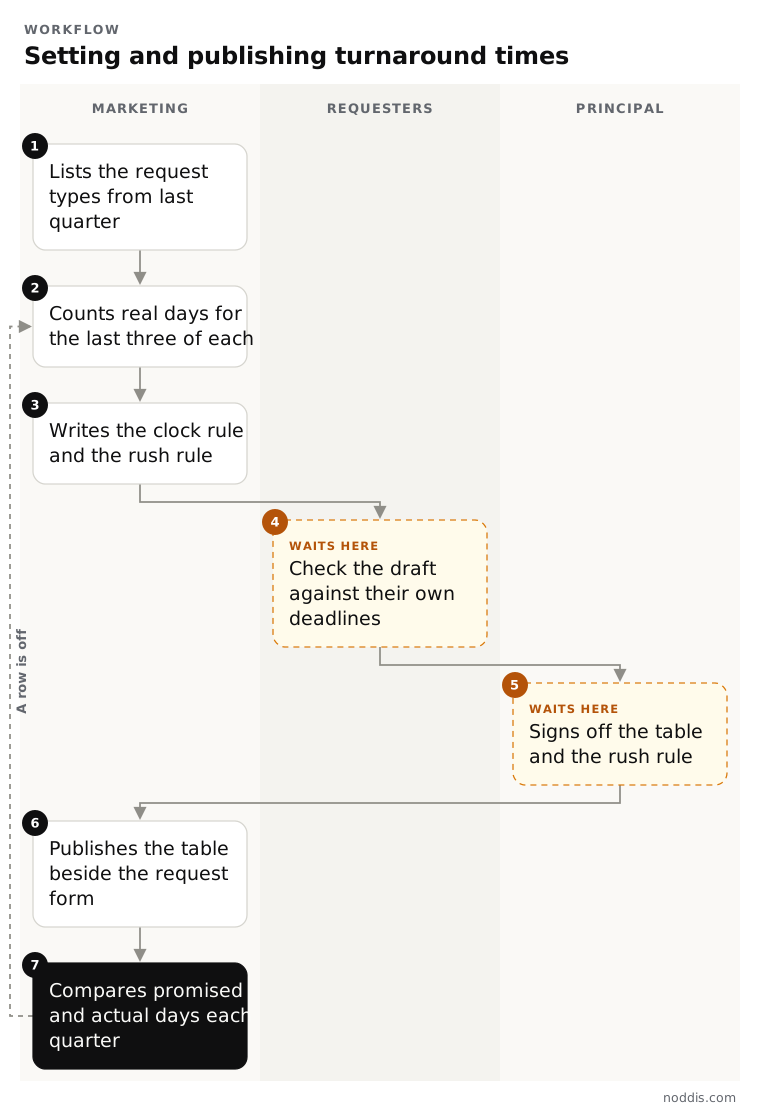
For step 2, count from the day you had everything to the day you delivered, and note the days the piece sat with the requester. Steps 4 and 5 are waits, so give each a date.
What should the rush rule say?
The rush rule should say who can approve a rush, how fast the fastest version can be, and which work moves to make room. Without the third part, a rush costs the requester nothing, and every request becomes one.
An example to adjust: one named person approves a rush, no rush is faster than half the standard turnaround, and the owner of the displaced work hears the same day with a new date.
Then apply the table to every request. Send the dates on the day the request is complete:
Subject: Your flyer request: the dates
Hi [Name],
Your request was complete on Monday the 16th, so the clock starts on Tuesday. A one-page flyer takes 5 working days: 3 for us and 2 for your review.
You will have the draft on Wednesday the 18th. I need your changes in one list by Friday the 20th, and the final file follows on Monday the 23rd. If the review takes longer, the final date moves by the same number of days.
Thanks,
[Your name]
How does Noddis keep requests and their due dates in view?
Noddis is a project management app that keeps tasks, follow-ups, and related project details connected. When we built Upcoming in Noddis, we put the deadlines from every project in one list, so nothing has to be opened to see what is due.
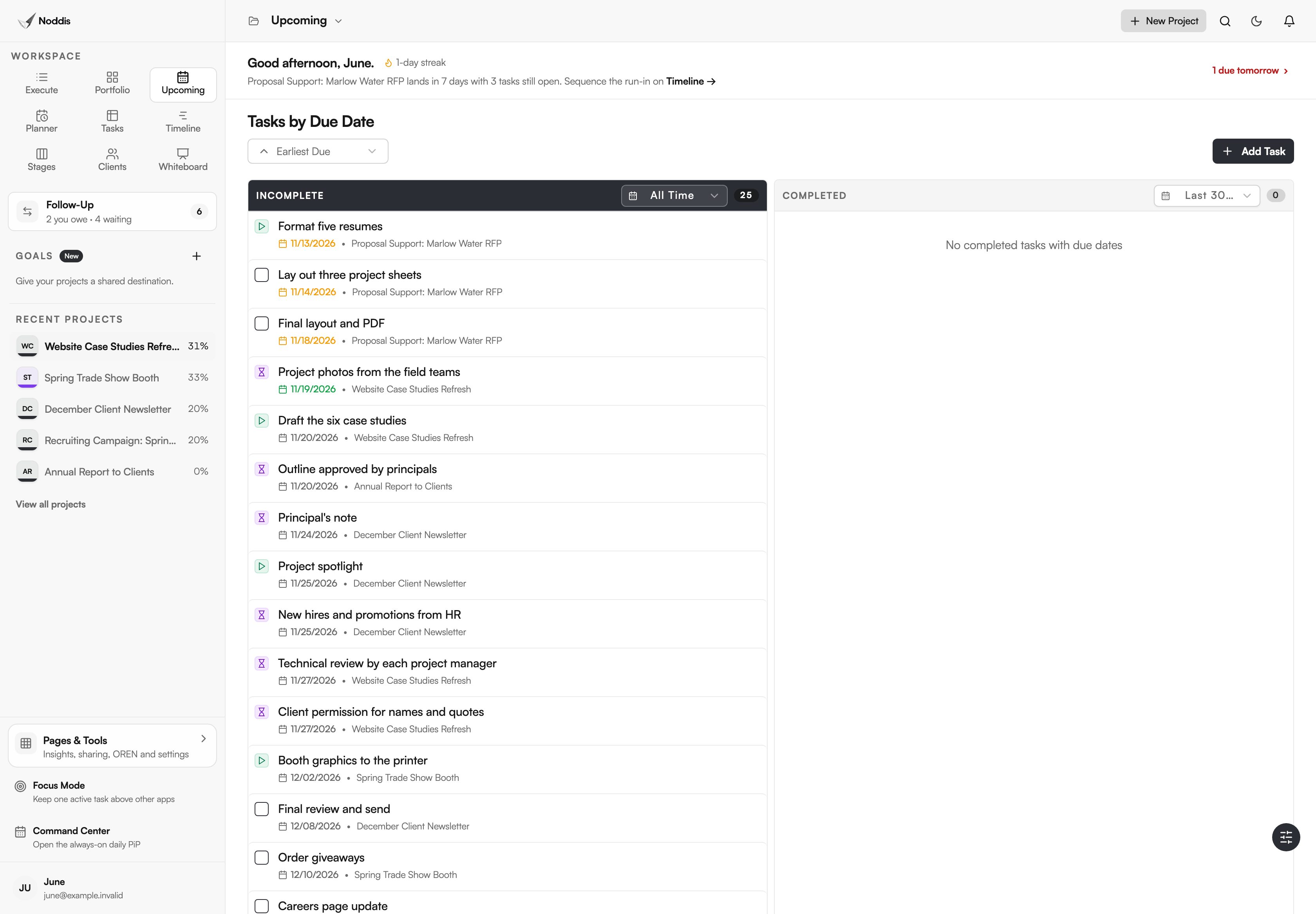
Upcoming, on the Free plan, is where you read the dates your table produces: the deadlines from every campaign, filtered by This Week, Next 30 Days, This Year or All Time. The front door is the intake form and the Task Queue, both on Pro as of November 2026.
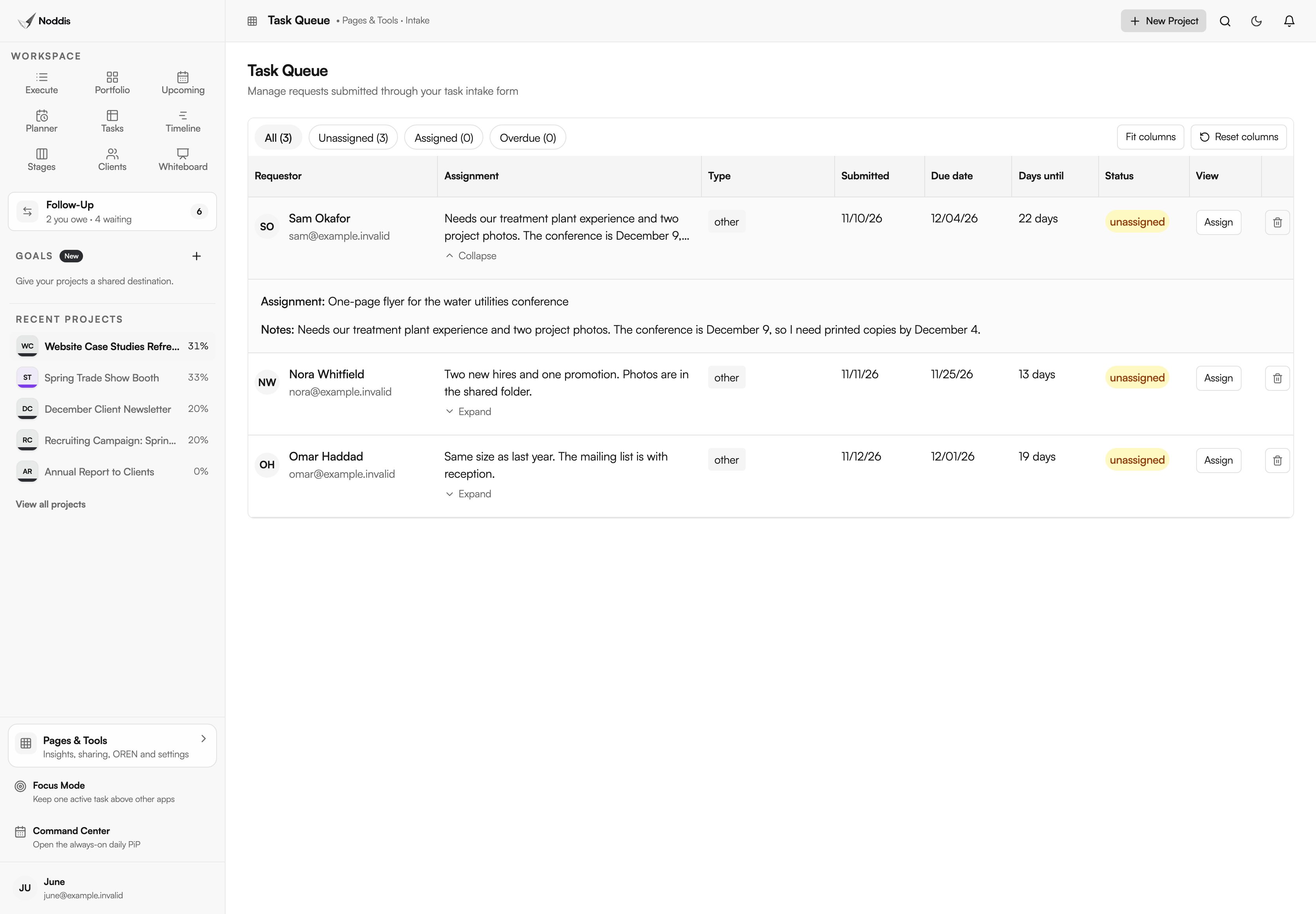
Colleagues submit the form without an account, and each request waits unassigned in the queue, with its due date and days remaining, until you accept it into a project. That is the moment to check the request is complete and set the due date from your table. Noddis has no SLA timer or alert. It does not count turnaround days or warn you when a request passes its number, and the table itself stays beside your form. The workflow for in-house marketing teams shows the queue with sample requests.
Your next step
Open your sent folder, find the last three flyers, document edits and newsletters you delivered, and count the working days each took. To put the deadlines from your own projects in one list, open the live demo. No account is needed.
Common questions
Should turnaround times be in working days or calendar days?
Turnaround times should be in working days. Calendar days hide weekends and holidays, so a request sent on Friday afternoon seems to lose two days before anyone has opened it. State the unit in the table's header, and say which office calendar applies.
What if leadership will not agree to the numbers?
Show the evidence, then offer a trade. Bring the last three deliveries of each type with their real days, and ask which number is too long. A shorter number is possible when something else gives: fewer review rounds, or a template instead of a new design.
Do turnaround times work for a marketing team of one?
Turnaround times work for a team of one, with an extra line about capacity. Say that the numbers assume a normal queue and that real dates come in the acknowledgement. Name the weeks when every number stretches: a live proposal, a trade show, your holiday.

Katleen is the founder of Noddis. She runs client projects through her app studio, 693 Labs, and builds Noddis around the problems that work creates.
Last reviewed . Feature details reflect Noddis at the time of review.