
Short answer
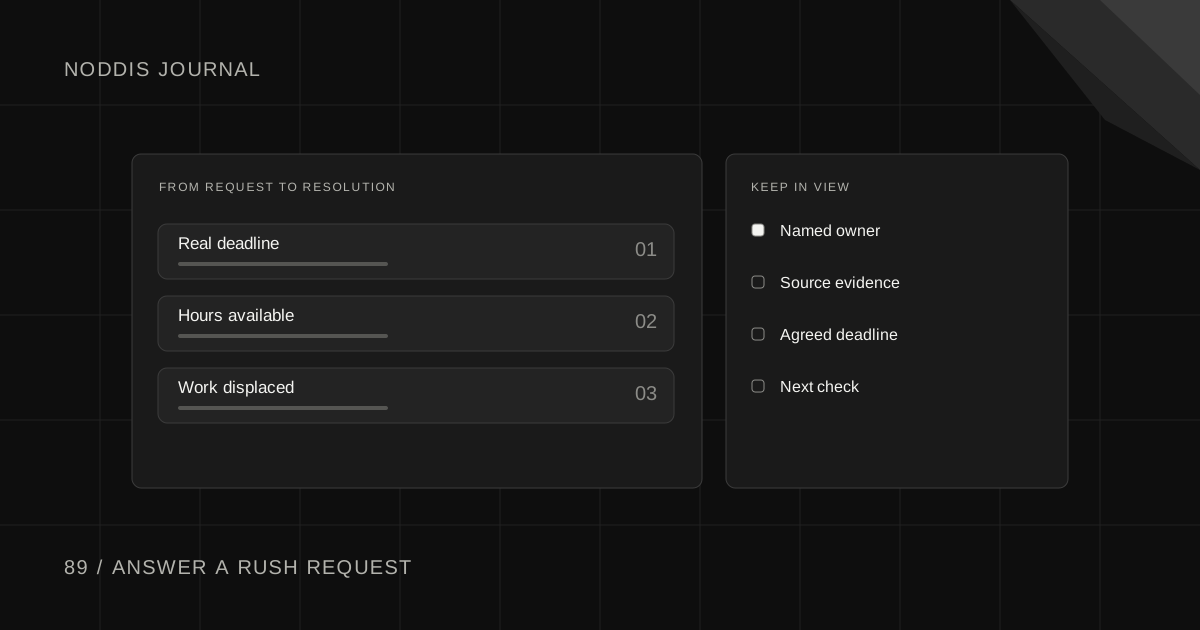
To respond to a rush request from a client, do not answer yes or no in the first reply. Ask what the real deadline is and what it is for, check what the rush would push aside, then offer two or three options with a price and a delivery time for each. A rush is a trade, and the client should choose it knowingly.
How do you respond to a rush request from a client in the first reply?
Say you have the request, ask two questions and give a time for your full answer. That first reply buys you room to check your schedule without leaving the client waiting.
Subject: Re: [Request], needed by [their date]
Hi [Name],
Got it, and I want to help. Two quick questions so I can give you an accurate answer:
1. What is the hard deadline, and what happens on that date?
2. If the whole thing cannot be done by then, which part matters most?
I will check my schedule and reply with options by [time today].
Thanks,
[Your name]
The two questions do most of the work. "ASAP" is not a date. A launch on Friday morning is a real deadline, while "before the board meeting sometime next week" leaves more room than the first message suggested.
How do you decide whether to accept a rush request?
Decide with three checks: whether the deadline is real, whether you have the hours, and what the rush pushes back. A rush is worth accepting when all three answers are ones you can say out loud to the people affected.
Urgent and important are different things. In a 1954 address, President Dwight D. Eisenhower quoted a former college president who divided his problems into two kinds, the urgent and the important, and said: "The urgent are not important, and the important are never urgent." A client's rush is urgent by definition. Your job is to find out whether it is also important enough to move other work.
| Check | Question to answer | If the answer is no |
|---|---|---|
| Real deadline | Is there a fixed event behind the date? | Offer the normal schedule |
| Hours | Do I have the working hours before then, without overnight work? | Offer a smaller version |
| Displacement | Can the work it pushes back absorb the delay? | Decline, or ask the other client first |
The third check is the one people skip. Saying yes to one client's rush is saying "later" to another client, who was not asked. If a promised date has to move, that client hears it from you before the rush work begins.
What options can you offer instead of a simple yes or no?
Offer three options, each with a delivery time and a price. Options turn a tense request into a normal buying decision, and they let the client decide how much the speed is worth.
Take a bakery, Juniper, that asks on Tuesday for a holiday landing page by Friday, in a week already booked for another client:
| Option | What the client gets | Delivered | Price |
|---|---|---|---|
| A. Full rush | The complete landing page | Friday, 9 am | Normal fee plus a rush fee |
| B. Smaller version on time | One section with the offer and an order button | Friday, 9 am | Normal fee for the smaller scope |
| C. Full page, normal schedule | The complete landing page | The following Wednesday | Normal fee |
Subject: Holiday page: three ways to do it
Hi [Name],
Thanks for the detail. Here are three options.
A. The full page by Friday 9 am, at [fee] plus a rush fee of [amount]. This moves other booked work, which the rush fee covers.
B. A single section with the offer and the order button by Friday 9 am, at [fee].
C. The full page by next Wednesday, at [fee], with no rush fee.
Tell me A, B or C by [time] and I will confirm in writing and start.
Thanks,
[Your name]
Option B is the one to think hardest about. A smaller deliverable that meets the real deadline can solve the client's problem at no extra cost to anyone.
Should you charge a rush fee?
Charge a rush fee when the rush moves other paid work or pushes you outside your normal working hours. The fee is not a penalty. It pays for the rescheduling and makes the cost of speed visible, which helps the client choose.
Three rules keep a rush fee fair:
- State it before you start. A fee that appears on the invoice afterward is a dispute waiting to happen.
- Tie it to the option, not the client. The same client pays no fee for option C.
- Get the choice in writing. A rush changes the timing and the price, and both belong on record.
The last rule matches a published contract template. The Freelancers Union's contract template opens its change clause with "Any material changes to the Services, including work to be performed and related fees must be approved". For a small job, a one-line reply that says "Option A, confirmed" gives you that written record.
If rushes are regular, put a rush rate in your agreement. A client who has already seen the rate is not surprised by it.
How do you say no to a rush request without losing the client?
Say no by offering the nearest thing you can do and the date you can do it. A plain "I can't" ends the conversation. "Not by Friday, but here is what is possible" keeps it going.
Subject: Re: [Request]
Hi [Name],
I cannot deliver [request] by [date] without moving work I have promised to other clients this week, so I have to say no to that date.
Here is what I can do: [smaller version] by [date], or the full job by [later date]. If neither works, I understand, and I am glad to pass on the files so someone else can pick it up quickly.
Thanks,
[Your name]
Offering to hand over files shows that the no is about your calendar, not about the client.
When the same client sends rush requests often, the pattern is a planning problem. Raise it outside the moment, with the guide to managing client expectations, and agree how much notice normal work needs.
How does Noddis help you answer a rush request with facts?
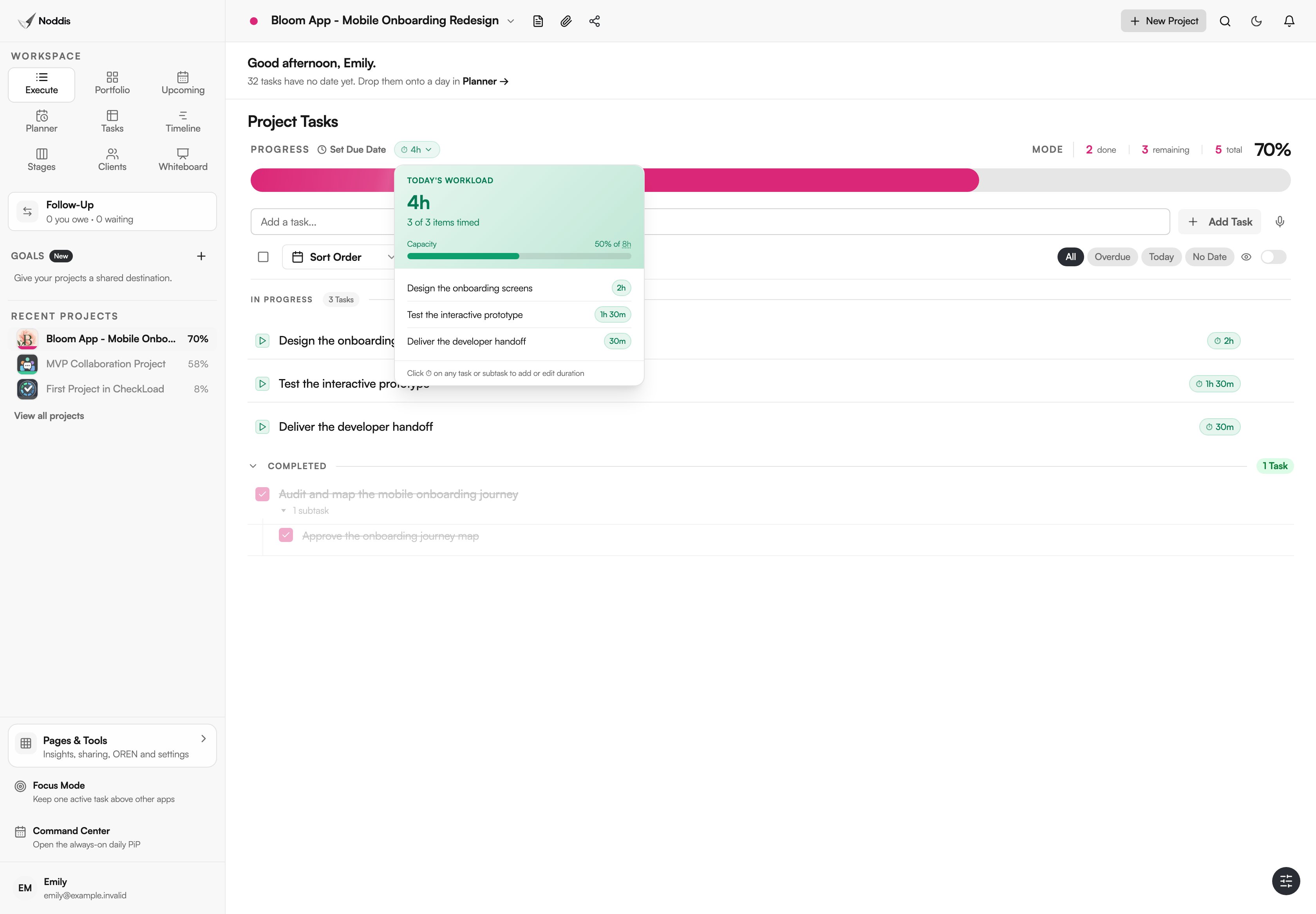
Noddis is a project management app that keeps tasks, follow-ups, and related project details connected. When we built the duration summary in Noddis Execute, we made it total the unfinished time estimates for the selected project against capacity hours you can adjust.
That total answers the hours check with a number in place of a feeling. The Upcoming view shows dated tasks across projects, so you can see which promised dates a rush would land on before you reply. The summary covers one project at a time and counts only tasks that have an estimate, so treat it as a starting point, not a forecast.
For planning beyond this week, see the guide to freelancer capacity planning. For the wording of a scope or date change, use the free client email templates for freelancers.
Your next step
Save the first-reply message as a template now, so the next rush request gets a calm answer within the hour. To check dated work across projects before you commit, open the live demo.
Common questions
How much should a rush fee be?
There is no standard amount. Set the fee from what the rush costs you: the hours outside your normal schedule and the work of moving other clients. Some freelancers use a percentage on top of the normal fee and others a flat amount per rushed day. Whichever you choose, write it into your agreement so the number is known in advance.
Should I ever do a rush job for free?
Occasionally, and on purpose. A free rush for a long-standing client facing a true emergency can be a good decision. Say that it is an exception when you agree to it, so it does not become the expected price of speed. A favour the client knows about builds goodwill, while one they never notice only sets a precedent.
What if the client says everything is urgent?
Ask them to rank. Reply with the list of open requests and ask which one should be finished first if only one can be. Ranking forces a real priority to appear, and it shows the trade-offs without an argument. If everything stays urgent after that, agree a fixed weekly slot for their requests.

Katleen is the founder of Noddis. She runs client projects through her app studio, 693 Labs, and builds Noddis around the problems that work creates.
Last reviewed . Feature details reflect Noddis at the time of review.