
Short answer
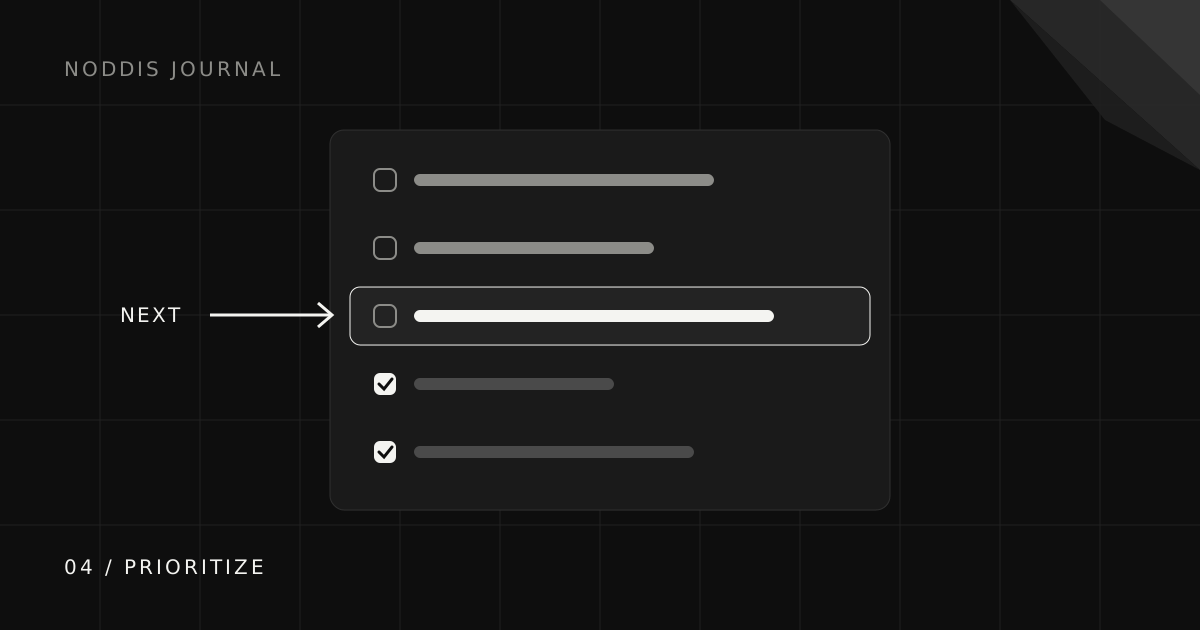
Pick the task that is both time-sensitive and blocking someone else, then shrink it to a slice you can finish in the time you actually have. A dependable order is: an urgent blocker, then anything that unblocks another person, then the deliverable closest to done, and only then new work. Write the next action as a verb plus a concrete outcome so you can start without rereading the project.
Why doesn't a priority list tell you what to do next?
A priority list is a snapshot of importance taken at some point in the past, and importance is only one of the inputs to a good decision about the next hour. The others change constantly: what can actually move right now, who is waiting on you, and what becomes expensive if it slips another day.
Lists also mix unlike things. “Launch the Hartwell site” sits beside “email Sam the invoice,” even though one is an outcome that will take weeks and the other is a two-minute action. Comparing them forces your brain to rebuild the context of both before you can begin either, which is how a free hour quietly becomes twenty minutes of rereading.
When you run several client projects at once, the problem compounds, because each client’s list was ordered in isolation. Nothing on Client A’s list knows that Client B’s approval is due at noon.
How do you choose the next task in five steps?
To choose the next task, run five checks in order: commitments, constraints, a finishable slice, visible momentum, and a written next step.
- Check hard commitments. Look for promised delivery times, meetings that need preparation, and decisions with a latest useful date. These are the only things that are genuinely fixed.
- Find the constraint. Ask which missing action is stopping the most other work. A five-minute approval request can outrank a full day of independent design work, because it releases someone else.
- Choose a finishable slice. Define something you can complete with the time and energy you have now. “Draft three subject lines for the launch email” beats “work on launch.”
- Prefer visible momentum. When two options are otherwise equal, push the deliverable closest to done over the line. Finished work changes what the client sees; started work does not.
- Leave the next step written down. Before you switch, note the next physical action. Your future self, or the person covering for you, should not have to reconstruct the project.
Could you start this action right now without asking “what did I mean by this?” If not, rewrite it until the verb and the outcome are obvious.
Which signals matter more than a priority score?
High, medium, and low labels are useful shorthand, but they hide the reason behind the ranking, and the reason is what you need when two “high” items collide. These signals explain the decision instead:
| Signal | Question to ask |
|---|---|
| Urgency | What becomes harder or impossible if this waits a day? |
| Unblocking power | Who or what can move once this is done? |
| Proximity to done | Will this close a deliverable, or open another loop? |
| Capacity fit | Can I finish this slice with the time and focus I have right now? |
| Decision risk | Is someone waiting on information that only I have? |
You do not need to score every task. Scan for the strongest signal, write the action, and start.
What does this look like across three client projects?
Say it is Tuesday afternoon and you have ninety minutes. Client A needs homepage photography approved before their developer can finish. Client B’s monthly report is due Friday and is half written. Client C sent a long email this morning with “a few small changes.”
The photography approval goes first: it takes ten minutes to send a tight selection with a clear question, and it unblocks a developer who is otherwise idle. Next, Client C’s email gets ten minutes, not to do the changes, but to turn the email into three concrete tasks with dates so it stops living in your inbox. The remaining hour goes to Client B’s report, because it is the deliverable closest to done and it has a real deadline.
Notice that the order was not decided by which client was loudest, which task was oldest, or which one you liked best. It followed dependencies, deadlines, and the time actually available.
When should you change the order?
Change the order when a commitment, a dependency, or your available capacity changes. Do not change it simply because a newer message arrived, because constant reshuffling makes a day feel busy while charging you the cost of starting over each time.
If Client A approves the photos early, the developer’s next step may jump ahead of your report. If the approval is delayed, send one precise follow-up and move to work that does not depend on the answer. Either way, the reason for the change should be something you could say out loud in one sentence.
How does Noddis make the next action easier to see?
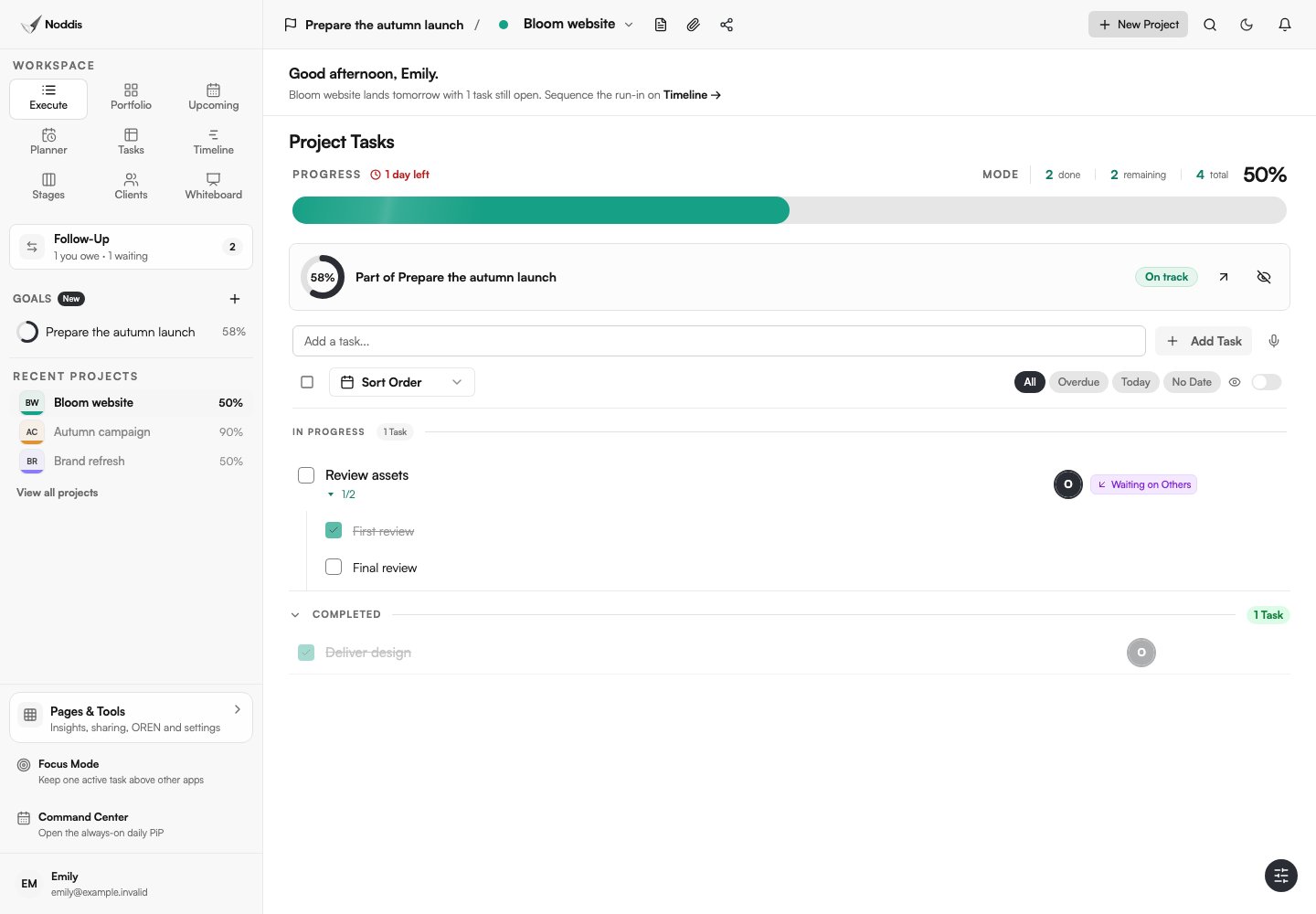
Use Portfolio, Upcoming, Planner, and All Tasks to compare work across projects. Once you choose the next action, select its project in Execute. Record promised replies and waits in Follow-Up so they have a date rather than depending on memory.
Noddis Drift measures scope growth against a baseline. Establish the agreed scope, then review additions as client-requested, internal, or unclassified. This gives you a concrete record for a scope conversation. It does not decide that a project is late merely because nothing changed for a few days.
The workspace guide explains these boundaries. You still decide what matters most when a client promise or constraint changes.
Common questions
What is the best way to prioritize tasks when everything feels urgent?
Separate real consequences from general pressure. Handle items with a fixed deadline, a dependency, or a decision only you can make first. Then ask which of the remaining items could be renegotiated or delayed without real cost.
How do you prioritize work across multiple clients?
Look across all clients at once rather than one list at a time. Clear anything that unblocks another person, then protect hard deadlines, then finish the deliverable closest to done. A single view of every project makes this possible without rebuilding context.
Should I use a priority scoring system like RICE or Eisenhower?
Scoring frameworks help with planning a backlog. For the next hour, a short check of deadlines, blockers, and finishable slices is faster and usually gives the same answer.
How often should I reprioritize?
At natural transitions: the start of the day, after a meeting, or when a commitment changes. Reordering after every new message wastes the context you just built.

Katleen is the founder of Noddis. She runs client projects through her app studio, 693 Labs, and builds Noddis around the problems that work creates.
Last reviewed . Feature details reflect Noddis at the time of review.