
Short answer
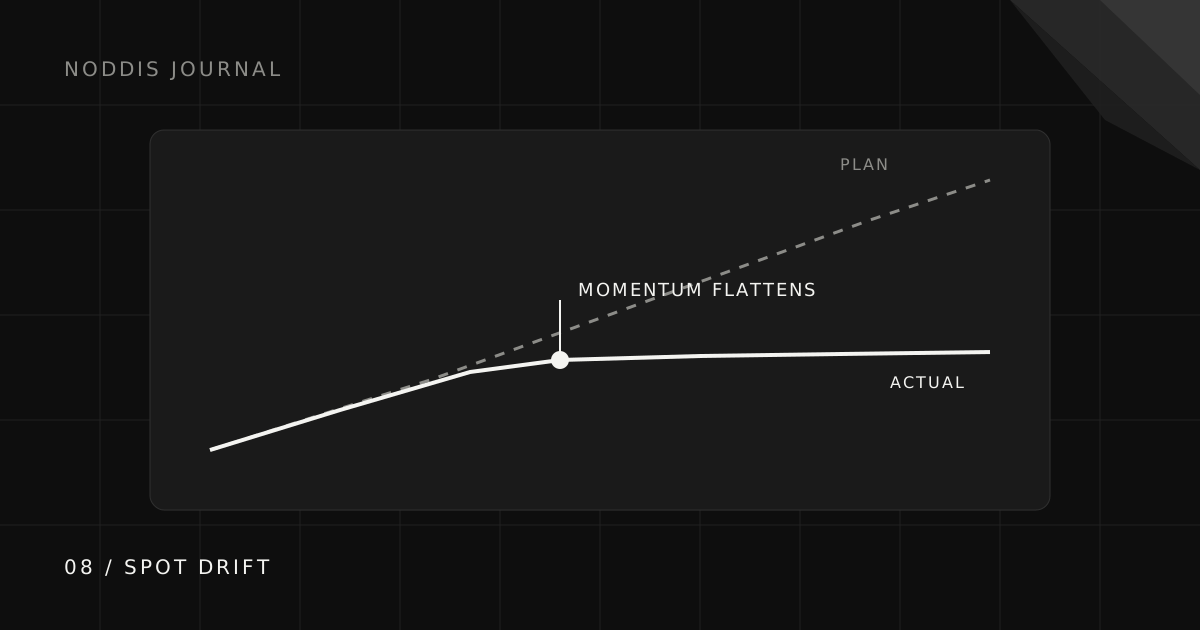
Project drift is the growing gap between planned and actual movement on a project, usually before any deadline has officially moved. The earliest signs are tasks that are “almost done” more than once, updates that describe activity rather than outcomes, decisions with no decision date, and client replies that are overdue but untracked. Catch it with a short weekly review of blocked work, aging tasks, and the last meaningful outcome delivered.
What is project drift?
Project drift is not the same as being late. It is the quieter period before lateness, when activity continues but the distance between activity and a finished outcome keeps growing. Messages are flowing, everyone is busy, and the plan still looks plausible right up until the moment the buffer is gone.
Drift is hard to see because it hides inside perfectly reasonable explanations. The review was postponed because the client was traveling. The task rolled to next week because something more urgent came up. You are waiting on “one more reply.” Each event is small and defensible. The pattern is the warning.
In client work, drift has a second cost: the client usually feels it before you say it, and trust erodes in the silence between the slip and the explanation.
What are the seven early warning signs of project drift?
The seven early warning signs of project drift are behavioral, and they show up well before a deadline moves:
- The same task is almost done more than once. The remaining work is undefined, larger than expected, or quietly blocked.
- Updates describe activity, not outcomes. “Worked on the proposal” does not say what changed.
- Tasks have owners but no next action. Someone is responsible, yet the next physical step is ambiguous.
- Decisions have no decision date. Work waits politely until the delay suddenly becomes urgent.
- Client replies are overdue and nobody is tracking them. “Waiting on client” has become a place where work goes to rest.
- Dates move on their own. One deadline shifts, but the dependent tasks and the promises made to the client do not.
- Status requires a meeting. If the project cannot explain itself between calls, its current state is not being captured where the work lives.
How do you run a 15-minute drift review?
Once a week, review movement rather than percentages. Four quick passes are enough:
- Last movement: what meaningful outcome was completed since the previous review?
- Current constraint: what is preventing the next outcome, and who can remove it?
- Upcoming promises: which client commitments in the next two weeks need movement now?
- Next visible proof: what will the client be able to see finished by the next review?
End by writing one recovery action per drifting project. “Get the homepage back on track” is a wish. “Send two homepage directions to Maya for a decision by Tuesday” is an action.
What should you avoid when a project starts drifting?
Do not respond by adding more reporting. A second dashboard or a longer status call makes the project look more managed while leaving less time to actually move it.
Avoid across-the-board urgency, too. When every task becomes critical, you lose the information needed to recover. Narrow the active work, name the constraint, and renegotiate scope or sequence early, while the conversation with the client is still about choices rather than apologies.
What is the smallest finished outcome that would make this project feel honest again?
How do you recover a project that is already drifting?
Reduce the project to the next decisions and actions that restore movement. A full replan is rarely needed unless the goal itself has changed.
- Name the stalled outcome in plain language.
- Find the constraint: a missing decision, missing capacity, unclear scope, or an external wait.
- Assign one recovery action with an owner and a specific check-in date.
- Close or defer competing work. A recovery plan that keeps every optional task active is not a recovery plan.
If the constraint is a missing client answer, use a clear follow-up loop. If everything is technically unblocked but you cannot choose where to start, run the five-step next-task check.
How does Noddis surface drift?
The general warning signs above require a review of work and commitments. The product feature named Drift has a narrower definition:
Noddis Drift measures scope growth against a baseline. Establish the agreed scope, then review additions as client-requested, internal, or unclassified. This gives you a concrete record for a scope conversation. It does not decide that a project is late merely because nothing changed for a few days.
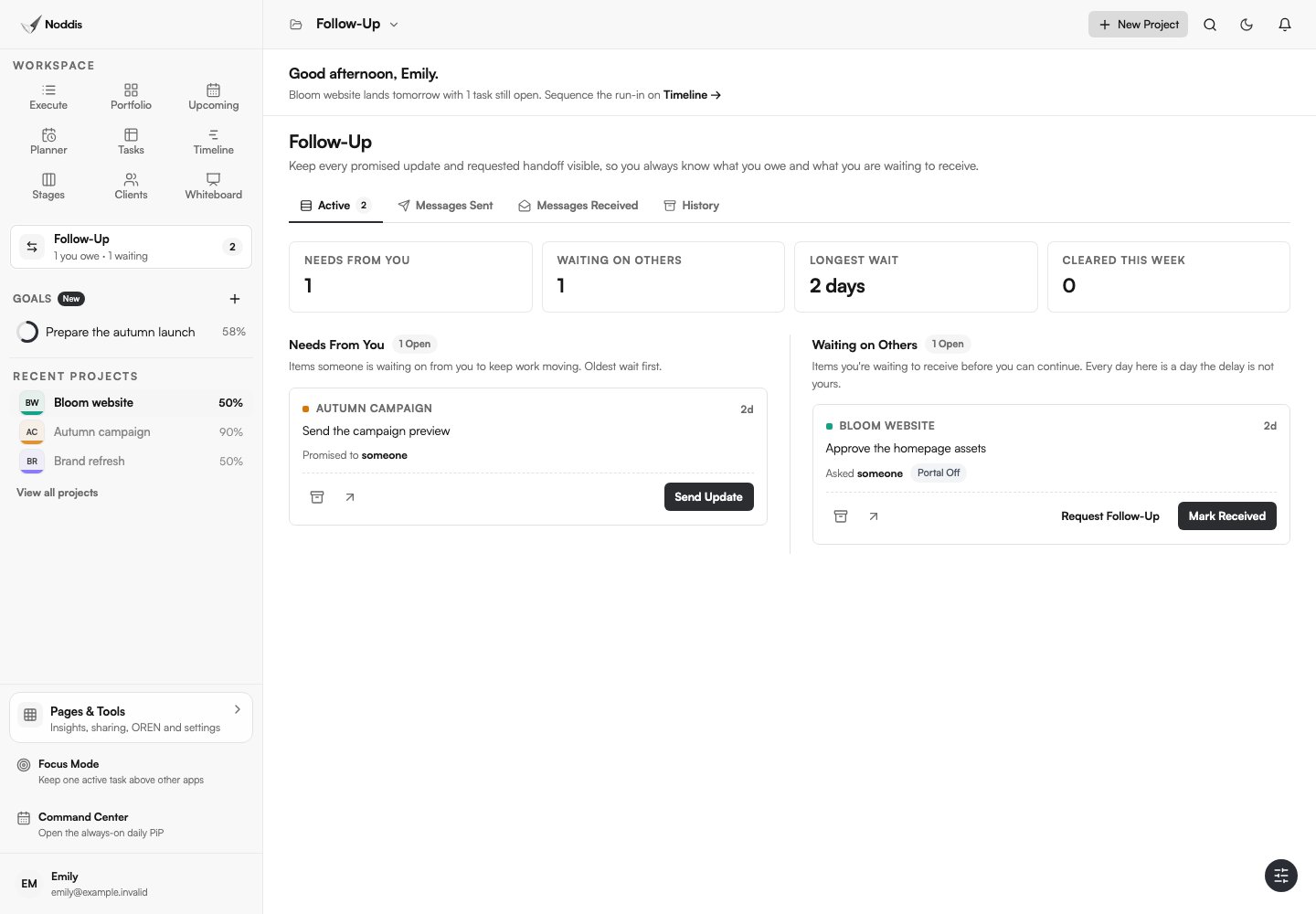
For overdue replies, use dated commitments in Follow-Up. For deadlines and blocked tasks, review the project and cross-project views. Together these provide evidence for the review; they do not automatically diagnose every cause of lost momentum.
Common questions
Is project drift the same as scope creep?
No. Scope creep is uncontrolled growth in the work. Drift is a loss of momentum or alignment. Scope creep can cause drift, but drift also comes from blockers, vague next actions, slow decisions, and too much work open at once.
Can a project be on schedule and still be drifting?
Yes. A project can keep its original deadline while quietly using up all of its buffer and accumulating unresolved dependencies. The date has not moved yet, but the path to it is weakening.
What is the best way to measure project momentum?
Count meaningful completed outcomes over time rather than activity. Pair that with the age of blocked items and whether each open item has a clear next action.
How do you tell a client a project is behind?
Early, specifically, and with a plan. Name what slipped, why, what you are changing, and what you need from them. Clients handle a clear reset far better than a surprise.

Katleen is the founder of Noddis. She runs client projects through her app studio, 693 Labs, and builds Noddis around the problems that work creates.
Last reviewed . Feature details reflect Noddis at the time of review.