
Short answer
Freelancer capacity planning estimates how much additional client work you can safely accept after accounting for delivery time, meetings, administration, and uncertainty. Start with realistic working hours, subtract existing commitments, and keep a buffer. The goal is not to fill every hour; it is to make promises you can deliver.
How do you calculate freelance capacity?
Use this basic model:
Available delivery capacity = workable hours − fixed obligations − contingency buffer.
Example: suppose you have 35 workable hours next week, 8 hours of meetings and administration, and a 5-hour contingency buffer. That leaves 22 delivery hours. If current commitments require 18 hours, you have roughly 4 hours for additional work. These numbers are illustrative, not industry benchmarks.
Why isn't counting clients enough?
Three active clients can be more demanding than seven. A complex launch might require continuous focused work, while a retainer may have short predictable tasks. Estimate remaining effort by deliverable and account for deadlines and dependencies. Waiting on a client does not necessarily mean the hours are free: feedback may arrive all at once.
What should a weekly capacity worksheet include?
| Item | Sample hours |
|---|---|
| Workable hours | 35 |
| Meetings and admin | 8 |
| Contingency buffer | 5 |
| Available delivery capacity | 22 |
| Already committed delivery work | 18 |
| Remaining capacity | 4 |
If the remaining capacity is negative, do not solve it by assuming you will work faster. Renegotiate deadlines, reduce scope, delegate appropriately, or decline new work.
How do you account for uncertain tasks?
Use a range when a task has meaningful uncertainty. For example, estimate a revision at 2–5 hours rather than pretending it will take exactly 2. Schedule based on the higher end when the deadline is fixed or when several uncertain items overlap.
When should you accept another client?
Accept new work when the expected effort fits within your delivery capacity and its deadlines do not collide with critical existing milestones. A project starting next month may be safe even when this week is full. A small urgent request may be unsafe if it interrupts a launch.
How can Noddis help?
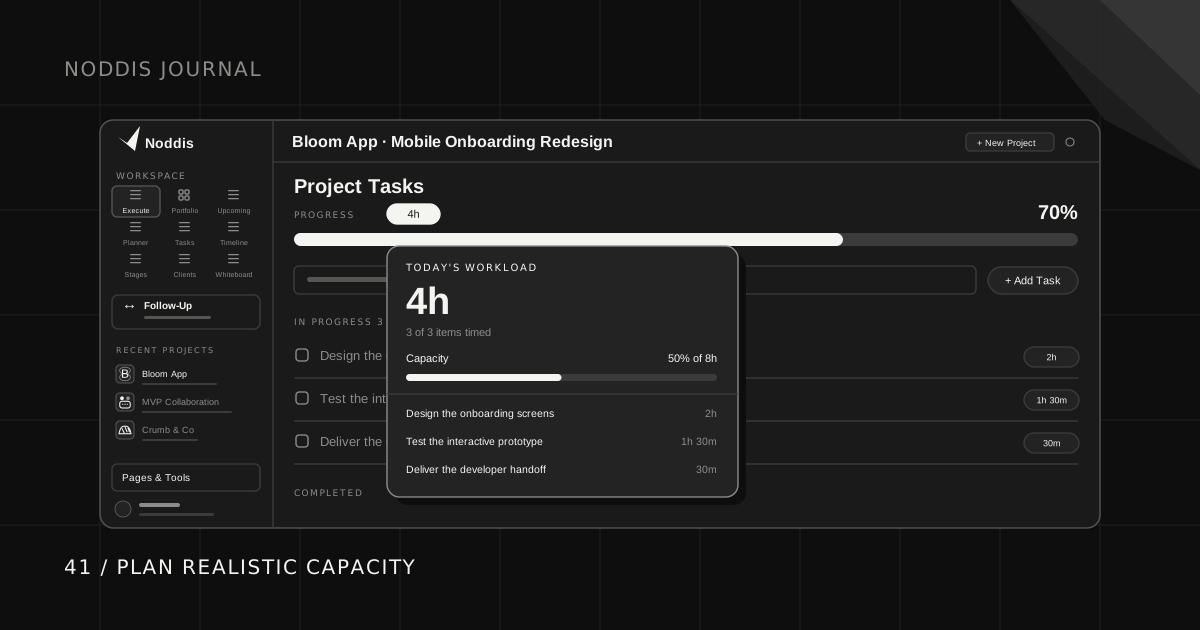
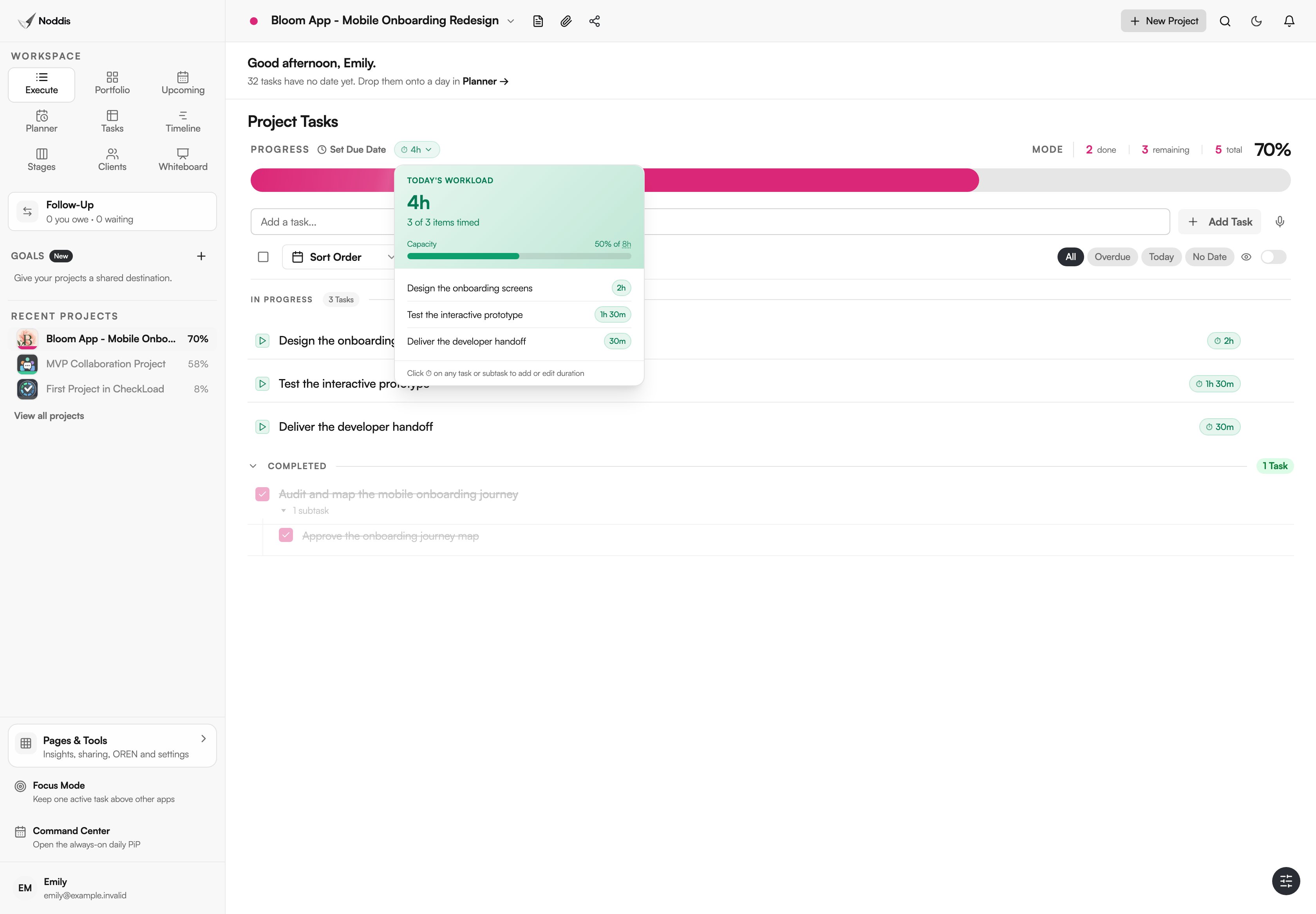
Noddis supports task and subtask duration estimates. In Execute, the duration summary compares recorded estimates for unfinished work in the selected project with an adjustable capacity-hours setting. Untimed work is not counted as estimated effort, and the percentage is not a forecast of weekly availability across all clients.
Use Portfolio to compare projects, Upcoming to review deadlines, and Planner to arrange work. Then calculate the weekly worksheet below using your own working hours, meetings, and buffer. Noddis does not automatically subtract those obligations or decide whether you can accept another client. The prioritization guide helps turn that review into a next action. Try the live demo with sample work.
Worked example: calculating next week's capacity
Imagine a freelancer has 40 working hours available. They reserve 8 for administration, sales, and meetings and another 4 for revisions and interruptions. That leaves 28 hours of planned client-delivery capacity. Existing commitments require 10 hours for Client A, 8 for Client B, and 7 for Client C, leaving just 3 unallocated hours.
This is an illustrative planning model, not a universal utilization benchmark. It shows why an apparently open calendar does not necessarily mean room for another ten-hour assignment.
Weekly capacity worksheet
| Component | Example hours |
|---|---|
| Working time | 40 |
| Administration and meetings | −8 |
| Contingency buffer | −4 |
| Available delivery capacity | 28 |
| Already committed | −25 |
| Unallocated | 3 |
Formula: available delivery capacity = working hours − non-delivery work − buffer. Remaining capacity = available delivery capacity − committed work. Keep all estimates in the same units.
Why delayed work still counts
A project waiting on feedback may require only two hours this week, but the remaining work can return suddenly when the client replies. Track the likely resumption window and deadline, not just the current task count. Ask: “If every waiting client replied tomorrow, would the plan still hold?” If not, you need a larger buffer or fewer simultaneous promises.
What to do when capacity is negative
Choose deliberately between moving a deadline, reducing scope, delegating suitable work, or declining a new engagement. Extra evening hours might handle an occasional spike, but they are not a sustainable baseline. Check both total hours and deadline concentration: two critical deliverables due Friday may be harder than the same hours spread across the month.
A practical weekly review
List fixed deadlines first. Re-estimate only work that has materially changed. Block focus time for the highest-impact deliverables and keep some unscheduled time for revisions. Midweek, review returning approvals and adjust the plan. Noddis's project workload summary and cross-project views provide inputs to this review; a full weekly capacity calculation still needs your own commitments and contingency buffer.
Common questions
How many clients can one freelancer handle?
There is no universal number. Capacity depends on the hours and uncertainty of the work, review cycles, and whether clients require simultaneous attention.
Should I plan for 100% utilization?
Usually not. A full schedule leaves little room for feedback, unexpected revisions, or administrative work. Choose a buffer based on your actual delivery history.
What if clients are slow to respond?
Track the approval dependency and the possible return of work separately. Do not assume a delayed review eliminates the hours you will need once feedback arrives.

Katleen is the founder of Noddis. She runs client projects through her app studio, 693 Labs, and builds Noddis around the problems that work creates.
Last reviewed . Feature details reflect Noddis at the time of review.