
Short answer
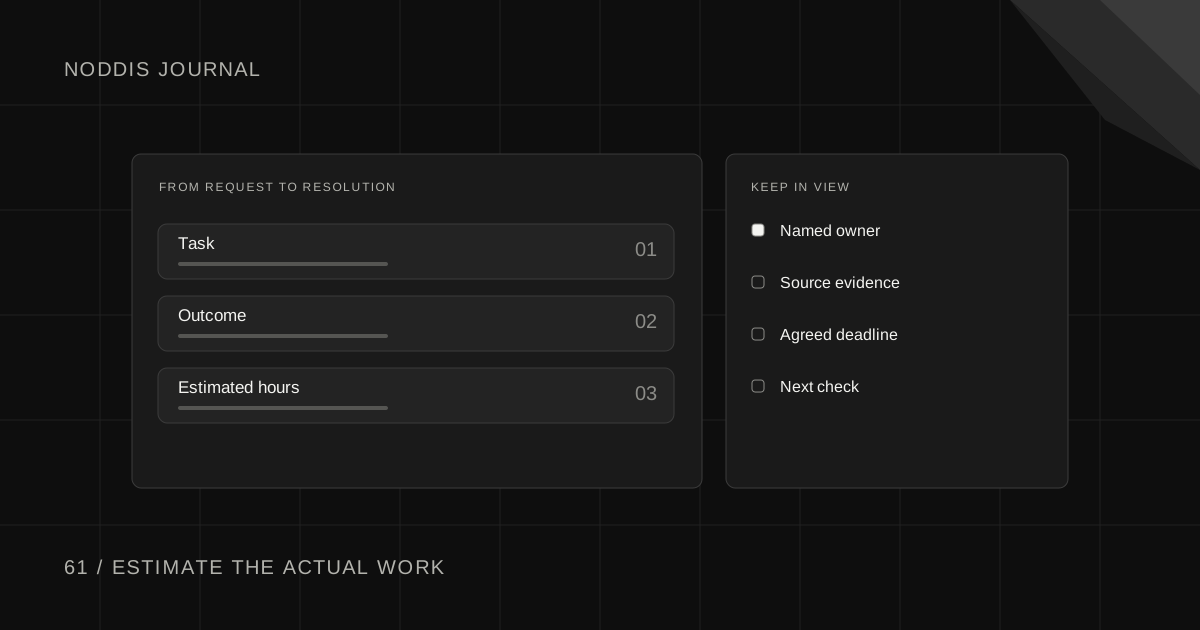
Estimate task duration for client projects by breaking the work into a verifiable outcome, comparing it with similar past tasks, accounting for uncertainty, and separating hands-on effort from waiting time. A good estimate states its assumptions. It is a planning tool to revisit as real work reveals more information.
Free resource
Download the blank task estimate calibration spreadsheet. No account is required. Save a copy before adding your project details.
What is the difference between effort and duration?
Effort is the amount of working time the task requires. Duration is the elapsed calendar time from start to finish, including handoffs and waiting. A four-hour design task can take several days from assignment to approval when the client reviews it later.
This matters for projects with many client checkpoints. If you add four hours of production to the schedule but forget two review windows, your estimate may fit the work while missing the promised delivery date.
Atlassian's project dependency guide explains how sequencing affects schedules. Duration estimates should consider those relationships, especially when someone else controls the next input.
How do you estimate a task you've done before?
Start with actual durations from comparable completed tasks. Choose work with similar complexity and the same type of deliverable, then adjust for known differences. Avoid comparing an ordinary content update to a custom integration simply because both are labeled “website task.”
Use this fictional calibration table:
| Past task | Planned effort | Actual effort | What changed |
|---|---|---|---|
| Homepage design revision | 3 h | 4 h | Additional responsive review |
| Product copy edit | 2 h | 2.5 h | Source facts needed checking |
| Contact form setup | 2 h | 5 h | Access and routing issues |
The lesson is not to blindly add the same buffer to everything. The contact form overrun was caused by uncertainty around access and integration, so similar future work deserves an earlier access check and a wider estimate.
How do you estimate a task you have never done?
Break it into pieces that can be observed or tested. For example, “Set up a campaign landing page” might include content assembly, layout, responsive QA, form testing, and client review. If the implementation is unfamiliar, mark that uncertainty explicitly.
You can use three scenarios: an optimistic estimate, a most-likely estimate, and a difficult-case estimate. They are planning ranges, not probabilities unless you have the data to justify them.
| Subtask | Low | Likely | High |
|---|---|---|---|
| Assemble approved content | 1 h | 2 h | 3 h |
| Build responsive layout | 3 h | 5 h | 8 h |
| QA and corrections | 1 h | 2 h | 4 h |
| Total effort | 5 h | 9 h | 15 h |
The range shows why promising a specific completion hour before clarifying layout complexity may be risky. Add review calendar time separately.
How do you avoid underestimating a revision?
Define what version is under review and which kinds of changes are included. A small wording correction is different from a new stakeholder reopening the approved concept. Treat unclear feedback as an input that must be clarified before a reliable estimate.
If the change adds a deliverable, return to the scope process. The guide to out-of-scope requests explains how to communicate that boundary. The freelancer capacity planning guide can help assess whether the resulting effort fits the week.
How should estimates improve over time?
At completion, record estimated hours, actual hours, reason for difference, and the result. Review patterns monthly or after several similar tasks. Improve the task breakdown, estimate range, or prerequisite checks that caused the gap.
Do not use estimates to punish someone for encountering legitimate unknowns. The purpose is to learn what the work really requires and make better promises to clients.
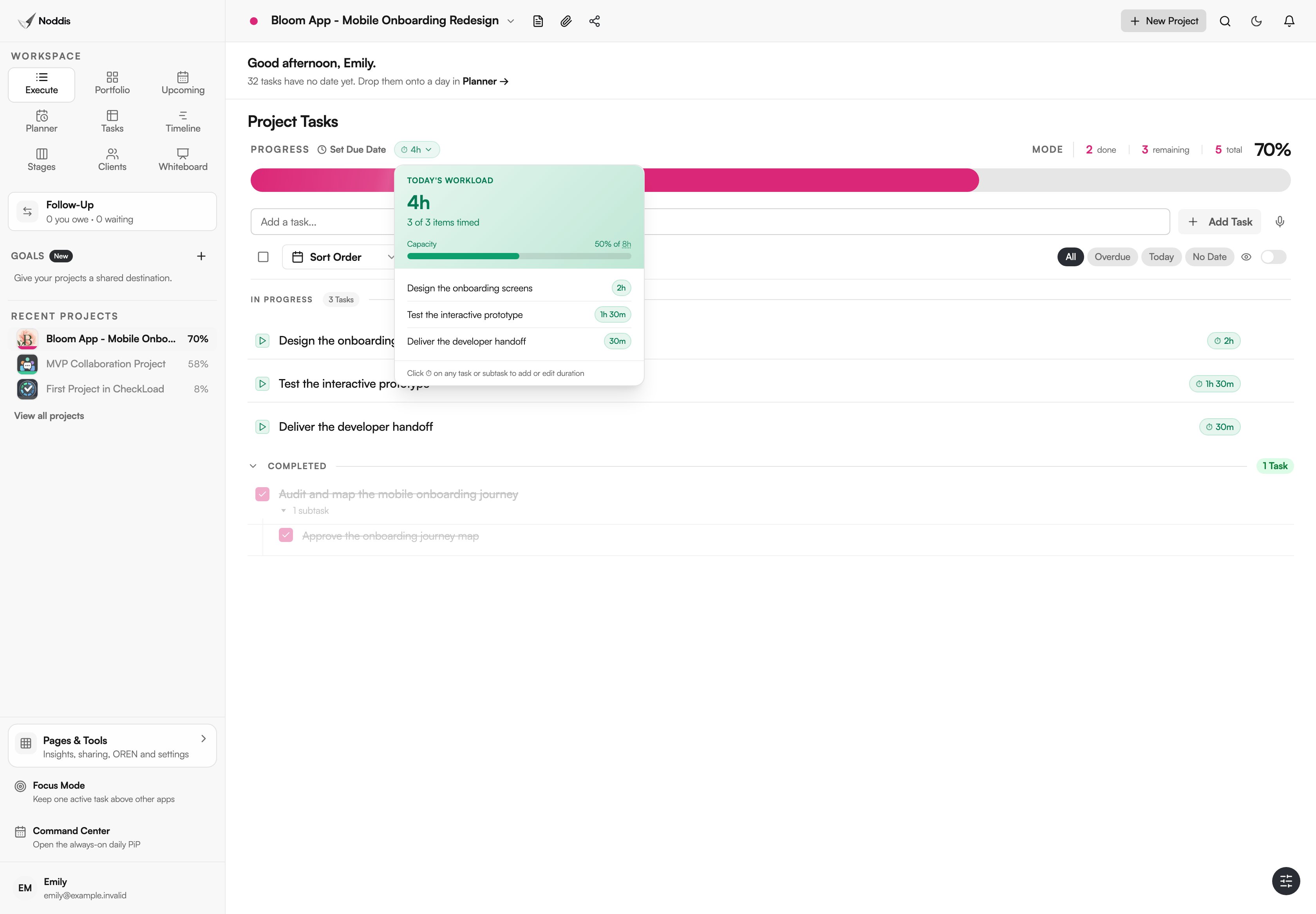
Noddis is a project management app for connected projects and tasks. Use the duration control on a task or subtask to record its estimate, and keep the assumptions in its notes. Execute’s workload summary totals unfinished recorded estimates for the selected project and compares them with adjustable capacity hours. Use Timeline for dated sequencing and the calibration worksheet to compare estimates with actual effort. The workload total is not an automatic four-week forecast across clients. Stages and Timeline are Pro workspaces for signed-in accounts; they can also be explored in the visitor demo. You can explore the live demo.
Your next step
Choose three recent tasks and compare estimates with actual time. The explanations for those differences are often more useful than another generic estimating formula.
Common questions
Is it better to estimate in hours or days?
Use hours for expected production effort when that helps planning, and dates for client delivery commitments. Do not equate eight estimated hours with one calendar day when other client work and reviews occupy the schedule.
Should every task have an estimate?
No. Estimate work that influences capacity, pricing, deadlines, or dependencies. For very small routine tasks, the overhead of precise estimation may exceed its usefulness.
How do I estimate client feedback time?
Agree on a review window with the client and include it as a calendar dependency. Do not count it as hands-on team effort unless your team will actively review, revise, or respond during that period.

Katleen is the founder of Noddis. She runs client projects through her app studio, 693 Labs, and builds Noddis around the problems that work creates.
Last reviewed . Feature details reflect Noddis at the time of review.