
Short answer
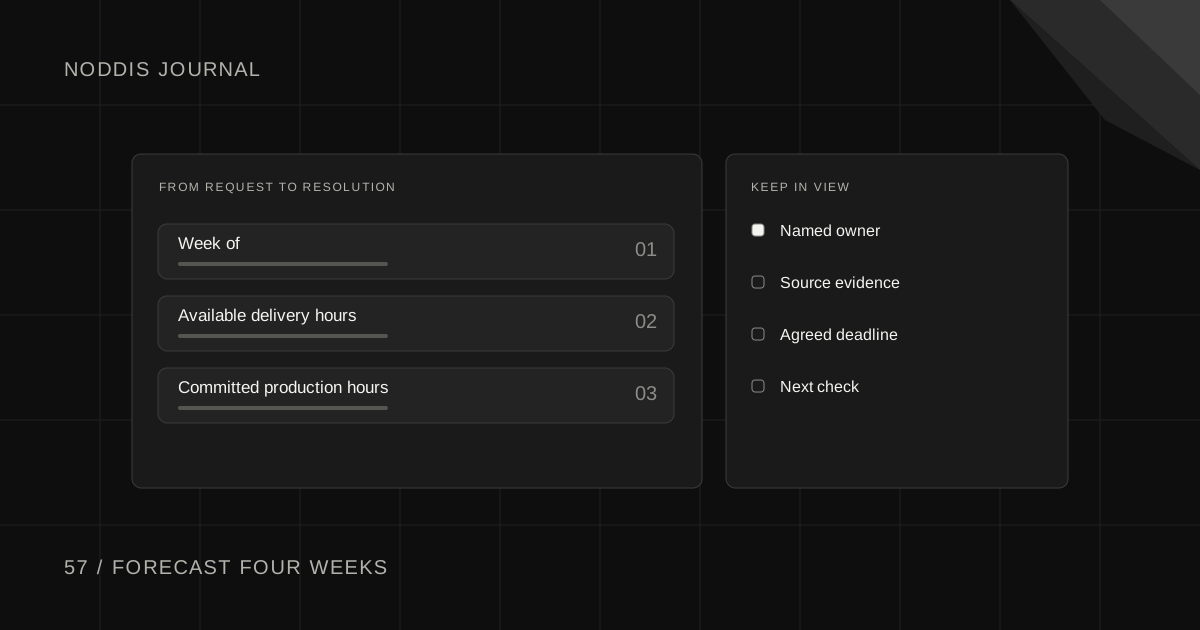
A freelancer workload forecast compares the work already promised with the hours realistically available in each coming week. Unlike a one-time capacity calculation, it shows when demand exceeds supply. A four-week forecast makes deadline collisions visible early, so you can shift reviews, negotiate scope, or decline new commitments before the calendar is full.
Free resource
Download the blank four week workload forecast spreadsheet. No account is required. Save a copy before adding your project details.
How is a workload forecast different from capacity planning?
Capacity planning determines how much work you can reasonably take on. A workload forecast places the existing commitments into specific future periods to identify overload before it happens. You can have enough hours in a month overall and still face an impossible second week.
Work must be scheduled in the sequence it can happen. Atlassian’s dependency guidance explains how prerequisites shape a project schedule; forecasts must account for client approvals that prevent later tasks.
The existing Noddis freelancer capacity guide covers the basic available-hours calculation. Use that as the input to this forecast rather than repeating it here.
A four-week workload forecast template
Suppose a fictional freelance designer has 25 usable client-delivery hours per week, after accounting for non-billable obligations. The current commitments look like this:
| Workstream | Week 1 | Week 2 | Week 3 | Week 4 |
|---|---|---|---|---|
| Juniper website | 12 | 16 | 6 | 2 |
| Orbit Bikes campaign | 8 | 12 | 10 | 4 |
| Leo retainer | 4 | 4 | 4 | 4 |
| Committed hours | 24 | 32 | 20 | 10 |
| Usable capacity | 25 | 25 | 25 | 25 |
| Remaining capacity | 1 | -7 | 5 | 15 |
The negative seven hours in week two are the warning. The freelancer should not accept another promise in that week without addressing the shortfall. The forecast does not claim that the fictional tasks can actually be moved; review dependencies and client commitments before rescheduling.
How do you build the forecast from your projects?
Start with accepted work, not speculative leads. For each deliverable, estimate the remaining production effort and the week when the work must occur. Include client review and revisions where your team must actively participate.
- Set usable weekly capacity. Start from working hours and subtract recurring meetings, administration, leave, and a realistic interruption allowance.
- List committed deliverables. Do not include optional or unapproved client requests in the committed baseline; track them as scenarios.
- Distribute effort into weeks. Put work in the periods when it can actually happen, considering approvals and deadlines.
- Add recurring obligations. Retainers, reporting, and routine QA consume capacity even when their tasks look small.
- Calculate the gap.
Available hours - committed hours = remaining capacityfor each week. - Review the overloaded weeks. Decide whether to move work, reduce scope by agreement, obtain support, or defer new commitments.
What should you do when a week is over capacity?
Rank the work by contractual deadline, dependency, and realistic consequences. Ask which tasks can move without affecting a commitment and which require a client conversation. Do not secretly borrow hours from a later week if the dependent deliverable must be finished earlier.
For the example above, shifting seven hours from week two to week three would remove the shortfall only if the associated work permits it. If the Orbit Bikes campaign launches at the end of week two, moving its final QA into week three is not viable. You may need to renegotiate another deliverable or bring in qualified help.
A forecast is a decision tool. It should expose tradeoffs, not automatically dictate which client loses priority.
How do you account for uncertain estimates?
For work with significant uncertainty, record an expected estimate and a higher planning estimate. You can also hold a percentage of time as contingency. Choose the method based on your history; do not assume a particular buffer works for everyone.
For instance, a design revision expected to take four hours might have a planning range of four to six hours if the number of changes is unknown. The high case makes risk visible before that time is committed elsewhere. Record why the range exists so it can be improved after delivery.
How often should the forecast change?
Review it weekly, and update it sooner when a client changes a deadline, approves added work, or postpones feedback that affects later tasks. Compare estimates with actual time to calibrate future work.
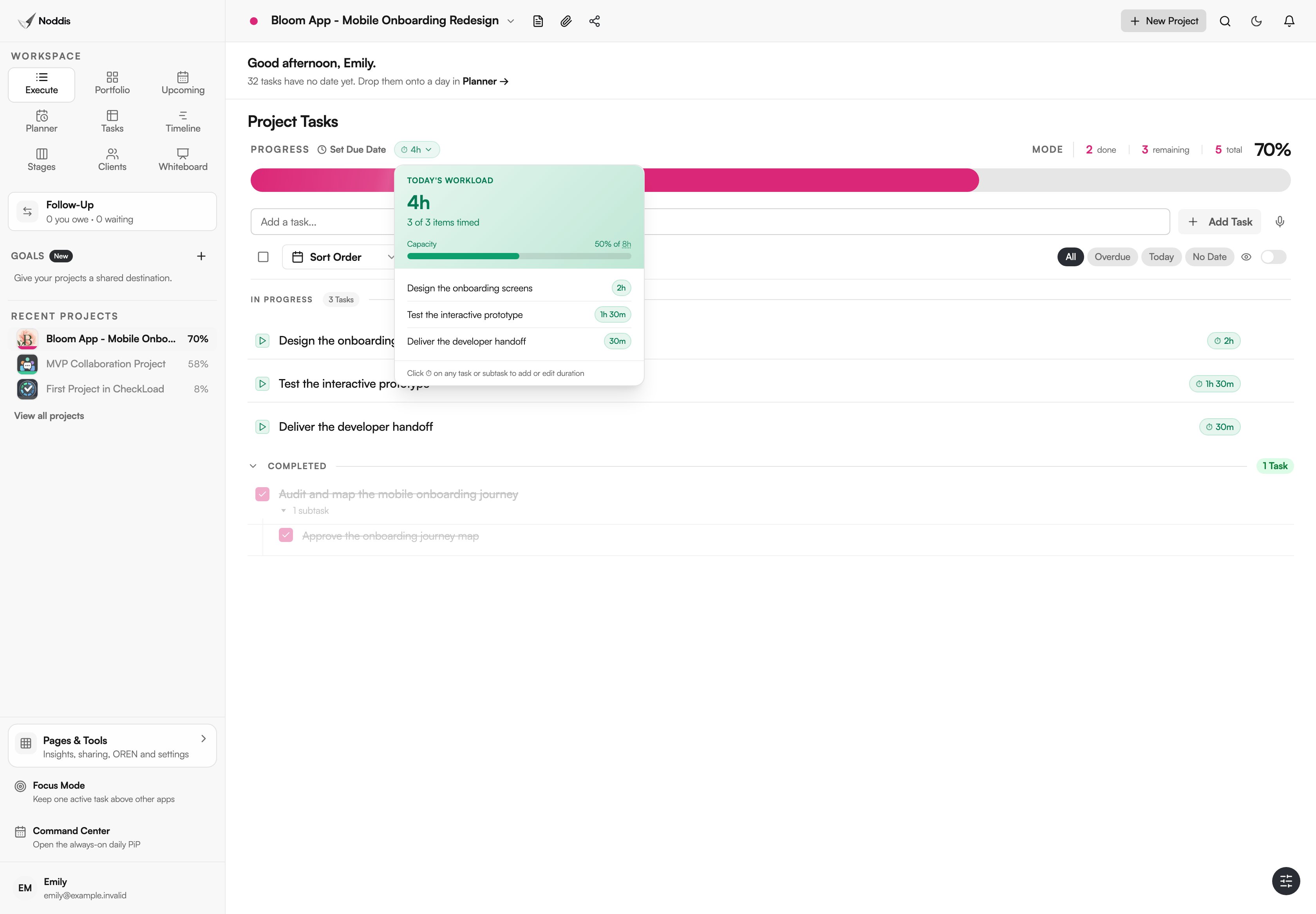
Noddis is a project management app with Portfolio, Planner, and project-level tasks. Use those views to inspect upcoming commitments. Tasks and subtasks can store duration estimates, and Execute summarizes unfinished recorded estimates for the selected project against adjustable capacity hours. Maintain this four-week, cross-client forecast separately; the project summary does not calculate the table for you. The multiple-client project guide covers the cross-project review habit. Explore the live demo.
Your next step
Build the next four weeks, not the whole year. Find the first negative-capacity week and resolve it before accepting more work.
Common questions
Should I include prospective projects in the forecast?
Keep probable opportunities in a separate scenario until they are accepted. That lets you test “what if this contract closes?” without treating sales interest as a confirmed commitment.
Is a weekly forecast enough for a launch week?
Not always. Move to day-level planning for periods with hard dates or many dependencies. A weekly forecast identifies overload; daily scheduling determines whether critical work fits the actual sequence.
What if I do not track my hours precisely?
Start with rough, explicit estimates and update them after each deliverable. Imperfect consistent data can reveal a repeated conflict. Avoid presenting guesses as precise forecasts, and improve the inputs over time.

Katleen is the founder of Noddis. She runs client projects through her app studio, 693 Labs, and builds Noddis around the problems that work creates.
Last reviewed . Feature details reflect Noddis at the time of review.