
Short answer
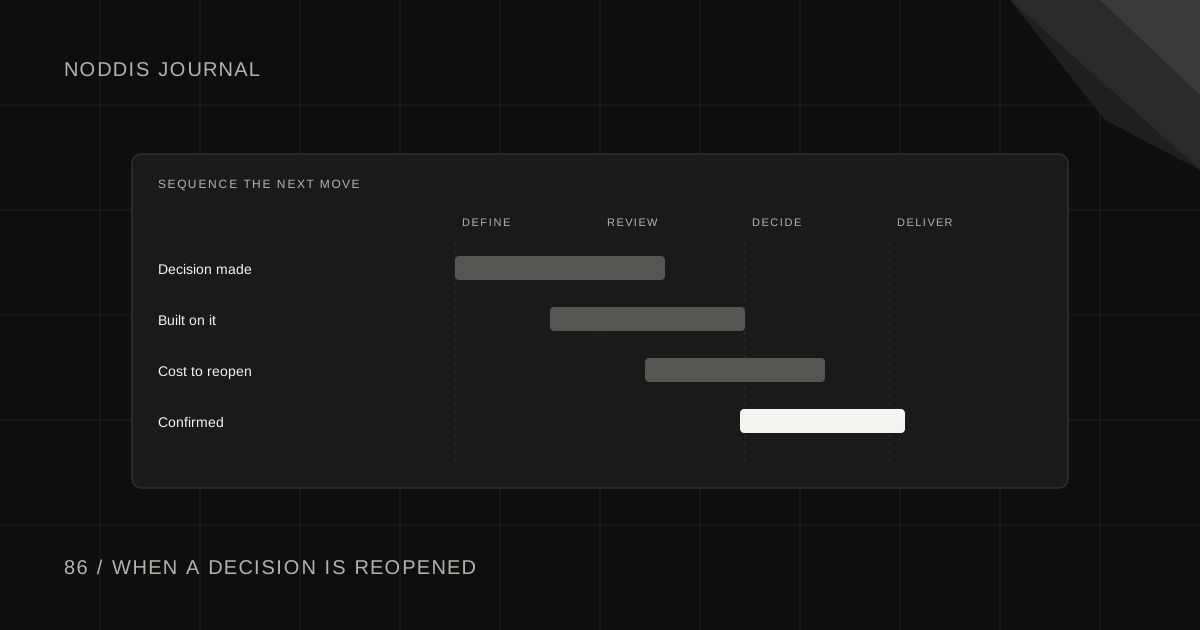
If a client keeps changing their mind, stop absorbing each reversal and start recording decisions. Write down every decision with its date and owner, show the cost of reopening one before you act on it, and ask for a real reaction earlier in the process. A reversal with a visible price becomes a choice instead of a surprise.
Why does a client keep changing their mind?
A client keeps changing their mind because they are seeing the real thing for the first time, and approval of a description is not approval of a result. Samuel Oladipupo makes the point on HackerNoon: "People cannot judge a description." A signed-off wireframe or outline tells you the client agreed with an idea. Their real opinion arrives with the working page.
Other causes are worth ruling out:
- A new voice joined. A partner or a manager saw the work late and disagreed.
- The goal was never fixed. Without an agreed measure of success, every option stays open.
- Changing was free. If reversals cost nothing, there is no reason to settle.
Each cause needs a different response. A new voice needs one named approver. A missing goal needs a short conversation. Free changes need a price.
How do you respond when a client reverses a decision?
Respond to a reversed decision by naming what was decided, what has been built on it and what reopening it costs. Then let the client choose. Do not argue for the old decision, and do not quietly rebuild.
Take a studio working with a client called Leo on a booking page. Leo approved a three-step booking form on October 14. Two weeks later, with the form built and connected to the calendar, he asks for a single-page form.
Subject: Booking form: change to an approved decision
Hi Leo,
On October 14 you approved the three-step booking form, and the calendar connection has been built on that version.
A single-page form is possible. It means rebuilding the form and the connection, which adds [time] and [cost] and moves launch from [date] to [new date].
Would you like me to make the change on those terms, or keep the approved form and review it after launch with real booking numbers?
Thanks,
[Your name]
The second option matters. It offers a way to test the idea later without paying for it twice.
What is a decision log and how does it help?
A decision log is a dated list of what the client decided, who decided it and what depends on it. The log helps because it replaces "I thought we agreed" with a record both sides can read.
| Date | Decision | Decided by | Built on it | Reopened? |
|---|---|---|---|---|
| Oct 7 | Navy and sand colour palette | Leo | All page designs | No |
| Oct 14 | Three-step booking form | Leo | Form, calendar connection | Asked Oct 28, kept |
| Oct 21 | Launch without a blog | Leo and Dana | Navigation, sitemap | No |
The "Built on it" column does the work. It turns an abstract reversal into a concrete list of things that would be redone, which is what makes the cost in your reply believable. For a ready-made version, use the client decision log template.
Send the log entry back to the client each time a decision is made. One line is enough: "Confirming today's decision: three-step booking form, approved by Leo."
Should you charge when a client changes their mind?
Charge when the change means redoing work that was built on an approved decision. Do not charge when the client is choosing between options you presented, or reacting to a first draft. That is what review rounds are for.
The line is approval. Before approval, a change of mind is feedback. After approval, a change of mind is a change to the agreement, and agreement changes belong in writing. Veronica Picciafuoco notes on A List Apart that "Some contracts even have a clause that requires all amendments to be in writing." The Freelancers Union's contract template takes the same position. Its change clause begins: "Any material changes to the Services, including work to be performed and related fees must be approved".
In practice, that means one short email per reversal, with the cost and the new date, and a reply that says "confirmed". The change request impact calculator helps with the numbers.
How do you prevent late changes of mind?
Prevent late changes of mind by getting a real reaction early and by narrowing who can decide. Three habits help:
- Show something real in week one. A rough working page draws out opinions that a document never will.
- Name one approver at kickoff. Other people can comment. One person decides.
- Offer two options, not five. Fewer options mean fewer versions to wonder about later.
When a late stakeholder is the cause, the guide to a new stakeholder after design sign-off covers what to reopen and what to hold.
How does Noddis show the effect of changed decisions?
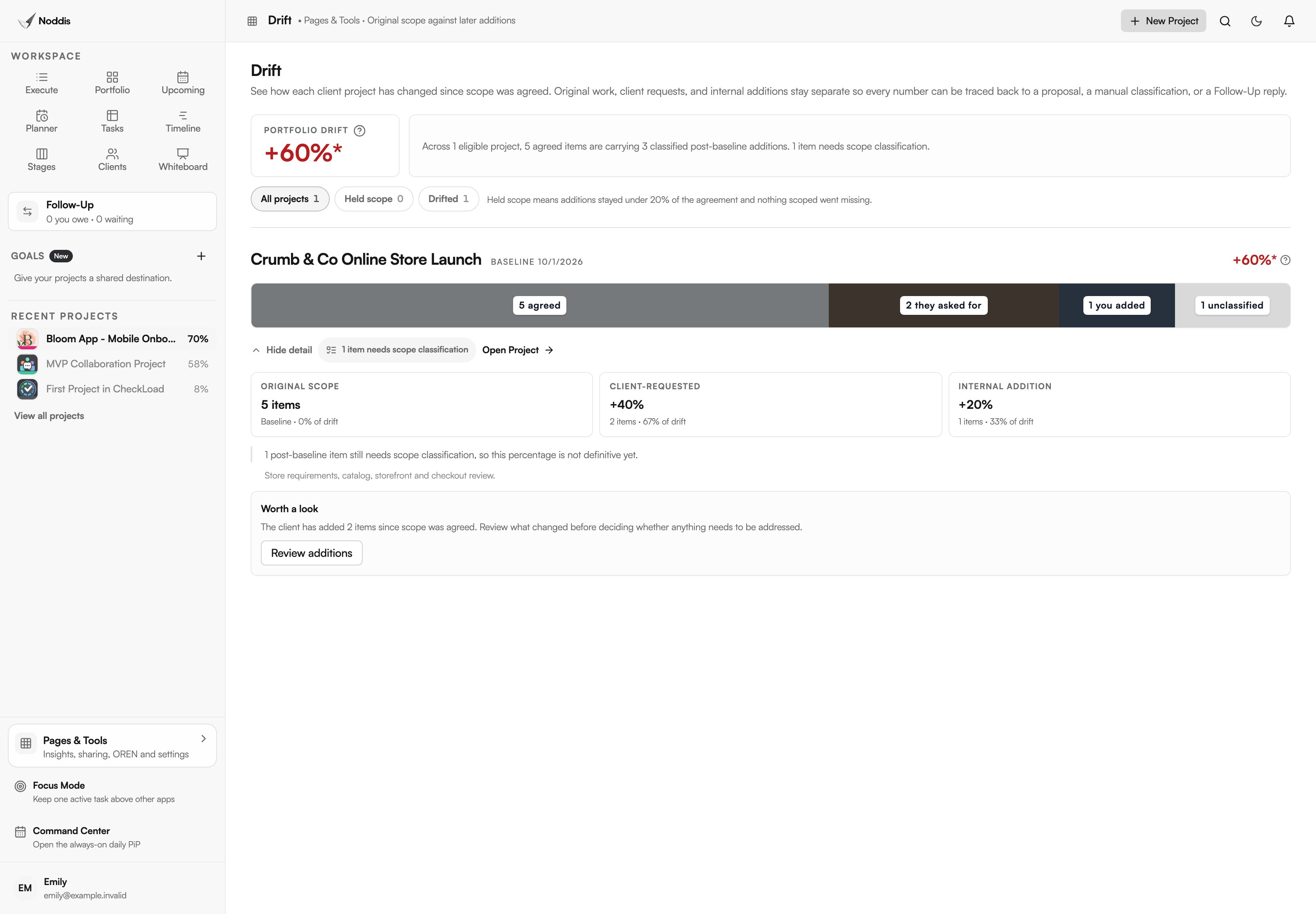
Noddis is a project management app that keeps tasks, follow-ups, and related project details connected. When we built Drift in Noddis, we made it compare the current task list with the agreed baseline and sort every addition as client-requested, internal or unclassified.
Set the baseline once the scope is approved. Each rebuild that comes from a reversed decision is added as client-requested work, so the project shows how far it has moved from the original plan. Drift counts items, not fees or hours. Drift works on one selected project on the Free plan and on every project on Pro.
The free client email templates for freelancers include a message for changes after approval, in a gentle and a firmer version.
Your next step
Start a decision log today with the three most recent decisions on your current project, and send the client a one-line confirmation of each. To measure your added work against a baseline, open the live demo.
Common questions
Is a client changing their mind the same as scope creep?
Not always. Scope creep adds new work to a project. A change of mind replaces work that was already agreed or built. Both move the project away from its plan, and both deserve a written change with a cost and a date, but a reversal also throws away finished work, which is why the decision log matters.
What if the client denies approving the earlier version?
Point to the written record, calmly, and move straight to options. Quote the date and the message where the approval was given. For a shared document, Google's help page on version history explains that "You can see changes that have been made to a document in Google Docs, Sheets, Slides, or Vids." If no record exists, treat this as the first clear decision and write it down now.
How many changes are too many?
There is no fixed number. The warning sign is direction: if each change reverses the previous one, the project is circling instead of improving. At that point, stop producing versions and ask for a short call to settle the goal and the approver. More work will not fix a decision that has not been made.

Katleen is the founder of Noddis. She runs client projects through her app studio, 693 Labs, and builds Noddis around the problems that work creates.
Last reviewed . Feature details reflect Noddis at the time of review.