
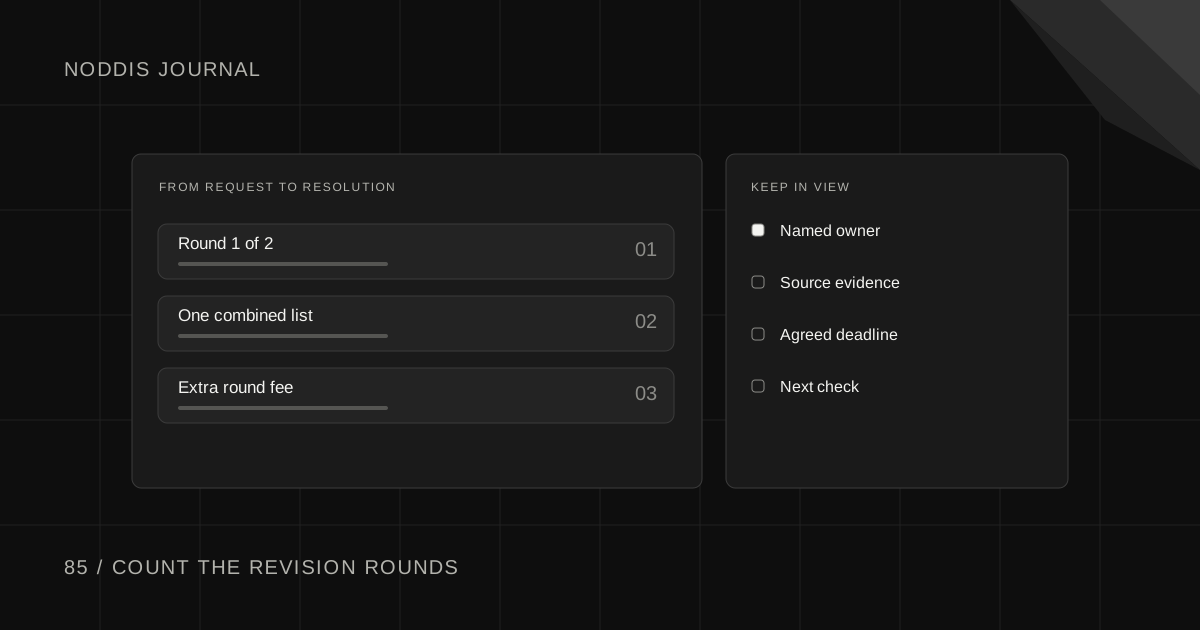
Short answer
If a client keeps asking for revisions, count the rounds out loud, ask for all feedback in one list, and price every round past the agreed number. Revision loops tend to have one of three causes: an unlimited offer, feedback that arrives in pieces, or a decision nobody on the client side has made yet.
Why does a client keep asking for revisions?
A client keeps asking for revisions when nothing in the process tells them to stop. Three causes are worth checking, and each has a different fix.
| Cause | What it looks like | Fix |
|---|---|---|
| No limit was agreed | "Can we try one more version?" for the sixth time | State the included rounds and the price of extra ones |
| Feedback arrives in pieces | Five emails from three people over two weeks | Ask for one combined list by one date |
| The decision is not made | Each version gets a different objection | Go back to the goal and ask who decides |
The third cause is the hardest to see. If each round reverses the last one, more versions will not help. The guide for a client who keeps changing their mind covers that case.
How many rounds of revisions should a freelancer include?
Two rounds of revisions is a reasonable default for fixed-fee work. Two rounds give the client one chance to react and one chance to refine, which is enough when feedback comes as a complete list.
The number matters less than writing it down. Ashlee Christian, writing on the Freelancers Union blog, recommends spelling out "How many rounds of revisions are included in the base fee and what constitutes a revision." Her example uses two rounds. The second half of that sentence is the part people skip: without a definition, a client can fairly treat every email as part of the same round.
A workable definition has three parts:
- One version. The round applies to a named version, such as homepage v2.
- One list. All reviewers send their changes together, through one person.
- One response. You make the changes and deliver the next version once.
The Freelancers Union's contract template leaves blanks for the number of included revisions and the deadline for requesting them, which shows what a written agreement should settle before work starts.
How do you tell a client they have used their revisions?
Tell a client they have used their revisions with a count, a price and a choice. Stay friendly. The message is not a refusal. It explains how more work gets added.
Take a studio, Juniper, working on a logo for a client. Two rounds were included and both are done. A third list arrives:
Subject: Logo revisions: round 3 and next steps
Hi [Name],
Thanks for the new notes. Our agreement includes two rounds of revisions, and round 2 was delivered on [Date].
I am glad to keep refining. A further round is [fee], and this list would take about [time].
Shall I go ahead on that basis, or would you prefer to pick the two changes that matter most?
Thanks,
[Your name]
If the client does not reply and sends more notes instead, use the firmer closing:
I will start on these as soon as you confirm the extra round in writing. Until then, version 2 stays as the current draft.
Counting only works if the client has seen the count before. Label every delivery from the start: "Here is version 1. This begins round 1 of 2."
How do you tell a revision from new work?
A revision changes how an agreed deliverable looks or reads. New work changes what the deliverable is. The test is the original brief: if the request could not have been predicted from it, it is new work.
- Revision: "Make the green darker." "Shorten the second paragraph." "Swap these two sections."
- New work: "Add a second logo for the app." "Write two more pages." "Can it also work as an animation?"
- Reopened approval: "I know I approved the layout, but can we go back to option A?"
Treat the third kind as new work as well, because everything built since the approval depends on it. When a note is too vague to sort, ask before you price it. Veronica Picciafuoco's plain-language contract rewrite on A List Apart gives the designer that right in one line: "Designer may request written clarification of any of Client's comments."
For requests that fall outside the brief, the guide to out-of-scope client requests has the options to offer.
How do you stop revision loops before they start?
Stop revision loops at kickoff, with three habits that cost nothing:
- Name one approver. Feedback from five people needs one person who combines it and decides.
- Give the review a date. A round that never closes cannot be counted. See the guide to client review windows.
- Use a form for changes. A revision request form makes the client state the version, the change and the reason in one place.
With those in place, the count is already in every delivery, so the price of round 3 is not a surprise.
How does Noddis help you count rounds and extra requests?
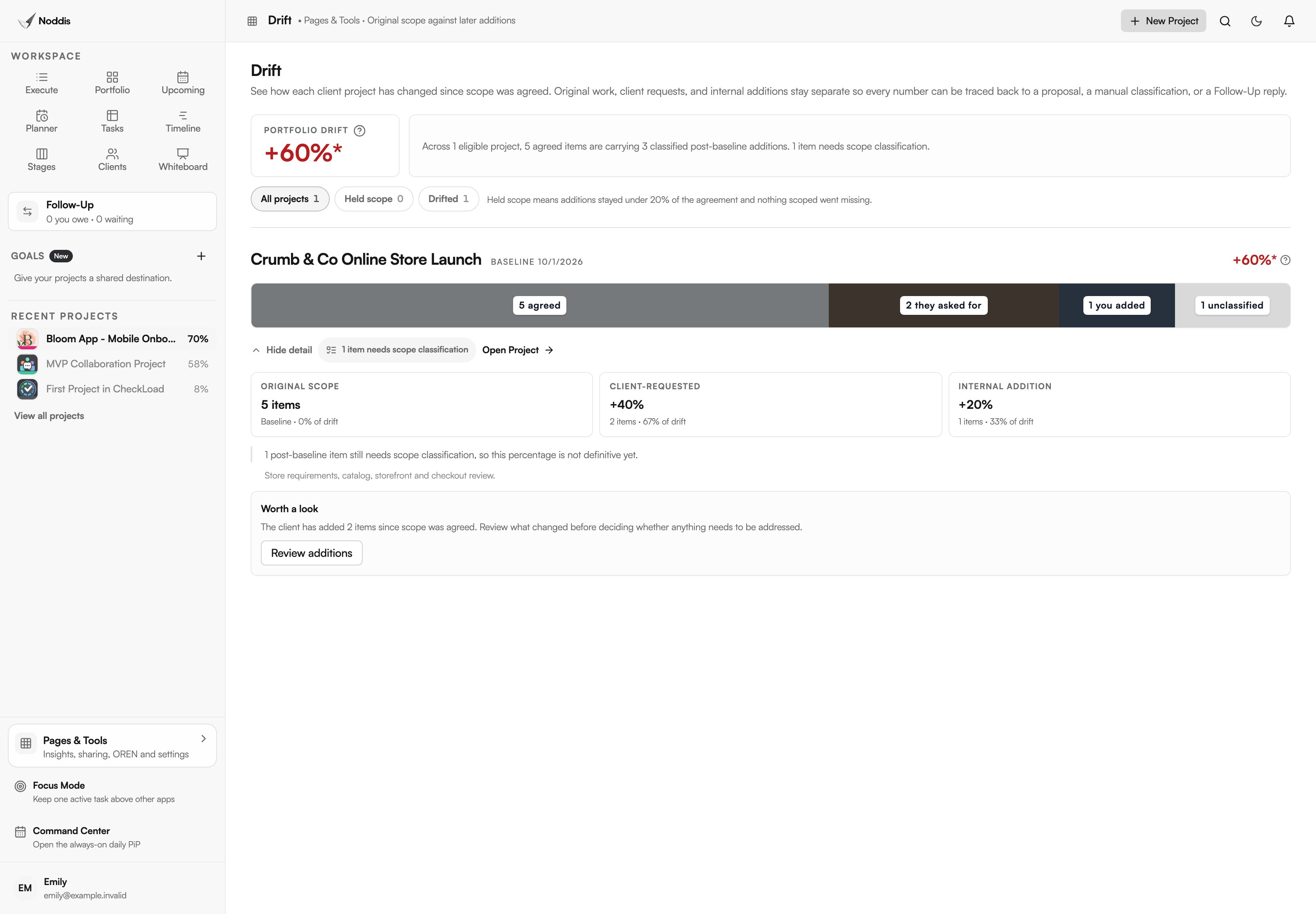
Noddis is a project management app that keeps tasks, follow-ups, and related project details connected. When we built Drift in Noddis, we made it compare the current task list with the agreed baseline and sort every addition as client-requested, internal or unclassified.
Set the baseline when the scope is agreed. Each extra round or new request you add afterward is marked client-requested, so the project shows how much work has been added since the start. Drift counts items, not fees or hours, so pricing the extra round stays your job. Drift works on one selected project on the Free plan and on every project on Pro.
The revision messages above also come in the free client email templates for freelancers, with a gentle and a firmer version of each.
Your next step
Add "round 1 of 2" to your next delivery email, and write your definition of a round into your proposal template. To count your added work against a baseline, open the live demo.
Common questions
Can I charge for revisions if my contract does not mention them?
You can propose a charge, but you cannot assume one. If the agreement says nothing about revisions, explain how many rounds you have done, state what further rounds cost and get a written yes before you continue. Then fix the gap in your next contract. New York City's guidance for freelance workers says "The written contract must spell out the work you will perform; the pay for the work; and the date you get paid."
What if the client says the work is still not right?
Ask what "right" means before you make another version. Go back to the goal in the brief and ask the client to name what the current version fails to do. If the answer is clear, one targeted round can fix it. If the answer keeps changing, the brief is the problem, and it needs a conversation.
Should I offer unlimited revisions to win the project?
No. Unlimited revisions remove the reason for a client to gather feedback or decide, and they make your fee impossible to predict. If a client is nervous, offer something specific instead: an extra round at a fixed price, or a short review call before each round to make sure the list is complete.

Katleen is the founder of Noddis. She runs client projects through her app studio, 693 Labs, and builds Noddis around the problems that work creates.
Last reviewed . Feature details reflect Noddis at the time of review.