
Short answer
If you are asking how long does an architect have to respond to an RFI, the honest answer is: as long as your contract says. Look in the general conditions, the supplementary conditions and Division 01 of the specifications. Where they are silent, standard wording asks for reasonable promptness and names no number of days.
Free resource
Download the RFI log. The file is a blank CSV for Excel or Google Sheets, with one row per RFI and columns for the question, who holds it now, the answer-needed-by date, the work it blocks and any cost or time impact. One example row shows how to fill it in. No account is required.
How long does an architect have to respond to an RFI?
An architect has to respond to an RFI within the period your contract documents set, and many set none. A request for information (RFI) is the contractor's written question about what the drawings or specifications require.
Kevin O'Beirne, a professional engineer writing on the Construction Specifications Institute's blog, says: "Standard contract documents in widespread use in the United States require that RFI responses be issued, 'promptly', but do not stipulate a maximum time limit." He cites Section 4.2.11 of AIA Document A201-2017, a widely used set of general conditions: "The Architect's response to such requests will be made in writing within any time limits agreed upon or otherwise with reasonable promptness."
In the A201 wording, an agreed time limit comes first. Without one, reasonable promptness is a judgment, not a date. A fixed number of days quoted online as the rule comes from somebody else's project.
Where does your contract set the RFI response time?
Your contract sets the RFI response time in one of four places. Check them in this order: a later document often changes an earlier one.
| Where to look | What to look for |
|---|---|
| General conditions | The article on the architect's administration of the contract |
| Supplementary conditions | An edit to that article that inserts a number of days |
| Division 01 of the specifications | Often the project management and coordination section, under "Architect's action" |
| Preconstruction meeting minutes | An agreed RFI procedure with a response period |
Owners often write their own number into Division 01. Caltech's Division One specifications for its own building projects, in the January 2021 edition, tell contractors: "Allow seven (7) working days for Architect's response for each RFI, with an additional 7 days for Owner response." That is one owner's rule for that owner's jobs. Yours may be shorter, longer or missing.
The same Caltech section restarts the architect's time whenever the architect asks for more information, and it returns some RFIs without action, such as requests to approve a submittal. Those belong in a submittal log.
What do you do when the contract is silent?
When the contract is silent on RFI response time, put a date on every RFI yourself and get a standing period agreed at the preconstruction meeting, in the minutes.
- Send it early. O'Beirne's rule for the contractor's side: "RFIs should be submitted as promptly as possible after the apparent conflict, ambiguity, or discrepancy is discovered." A question that sat in the truck for a week weakens any complaint about a slow answer.
- Date every RFI. State the day you need the answer and the work that stops without it. A dimension check deserves less time than a structural redesign.
- Offer the answer. Add your proposed solution and a sketch, so the architect can reply "confirmed".
- Keep it in writing. O'Beirne is blunt: "Regardless, RFIs and associated interpretations and clarifications should never be oral." An answer given in the parking lot gets a confirming RFI the same day.
How do you run an RFI from question to answer?
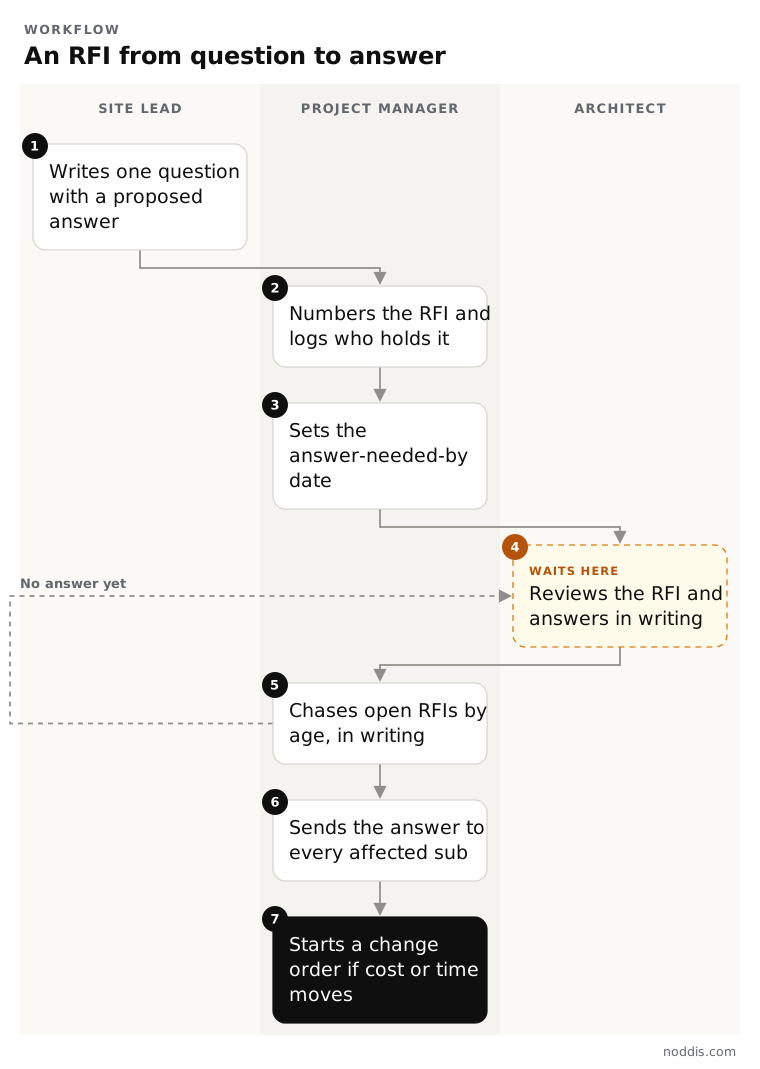
Run every RFI through the same seven steps, so each question has one number, one holder and one date. In a small firm the site lead and the project manager are often one person.
- The site lead writes one question, with the sheet or spec reference, a photo and a proposed answer.
- The project manager numbers and logs it, with the date sent and who holds it now.
- The project manager sets the answer-needed-by date from the contract's response period and the start of the work the question blocks.
- The architect reviews and answers in writing. The RFI waits here, sometimes with the architect's engineer.
- The project manager chases open RFIs by age: weekly, oldest first, in writing.
- The project manager sends the answer to every affected sub the same day.
- The project manager starts a change order if the answer changes cost or time.
What do you send when an RFI answer is late?
When an RFI passes its answer-needed-by date, send a short written follow-up that names the RFI, the date it was sent, the work it blocks and the day that work starts.
Subject: RFI [number], [project]: answer needed by [date]
Hi [Name],
RFI [number] ([one-line question]) was sent on [date sent] and is still open. It holds up [work], which starts on [start date].
Our proposed answer is in the RFI. Can you confirm it, or tell me today when to expect a response and what else you need from us?
Thanks,
[Your name]
Some answers do not answer, such as "contractor to coordinate". Reply on the same RFI number, say what is still unresolved and ask for a yes or a no on your proposed answer.
If the wait delays the job, say so in writing and read your contract's notice clause now: notice clauses carry their own deadlines. Ask a construction attorney when real money is at stake.
How does Noddis track open RFIs and the work they block?
Noddis is a project management app that keeps tasks, follow-ups, and related project details connected. When we built Timeline in Noddis, we drew each task as a bar from its start date to its due date and marked the project's due date with a flag.
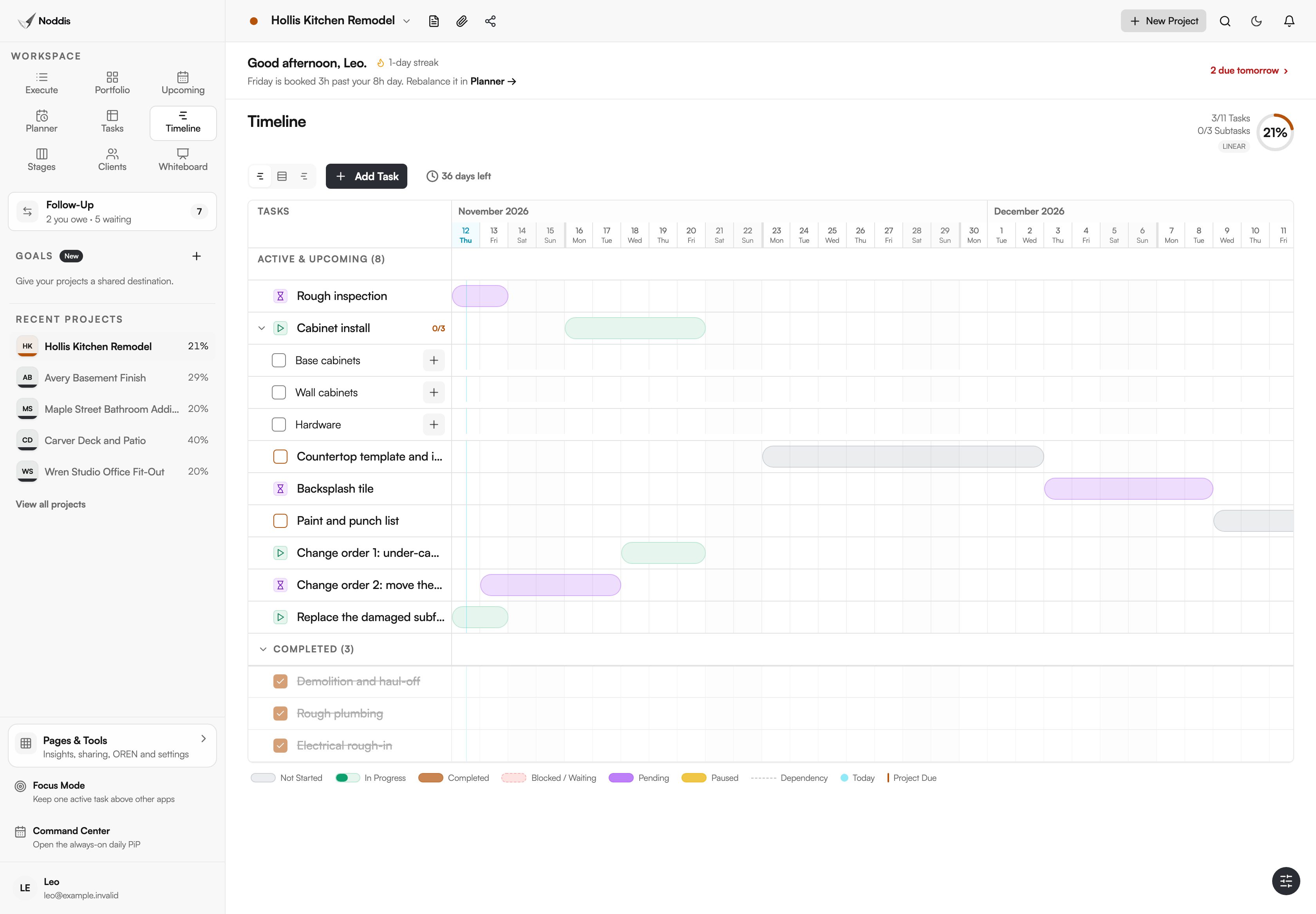
Each open RFI becomes a Waiting on Others item in Follow-Up, on the task it blocks, with its age in days: the sort in step 5. As of November 2026, Follow-Up is free for one project and covers every project on Pro. Timeline, on Pro, shows the blocked task as a bar, so its start date stays in view. It does not link tasks or move dates for you.
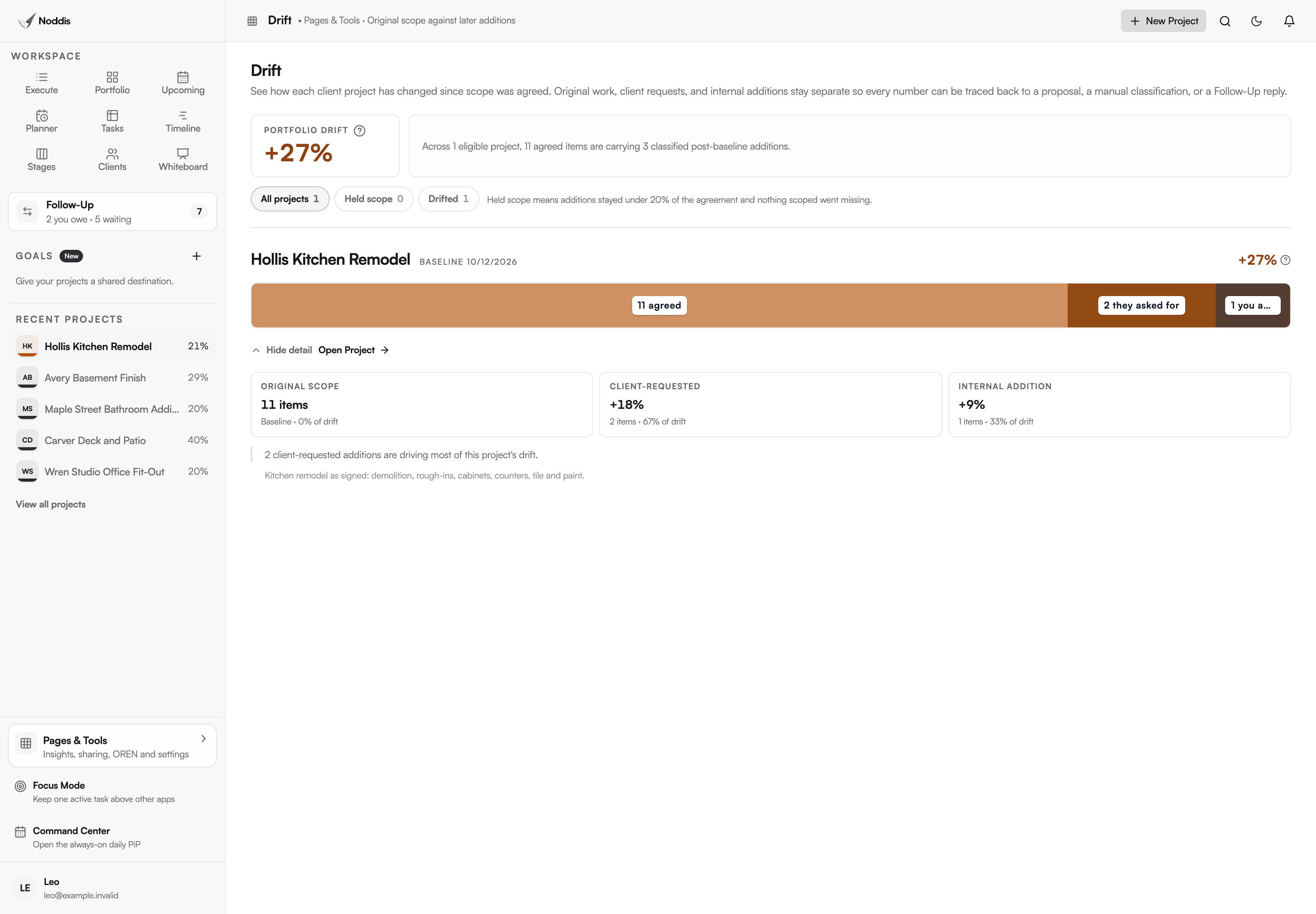
When an answer adds work, add it as a task, and Drift shows it against the job's agreed baseline. Drift counts items, not dollars or hours, so prices stay in your change order log. The RFI form, drawings, markups, stamps, money and signatures stay in the tools built for them. The workflow for contractors walks through the screens.
Your next step
Open your contract today, find the RFI response period and write it at the top of your RFI log. To list your own open questions with their age in days, open the live demo. No account is needed.
Common questions
Can you keep working while an RFI is open?
Keep working only on what the question does not touch. O'Beirne notes that widely used general conditions require the contractor to get the interpretation before doing the affected work, except in an emergency. Build around the open item and tell the architect in writing which activity stops and when.
Is an RFI response the same as a change order?
No. An RFI response explains what the contract documents already require. It does not change the price or the completion date. If you believe the answer adds work, tell the architect and the owner in writing before you build it, and price it as a change order.
Should a subcontractor send an RFI straight to the architect?
No. A subcontractor's question goes to the general contractor, who checks it against the documents, numbers it and sends it on. Specifications often say the architect will return RFIs that come from anyone else. Trade contractors should ask for the RFI number so they can follow it.

Katleen is the founder of Noddis. She runs client projects through her app studio, 693 Labs, and builds Noddis around the problems that work creates.
Last reviewed . Feature details reflect Noddis at the time of review.