
Short answer
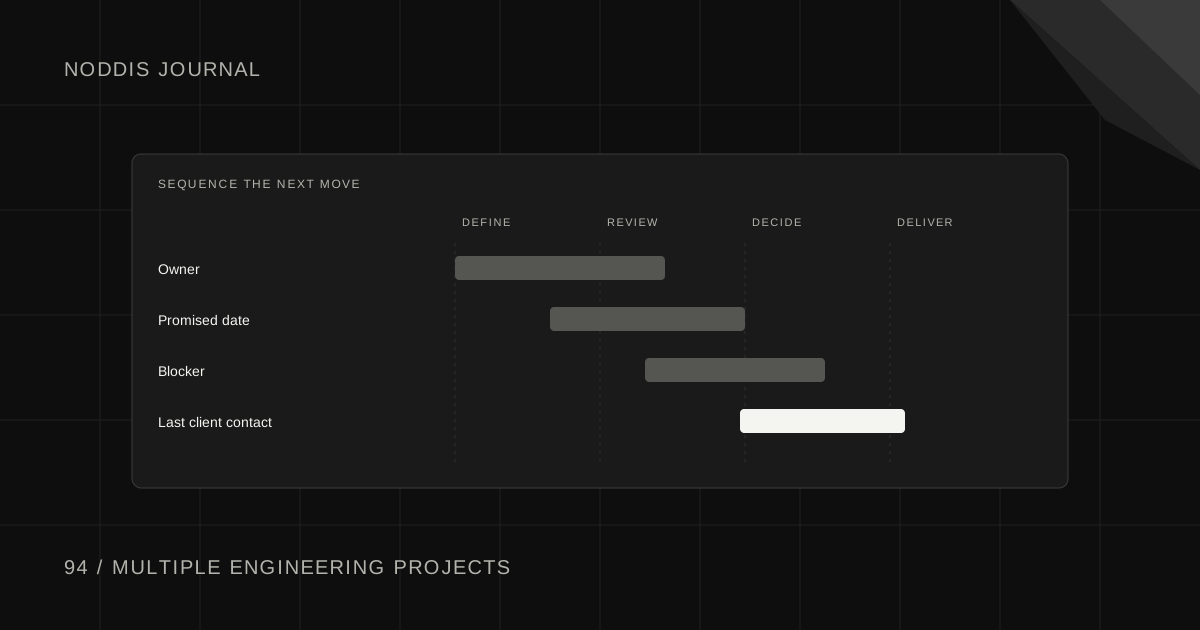
To manage multiple engineering projects at once, stop running a full plan for every job and keep one line per project with five facts: the owner, the promised date, the next milestone, what is blocking it and when you last spoke to the client. Then check each week which projects peak together, and move a date before the collision happens.
Why do engineering project managers lose track of projects?
Engineering project managers lose track because the number of projects grows faster than the method for watching them. In a small firm the project manager is often the lead engineer too, and nearly every open job is waiting on someone outside the firm.
The question comes up often. In a 2026 thread in the r/projectmanagement community titled "Managing many small jobs", a manager with 30 to 40 short integration jobs asked how to keep up without the per-project trackers and weekly meetings that had worked on large projects. One of the most upvoted replies was to drop the full process for small jobs and keep one shared board with one row per job.
That advice fits a small engineering firm as well. A detailed plan per project does not scale to twenty projects. A single list does.
How do you manage multiple engineering projects on one list?
Manage multiple engineering projects on one list by tracking the same five facts for every project, and nothing else. The detail lives inside each project. The list exists so you can find the two projects that need you today.
| Field | What it answers | Example |
|---|---|---|
| Owner | Who inside the firm moves this next? | Theo |
| Promised date | What did we tell the client? | Nov 24 |
| Next milestone | What is the next deliverable or decision? | 60 percent drawings to the county |
| Blocker | What are we waiting on, and from whom? | Survey data from the subconsultant |
| Last client contact | When did the client last hear from us? | Nov 6 |
The fifth field is the one people skip. A project with no client contact in three weeks is at risk even if the work is on schedule, because the client does not know that.
Sort the list by promised date, not by client. The order then matches the order of your week.
How do you stop two projects from peaking in the same week?
Stop two projects from peaking together by putting every project's major milestones on one calendar and looking for stacked weeks. A deadline is one day. The peak is the two weeks of drafting, checking and quality review before it.
Project management trainer Mike Clayton says in an American Society of Mechanical Engineers article on handling several projects: "You can't have two projects at critical points at the same time." The same article recommends a chart for each project, with major activities and milestones as bars, so you can see how projects interact.
When two peaks overlap, you have three moves:
- Pull one forward. Finish the smaller submittal a week early.
- Ask for a date. A client with a soft deadline may give a week if you ask in advance.
- Shift the people. Move checking or drafting to someone whose peak is elsewhere.
All three work two weeks ahead. None of them works two days ahead.
How do you track what you are waiting on?
Track what you are waiting on as a separate list from your task list, because waiting items need a different action. A task you do. A waiting item you follow up.
On an engineering project the waits are predictable: client review comments, an approval from a public agency, survey or geotechnical data, a subconsultant's drawings, a utility's response. Record each one with three facts:
- What you asked for, in a few words.
- Who owes it, by name or agency.
- The date you asked, and the date you were promised.
Then count the days. "The county has had the drainage report for 23 days" starts a different conversation from "we are waiting on the county". When a wait threatens a promised date, tell the client that week. The guide to tracking blocked project tasks covers how to triage them.
Changes to the work need the same discipline. Writing in STRUCTURE magazine, engineer Stan R. Caldwell notes that for extra services "additional compensation is almost never offered except in direct response to a clearly stated request". When a client's review turns into new design options, record it as added scope before you start. See scope creep in engineering projects.
What does a weekly review of every project look like?
A weekly review of every project is 30 minutes with the one-line list, done at the same time each week. For each project, ask four questions and write down one action:
- Is the promised date still true?
- What is the next milestone, and who has it?
- What are we waiting on, and for how many days?
- When did the client last hear from us?
A project that needs more than a minute gets a separate conversation after the review. The point of the 30 minutes is to touch every project, including the quiet ones. The weekly review template has a worksheet you can adapt.
How does Noddis help you see every project at once?
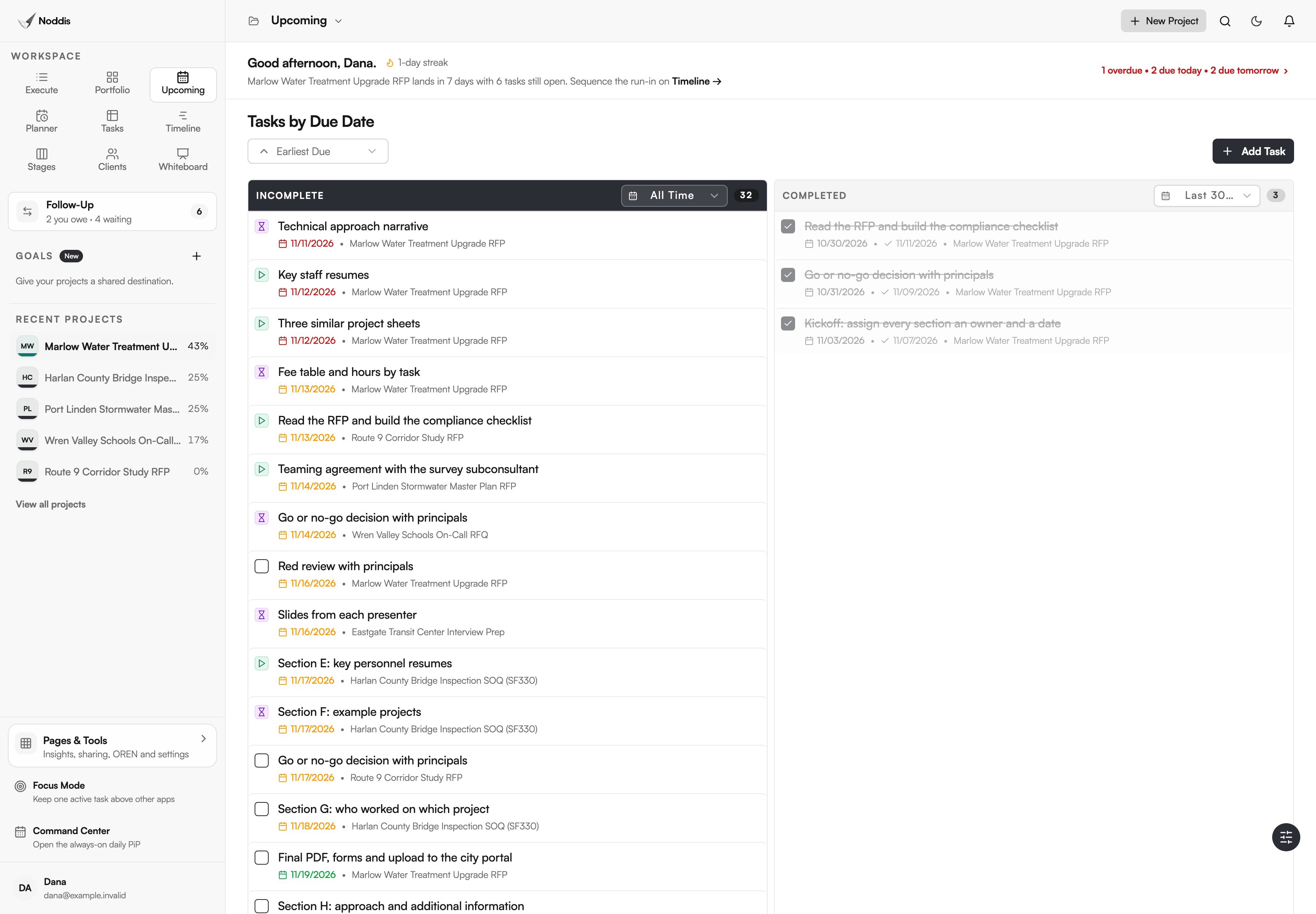
Noddis is a project management app that keeps tasks, follow-ups, and related project details connected. When we built Portfolio in Noddis, we put every active project and its progress in one view, so a weekly review can start from one screen instead of one tab per client.
Portfolio is the one-line list with progress and due dates on each project. Upcoming lists dated work across all of them, and Follow-Up holds what you are waiting on with its age in days. Noddis coordinates the work around a project. It does not replace design software, document control or project accounting. Portfolio and Upcoming are part of the Free plan, which includes three active projects.
Your next step
Write the five facts for every open project in one list today, and sort it by promised date. To try this with your own current projects, open the live demo.
Common questions
How many projects can one engineering project manager handle?
It depends on project size and how much the manager also designs. A better signal than the count is whether you can touch every project once a week. If the weekly review no longer fits in an hour, or clients are hearing from you only when something is late, the load is too high or the method needs to be simpler.
Is a spreadsheet enough to manage multiple engineering projects?
For the one-line list, yes. A spreadsheet works well for five fields per project. It works less well for the waiting list, because it cannot count days or remind you, and for seeing which projects peak together. A common setup is a spreadsheet for the list and a separate calendar for milestones.
How do you prioritize when everything is due at once?
Rank by what is promised to a client and cannot move, then by what unblocks other people, then by everything else. Tell the clients at the bottom of the list this week, with a new date. A late notice given early costs far less than a missed date discovered by the client.

Katleen is the founder of Noddis. She runs client projects through her app studio, 693 Labs, and builds Noddis around the problems that work creates.
Last reviewed . Feature details reflect Noddis at the time of review.