
Short answer
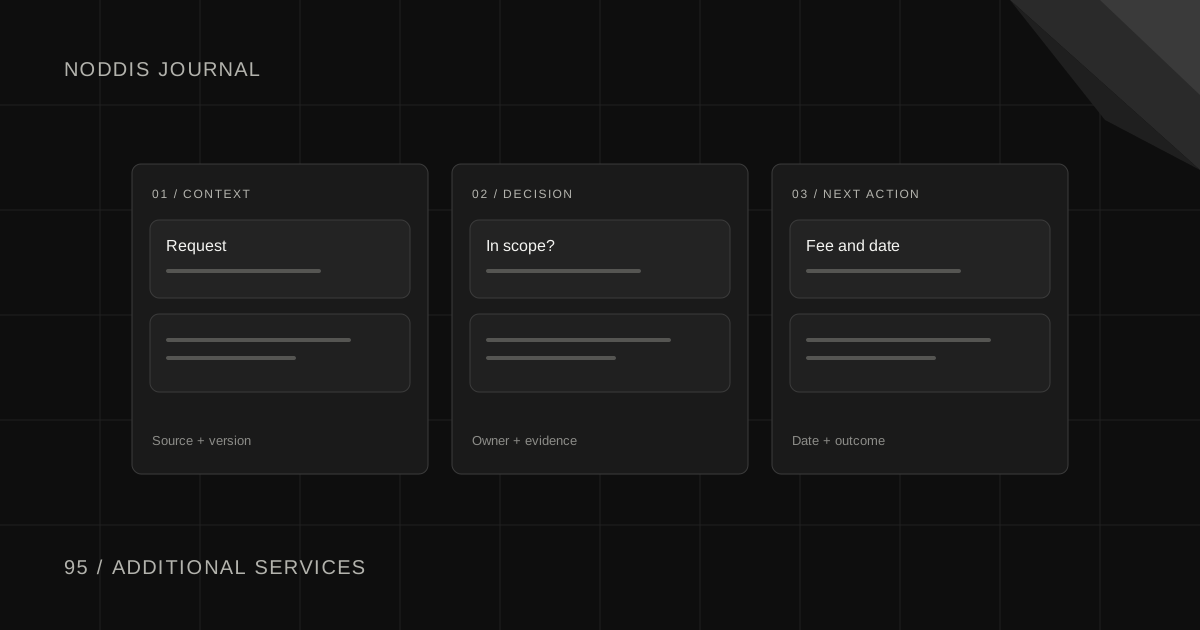
Scope creep in engineering projects is work the client asks for after the fee was agreed, done without a change to that fee. The remedy is the same every time: check the request against the written scope, tell the client before you start that it is an additional service, state the fee and the schedule effect, and get agreement in writing.
What does scope creep look like in engineering projects?
Scope creep in engineering projects rarely arrives as a new project. It arrives as a reasonable request in a meeting. The common forms are easy to recognize once you list them:
- Extra options. A third layout after two were agreed.
- Redesign after a client change. The owner moves a wall, and the structure follows.
- More meetings and site visits than the proposal counted.
- Additional review rounds with an agency or a peer reviewer.
- Extended construction administration when the build runs long.
- Value engineering after the design was complete.
Each is small alone. Together they can equal a second project that nobody priced.
Why do engineers so rarely get paid for extra work?
Engineers rarely get paid for extra work because they do it first and raise it later, if at all. By then the client has the deliverable and no reason to revisit the fee.
Stan R. Caldwell, a structural engineer writing in STRUCTURE magazine, describes the pattern: "additional compensation is almost never offered except in direct response to a clearly stated request". His advice for engineers is that "they must have the discipline to secure an agreement for appropriate additional compensation before providing any special or extra services."
The order matters. A request made before the work is a business conversation. A request made after it is an awkward invoice.
How do you tell additional services from a clarification?
Tell additional services from a clarification by reading the request against three parts of the agreement: the scope, the assumptions and the exclusions. A clarification completes something you already promised. An additional service adds something you did not.
| The client asks for | Check | It is probably |
|---|---|---|
| A detail the drawings need to be buildable | Scope: complete construction documents | A clarification, at no added fee |
| A third layout option | Assumptions: two options included | An additional service |
| Redesign after the owner changed the program | Assumptions: program fixed at kickoff | An additional service |
| Two more agency review rounds | Assumptions: one round of comments | An additional service |
| Attendance at weekly site meetings | Exclusions: construction phase limited to four visits | An additional service |
When the agreement is silent, the request is a negotiation, not an entitlement. Say so plainly and propose a fair split. Then add the missing assumption to your next proposal. The project scope baseline template shows how to write assumptions and exclusions.
How do you ask a client for an additional services fee?
Ask for an additional services fee in a short written message on the day of the request. Name the request, say why it falls outside the agreement, and give the fee and the schedule effect. Then offer a choice.
Subject: Additional service: third layout option for [Project]
Hi [Name],
In Tuesday's meeting you asked for a third layout option for the east parking area. Our agreement includes two options, and both were delivered on [Date].
We can prepare a third. It would be an additional service of [fee], and it moves the 60 percent submittal from [date] to [date].
Would you like us to proceed on that basis, or continue with option B as planned? A reply to this email is enough to authorize it.
Thanks,
[Your name]
Three details make this work. The message refers to the agreement, not to effort. The fee and the date come together, since the date can matter more to a client than the fee. The client keeps a real choice, including the choice to drop the request.
Do not start until you have the reply. For the wording of other change situations, see how to handle out-of-scope client requests.
What should the record of a scope change show?
The record of a scope change should let someone who was not in the meeting understand what was asked, what was decided and who decided it. Keep one log per project.
| Date | Request | Asked by | In scope? | Fee | Schedule effect | Decision | Authorized by |
|---|---|---|---|---|---|---|---|
| Nov 3 | Third parking layout | Owner's rep | No, two options included | [fee] | 60 percent moves 5 days | Proceed | Owner's rep, by email Nov 4 |
| Nov 10 | Curb detail at entry | Contractor | Yes, clarification | None | None | Issue sketch | Project manager |
| Nov 12 | Second agency resubmittal | Agency | No, one round assumed | [fee] | Permit set moves 10 days | Pending | Waiting on owner |
The example is made up. The row marked pending is the one to watch, because work on it should not have started. The scope change log template has a blank version.
On federal contracts the vocabulary is formal. The Federal Acquisition Regulation defines a change order as "a written order, signed by the contracting officer, directing the contractor to make a change". Private work has no contracting officer, but the idea carries over: a change exists when it is written and authorized.
How does Noddis show added scope on a project?
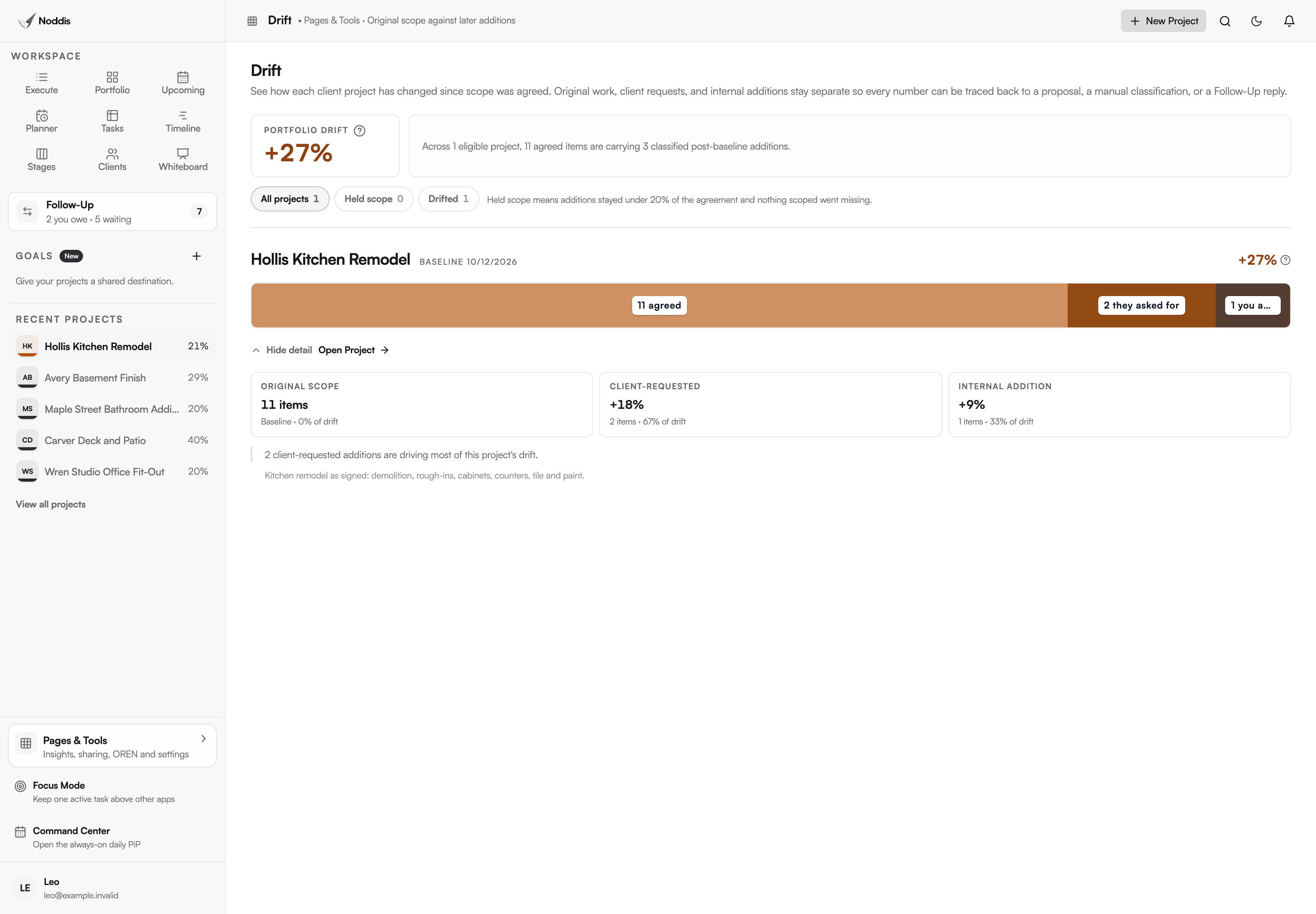
Noddis is a project management app that keeps tasks, follow-ups, and related project details connected. When we built Drift in Noddis, we made it compare the current task list with the agreed baseline and sort every addition as client-requested, internal or unclassified.
Set the baseline when the agreement is signed. Each additional service you add afterward is marked client-requested, so the project shows how much work has been added since kickoff and which additions still need a decision. Drift counts items, not fees or hours, so the pricing stays in your own records. Drift works on one selected project on the Free plan and on every project on Pro.
Your next step
Open your current agreement, list its assumptions and exclusions on one page, and log the last three requests against them. To measure your added work against a baseline, open the live demo.
Common questions
Should additional services be billed hourly or as a fixed fee?
Use a fixed fee when the extra work is well defined, such as one more layout or one more review round, because the client can approve a number. Use hourly rates with a stated limit when the extent is unknown, such as support during an extended construction period. In both cases, get the authorization before the work starts.
What if the client says the work is already included?
Go back to the document together. Point to the scope, the assumptions and the exclusions, and ask the client to show where the request appears. If the agreement supports them, do the work. If it is ambiguous, propose a split and tighten the wording in your next proposal. Keep the tone factual, since the goal is a decision.
Should small requests be done for free?
Sometimes, and visibly. A small courtesy can be worth more than its fee. Record it in the log as "no charge, courtesy" and mention it in your next update, so the client knows it was outside the agreement. Courtesies that are never mentioned become the baseline for the next request.

Katleen is the founder of Noddis. She runs client projects through her app studio, 693 Labs, and builds Noddis around the problems that work creates.
Last reviewed . Feature details reflect Noddis at the time of review.