
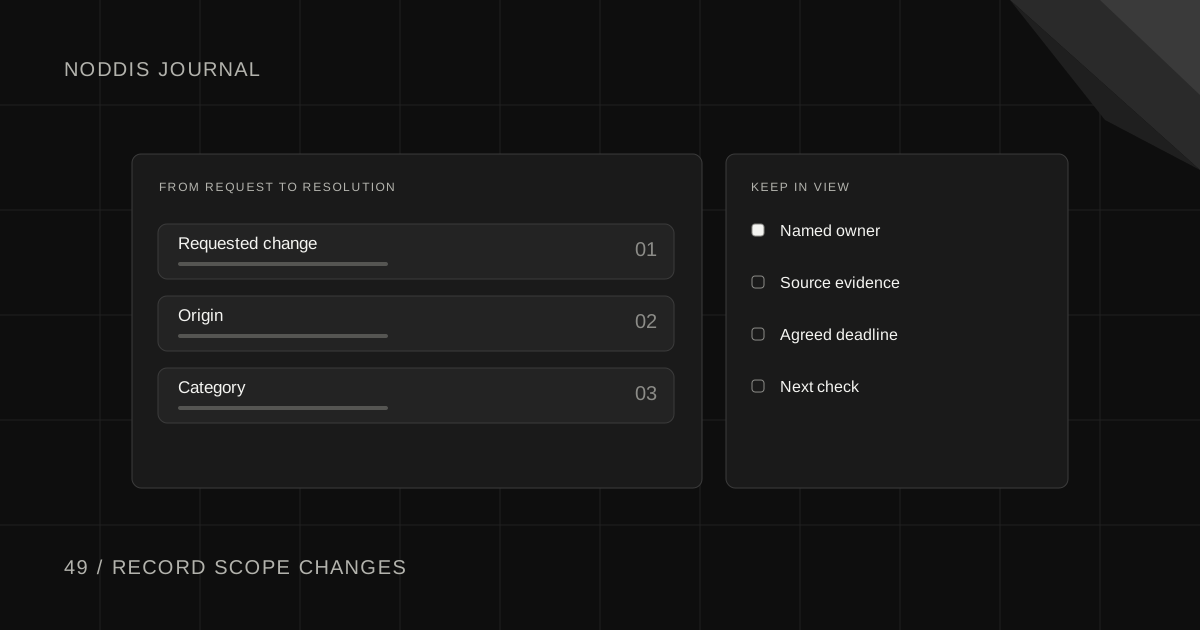
Short answer
A scope change log is a record of requests that may alter a project's agreed deliverables, cost, or schedule. Record each request before starting it, assess the effect, and capture an explicit approval or rejection. A useful scope change log gives both the client and the service provider a shared history of what changed and why.
Free resource
Download the blank scope change log spreadsheet. No account is required. Save a copy before adding your project details.
What belongs in a scope change log?
Every change record needs a unique ID, request description, origin, classification, estimated impact, decision-maker, decision, and the date it was agreed. Store links to the relevant estimate and written approval. For small projects, one spreadsheet is often sufficient.
The Project Management Institute's scope change control guidance emphasizes first defining scope, then evaluating and approving changes before including them in the project. You do not need enterprise bureaucracy to apply that idea to a freelancer's website or branding project.
Copyable scope change log template
The fictional example below involves Juniper, a small business commissioning a website redesign. The values are illustrative estimates, not Noddis customer results.
| ID | Requested change | Category | Effort | Fee impact | Schedule impact | Decision |
|---|---|---|---|---|---|---|
| CR-01 | Add an FAQ page | New deliverable | 6 hours | +$600 | +2 working days | Awaiting approval |
| CR-02 | Correct an outdated address | Agreed correction | 0.5 hour | Included | None | Approved |
| CR-03 | Add appointment integration | New feature | Needs estimate | TBD | TBD | Clarification |
| CR-04 | Swap stock image for approved photo | Included revision | 1 hour | Included | None | Approved |
Use a separate implementation status column if you also want to track whether an approved change is complete. Approval and completion are different events. An unapproved request should not become a scheduled work item merely because someone entered it into the log.
How do you decide whether something is a change?
Compare the request against the project baseline: the documented deliverables, exclusions, accepted design direction, and revision allowance. A new output may be outside scope, while correcting work that fails an agreed requirement may be included. This depends on the actual agreement and is not decided by how small the client says the request is.
Use four categories:
- Correction: Existing work does not meet an agreed requirement.
- Included revision: A requested adjustment fits an agreed review allowance.
- Potential change: The request adds or alters an outcome, or uses more review rounds than agreed.
- Clarification: The request cannot be estimated until the intended outcome is defined.
A potential change requires a decision, not an automatic “no.” The guide to handling out-of-scope requests provides language for discussing those options with clients.
How do you calculate a change's impact?
Calculate the effort needed to design, produce, review, revise, and release the added work. Consider whether the change interrupts a dependent task or pushes a milestone. Estimate new fees using the pricing agreement, not an arbitrary charge added after completion.
For CR-01 above, assume a fictional agreement charges $100 per additional production hour. Six hours would add $600 before any separate expenses. If those hours cannot fit into existing capacity, the launch could move by two working days. That is an example of a transparent negotiation, not a claim that all added pages cost $600 or delay projects by two days.
Present options when possible: accept the additional fee and timeline, swap the new work for something of comparable effort, or defer it to a later phase. The client should be able to choose knowingly.
What does approval look like?
Approval identifies the exact request and estimate, the person authorized to agree, and the effect on deliverables and dates. Save a written decision and link it in the log. For material contractual changes, use the amendment or change-order process required by the agreement.
A simple response might be:
Adding the FAQ page is a change to the original scope. The estimate is six hours, an additional $600, and a proposed two-working-day shift to final review. Would you like us to proceed under those terms or include the page in a later phase? We will hold the request until you confirm.
Avoid reclassifying an unanswered request as approved. If an executive or legal review is required, a casual chat acknowledgment may not be sufficient authorization.
How do you maintain the baseline after a change?
Preserve version one of the scope agreement and append approved changes, rather than rewriting history. The PMI discussion of baseline control describes why recording baseline changes makes performance comparisons meaningful. For a small client project, the same principle is simpler: you should be able to answer what was originally promised and which additions were later authorized.
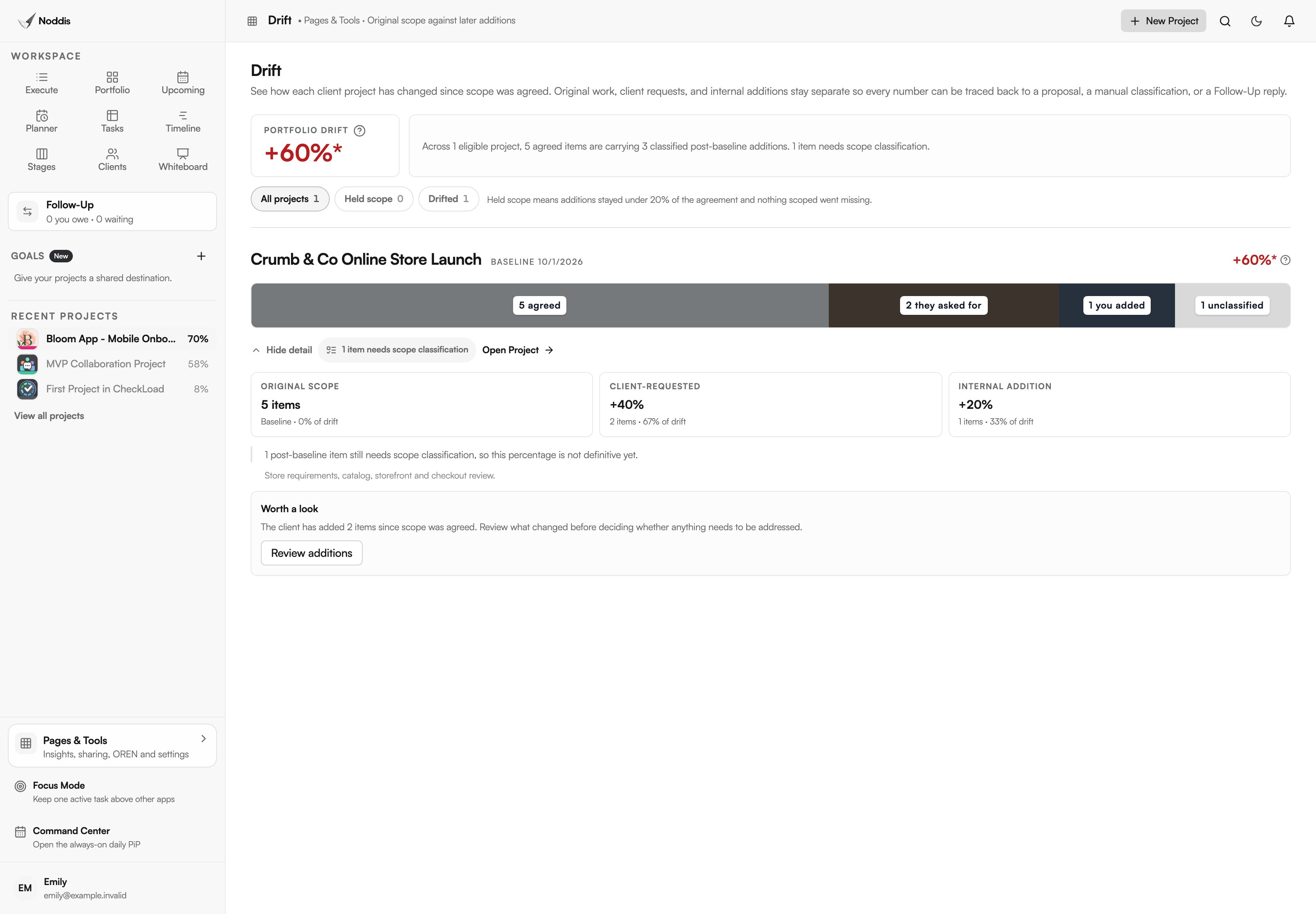
Noddis is a project management app that keeps client projects and their work connected. Its Drift feature measures scope growth against a baseline, helping make additions visible. This log provides the approval and commercial context that a scope-growth measure cannot decide for you. Connect it to the client project tracker and try the Noddis demo.
Your next step
Create one change log for an active engagement. Record the next request before estimating or assigning it. That single boundary can make subsequent scope discussions more precise.
Common questions
Should I log requests that were rejected?
Yes. Rejected and deferred requests explain why something was not delivered and may become relevant later. Mark the decision clearly instead of deleting the row.
How often should a scope change log be reviewed?
Review it whenever a new request arrives and before any milestone affected by open changes. In a busy project, include outstanding items in the weekly review. Waiting until the final invoice is too late to clarify expectations.
Is a scope change log legally binding?
A log is an operational record. Whether an entry modifies a contract depends on your agreement and applicable law. Use the required approval or amendment process and seek appropriate professional advice for contractual disputes.

Katleen is the founder of Noddis. She runs client projects through her app studio, 693 Labs, and builds Noddis around the problems that work creates.
Last reviewed . Feature details reflect Noddis at the time of review.