
Short answer
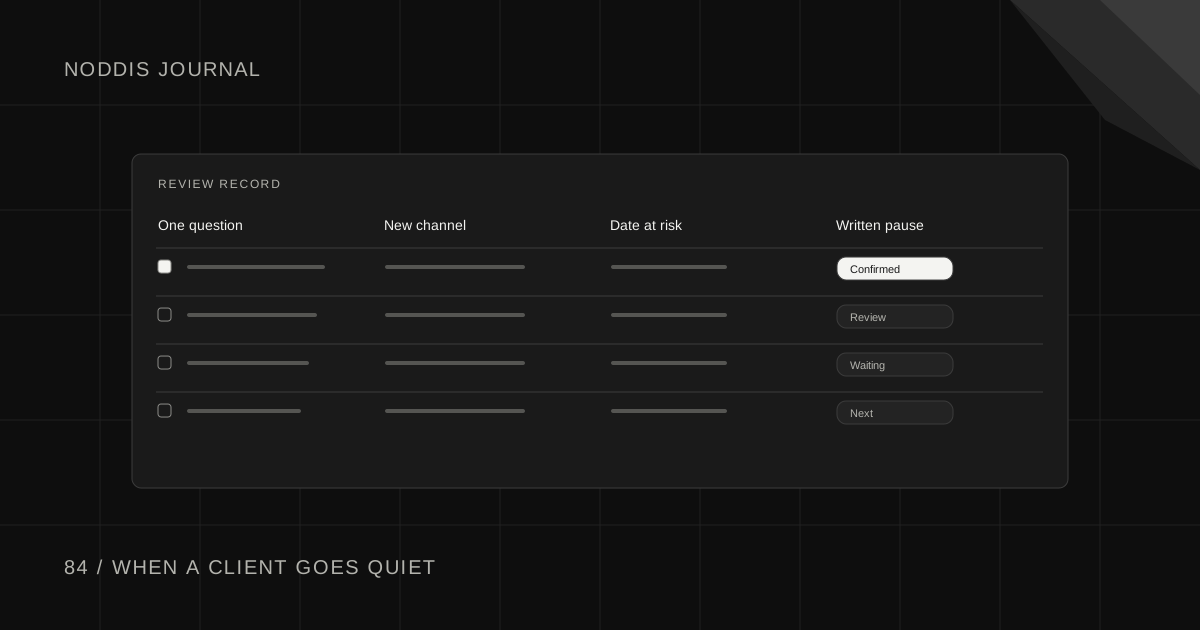
If a client is not responding to emails, follow a fixed ladder instead of sending more of the same message. Resend with one clear question, switch channel, state what the silence is holding up, then pause the work in writing. Each step has a date, so you always know what to do next.
Why is your client not responding to emails?
A client is usually not responding to emails for a plain reason: the message asked for too much, reached the wrong person, or arrived in a bad week. Rebecca Zucker writes in Harvard Business Review: "You email someone asking for a conversation, information, input, or an introduction, and you get no response." Her article covers coworkers, clients and recruiters alike.
Check your own message before you chase:
- Was there one clear question? An email with five questions is harder to answer than an email with one.
- Did it need a decision the reader cannot make alone? Then the delay is on someone you have not met.
- Was the request buried? A question in the fourth paragraph of an update is easy to miss. The U.S. government's plain language guide on Digital.gov puts the cost plainly: "Unnecessary words waste your audience's time."
- Did it reach them at all? Large attachments and new addresses end up in spam.
Fix the message first. Escalating only makes sense once the request itself is clear. If the silent person is a prospect who has not signed yet, use the steps for a client who ghosted after a proposal instead.
What should you do first when a client goes quiet?
First, resend the request as a new, shorter email with the question in the subject line. Do not reply to your own thread with "following up". A fresh message with one question is easier to answer than a long thread.
Subject: One question on [Project]: [the question, in a few words]
Hi [Name],
One thing is holding up [task or page]: [the question, as one sentence].
A one-line reply is all I need. If someone else is the right person to ask, point me to them and I will take it from there.
Thanks,
[Your name]
The last line matters. It gives the client a way to hand the question to a colleague, which helps when the question was never theirs to answer.
How many times should you follow up with a client who is not responding?
Follow up three times over about two weeks, changing one thing each time, then pause the work. The ladder below keeps you polite and keeps the project from sitting in limbo.
| Step | When | What changes | What you send |
|---|---|---|---|
| 1 | Day 3 | The message | A new, shorter email with one question |
| 2 | Day 6 | The channel | A phone call or a text, then a one-line email noting it |
| 3 | Day 10 | The stakes | What the silence is holding up, and the date it starts to cost |
| 4 | Day 14 | The status | A written pause, with what restarts the work |
The spacing borrows from a published contract template. The Freelancers Union's contract template asks the hiring party to "respond to Freelance Worker in a reasonable manner and within 3 days of contact". Three days is a fair first wait because it matches what a client could reasonably be asked to agree to.
If your own agreement names a response time, use that number instead of the ones in this table.
What do you say when the silence is delaying the project?
Say what is blocked, which date is at risk and what you need to protect it. Keep blame out of it. The message is a status report with a request attached.
Subject: [Project]: [milestone] date at risk
Hi [Name],
I have not been able to reach you about [the question] since [Date]. [Task] is waiting on it, and that puts the [milestone] date of [Date] at risk.
If I have an answer by [Day, Date], the date holds. After that, I will need to move it and will confirm the new date in writing.
Thanks,
[Your name]
Before you send this one, try a second channel. A short call can settle a question that email has not. Follow the call with a one-line email, so the answer is written down.
When should you pause work for an unresponsive client?
Pause when a blocking question has gone unanswered for about two weeks and three attempts. Keep working on anything that does not depend on the answer, and stop the rest. Working past a missing decision risks building the wrong thing.
Subject: [Project] is paused from [Date]
Hi [Name],
I have not been able to get an answer on [the question], so [Project] is paused from [Date]. Everything finished so far is saved.
To restart, reply with the answer. I will then confirm my next open slot and a revised date for [milestone].
Thanks,
[Your name]
A pause is not a threat. It is an accurate description of a project that cannot move. For longer wording and pause terms, see the guide to a project on hold email to a client. When the client returns, the guide to restarting a paused client project covers the first week back.
How does Noddis show what you are waiting on?
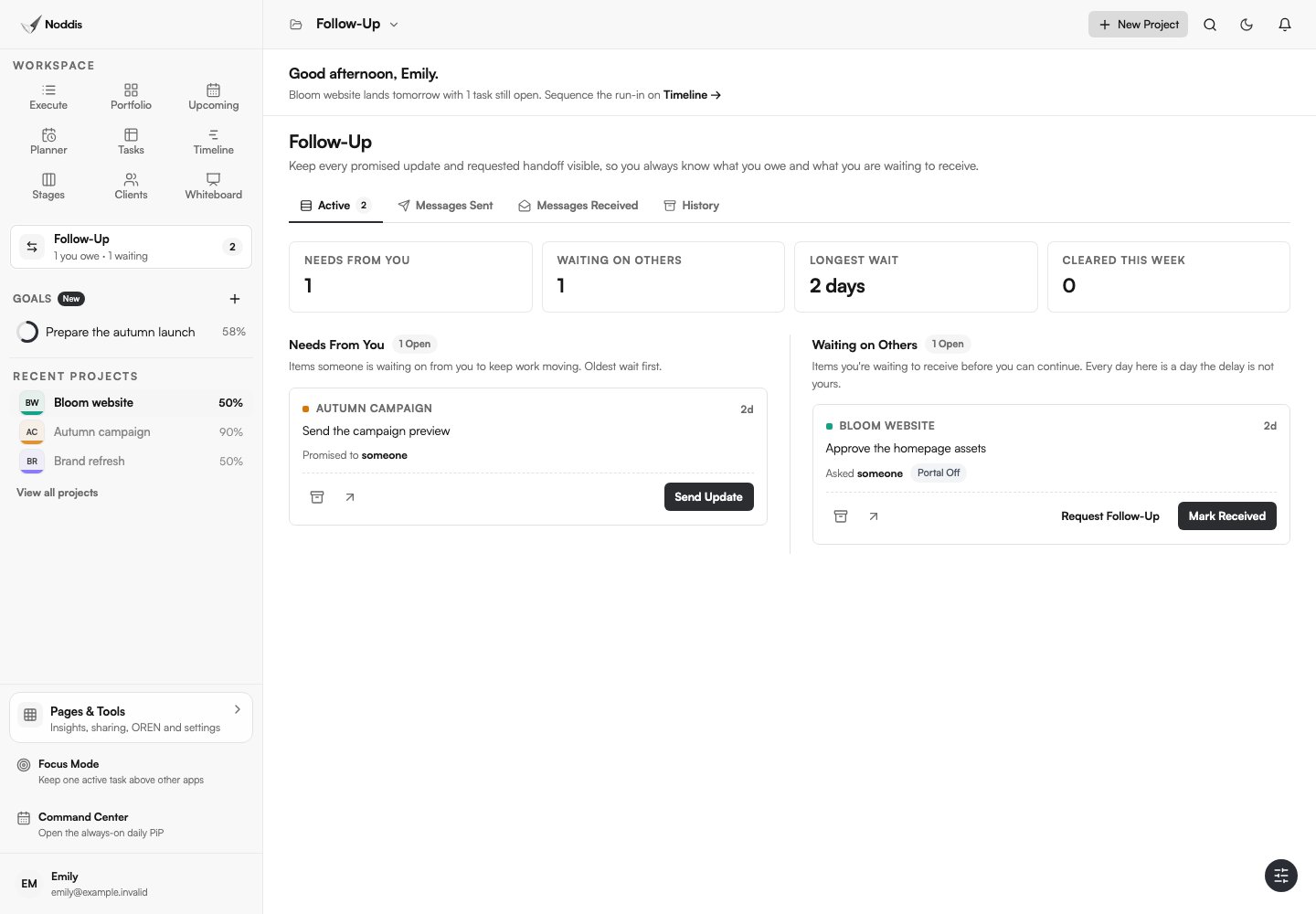
Noddis is a project management app that keeps tasks, follow-ups, and related project details connected. When we built Follow-Up in Noddis, we split it into two lists, Needs From You and Waiting on Others, and gave every open item an age in days.
Record the unanswered question as a Waiting on Others item on the task it blocks. The age tells you which step of the ladder you are on without counting back through your sent mail. Follow-Up works on one selected project on the Free plan and on every project on Pro. Sending the email and receiving the reply inside Follow-Up is a Pro feature.
The client email templates for freelancers include a gentle and a firmer version of the messages above.
Your next step
Find your oldest unanswered client email, rewrite it as one question and send it with the question in the subject line. To list your waiting items with ages, open the live demo.
Common questions
Should I keep working while the client is silent?
Keep working only on tasks that do not depend on the missing answer. Finish what is safely decided, then stop. Work built on a guess may have to be redone, and redoing it is hard to bill for. Tell the client which tasks are continuing and which are waiting, so the pause is not a surprise.
Is it rude to call a client who has not answered emails?
No. One call after two unanswered emails is reasonable, and a short call can be easier for the client than writing a reply. Keep it brief, ask the one question and follow up with a one-line email that records the answer. Avoid repeated calls or voicemails on the same day.
What if the client only replies when an invoice is due?
Treat it as a scheduling problem and attach decisions to dates the client already respects. Send the open questions with the invoice or the weekly update, and state which date each answer protects. If the pattern continues, agree a response time in your next contract and name a second contact who can decide.

Katleen is the founder of Noddis. She runs client projects through her app studio, 693 Labs, and builds Noddis around the problems that work creates.
Last reviewed . Feature details reflect Noddis at the time of review.