
Short answer
A weekly agency portfolio review is a short meeting or written sweep that compares all active client projects, identifies decisions that need attention, and assigns the next owner for each risk or blocker. It should not become a round-robin retelling of every task. Review exceptions, dependencies, capacity conflicts, and client commitments.
Free resource
Download the blank agency portfolio scorecard spreadsheet. No account is required. Save a copy before adding your project details.
What should an agency portfolio review actually answer?
A useful portfolio review answers four questions: Which commitments are at risk? Which clients or teammates owe a decision? Where do deadlines collide? Which action would unblock the most important work?
Consider a fictional five-person studio managing Juniper, Orbit Bikes, and Leo. Each project may look healthy when reviewed alone, but Juniper's launch and Orbit Bikes' campaign may both need the same developer on Thursday. Portfolio-level visibility reveals the conflict before it reaches the client.
Asana's project status reporting guidance emphasizes summarizing progress, blockers, and next steps for stakeholders. A portfolio review uses the same principle across multiple simultaneous engagements.
The Project Management Institute discusses managing multiple projects as a resource-allocation and prioritization problem in addition to individual project execution. This is why the agency review should compare engagements rather than merely summarize each one.
A 25-minute weekly portfolio review agenda
The agenda is a starting framework, not a guaranteed ideal meeting length. A small agency can shorten or extend it based on the number and complexity of projects.
| Minutes | Topic | Output |
|---|---|---|
| 0 to 5 | Deadlines in the next 14 days | List of real collisions |
| 5 to 10 | Blocked and waiting work | Unblock owners and follow-up dates |
| 10 to 15 | Scope and change requests | Decisions or estimates needed |
| 15 to 20 | Team capacity conflicts | Reassignments or client conversations |
| 20 to 25 | Commitments and next updates | Action list with owner and date |
Send a small portfolio snapshot beforehand so participants are not discovering the project list during the meeting. If the same person can make every decision alone, a written review may be sufficient.
Copyable agency portfolio scorecard
Use one row per active project. The sample data is fictional and does not represent Noddis customer outcomes.
| Client / project | Next milestone | Health | Waiting on | Conflict | Decision needed |
|---|---|---|---|---|---|
| Juniper redesign | Homepage approval Nov 5 | At risk | Client marketing lead | None | Confirm review date |
| Orbit Bikes campaign | Assets due Nov 6 | On track | Photographer | Developer overlap | Reassign QA |
| Leo newsletter | Draft Nov 7 | On track | Internal writer | None | None |
Health is a judgment explained by evidence. “At risk” should identify what is threatened and why. A percentage alone does not explain project health or client acceptance.
What should the review leader prepare?
Before the meeting, gather the latest milestone dates, open client commitments, blocked tasks, proposed scope changes, and near-term team capacity. Identify questions that genuinely need a decision. Do not recreate the whole task list in a slide deck.
A useful pre-read is one page:
This week: Juniper's homepage approval is at risk; Orbit Bikes and Juniper both need developer QA Thursday; Leo remains on schedule. We need decisions on Juniper's review date and Thursday's QA allocation. No other items require group discussion.
That is enough to direct attention to the work that matters.
How do you turn the meeting into actions?
Close with an action register containing decision, owner, and due date. If a client must decide, record the teammate responsible for requesting the answer and the agreed next check date.
| Decision or action | Owner | Date | Evidence of completion |
|---|---|---|---|
| Request homepage approval | Account lead | Mon | Client response recorded |
| Move Orbit Bikes QA to Friday | Delivery lead | Mon | Updated schedule confirmed |
| Quote proposed extra page | Project manager | Wed | Estimate sent for authorization |
Do not list “follow up” without naming the topic and desired outcome. That creates another reminder that requires context reconstruction later.
What should not be in the weekly review?
Avoid reading every completed task, debating colors, collecting unsolicited design feedback, or duplicating client-facing updates that already exist. Those belong in focused project conversations. The group review is for cross-project tradeoffs and decisions.
Also avoid allowing a loud client to determine priority simply through message volume. Review deadlines, dependencies, consequences, and the commitments actually made. The multiple client projects guide explains the daily cross-project sweep; this weekly meeting addresses the team-level decisions that the daily sweep identifies.
How does Noddis support this routine?
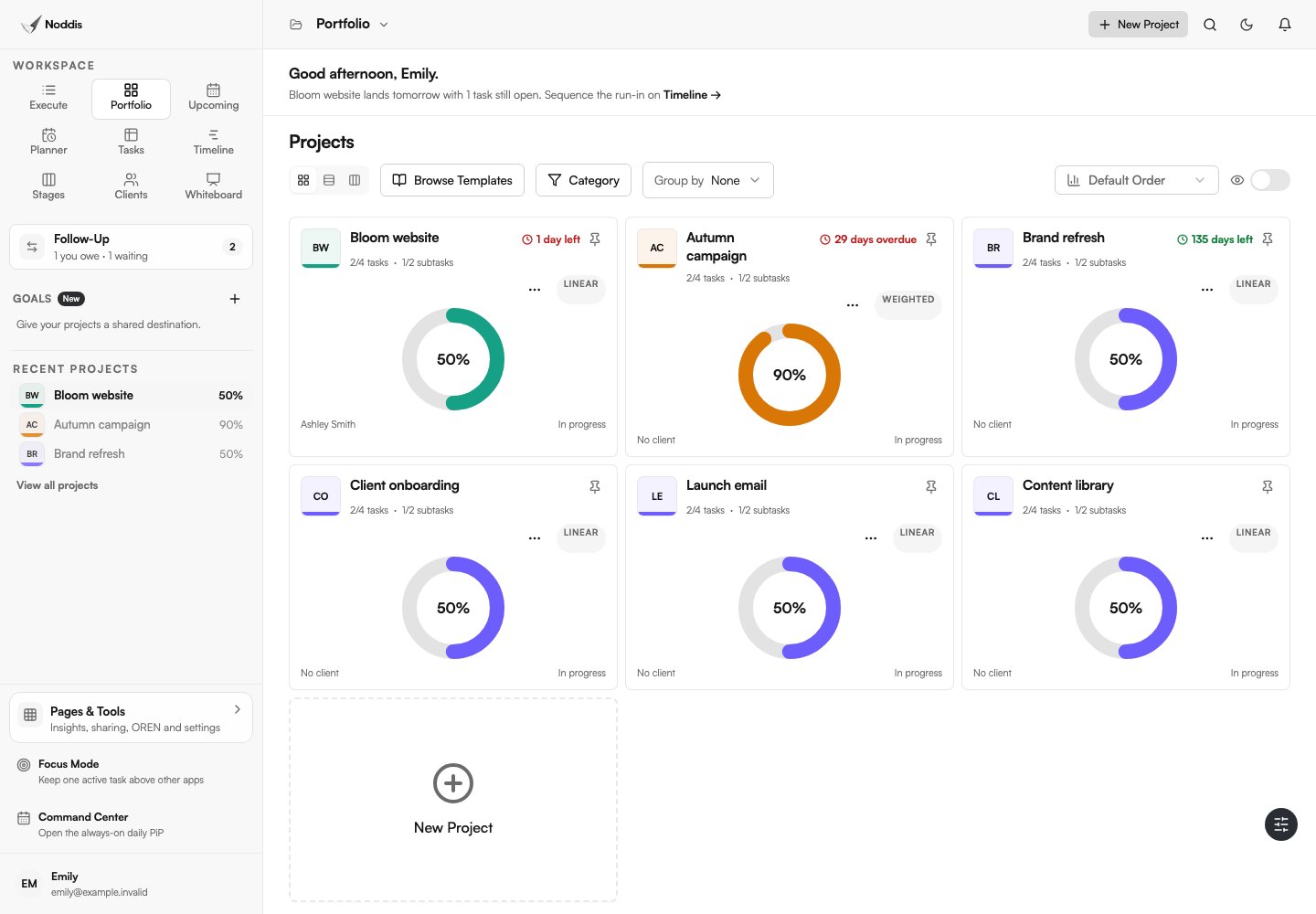
Noddis is a project management app with Portfolio views, project-focused Execute, Upcoming, and Follow-Up. Use Portfolio to compare active client projects and Follow-Up to find recorded promises or missing responses. A project can still need a manual capacity conversation; the app does not determine which client deserves priority on its own.
For day-to-day work, link to the client project tracker guide. The live demo shows how connected workspaces separate oversight from execution.
Your next step
Run the next review with only the scorecard and action register. If a topic cannot change a decision or commitment, move it out of the meeting.
Common questions
Do small agencies need a portfolio meeting every week?
Not always. If one person owns every project and the workload is stable, a written sweep may be enough. Use a meeting when several people need to make cross-client tradeoffs or resolve dependencies together.
Should clients attend the agency portfolio review?
Usually this is an internal coordination review. Share a separate client-facing update or portal containing only appropriate project information. The internal discussion may include staffing, pricing, or risks not intended for client access.
What is the difference between a portfolio review and a project status meeting?
A project status meeting examines one engagement. A portfolio review compares engagements, resources, and conflicts to decide what needs attention across the studio.

Katleen is the founder of Noddis. She runs client projects through her app studio, 693 Labs, and builds Noddis around the problems that work creates.
Last reviewed . Feature details reflect Noddis at the time of review.