
Short answer
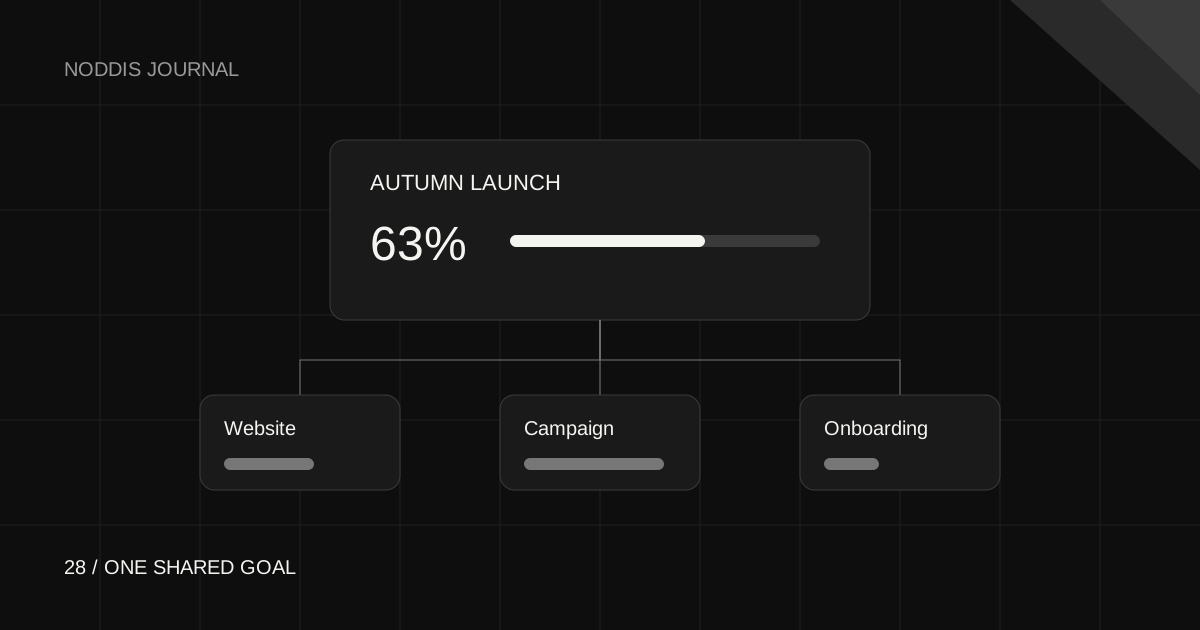
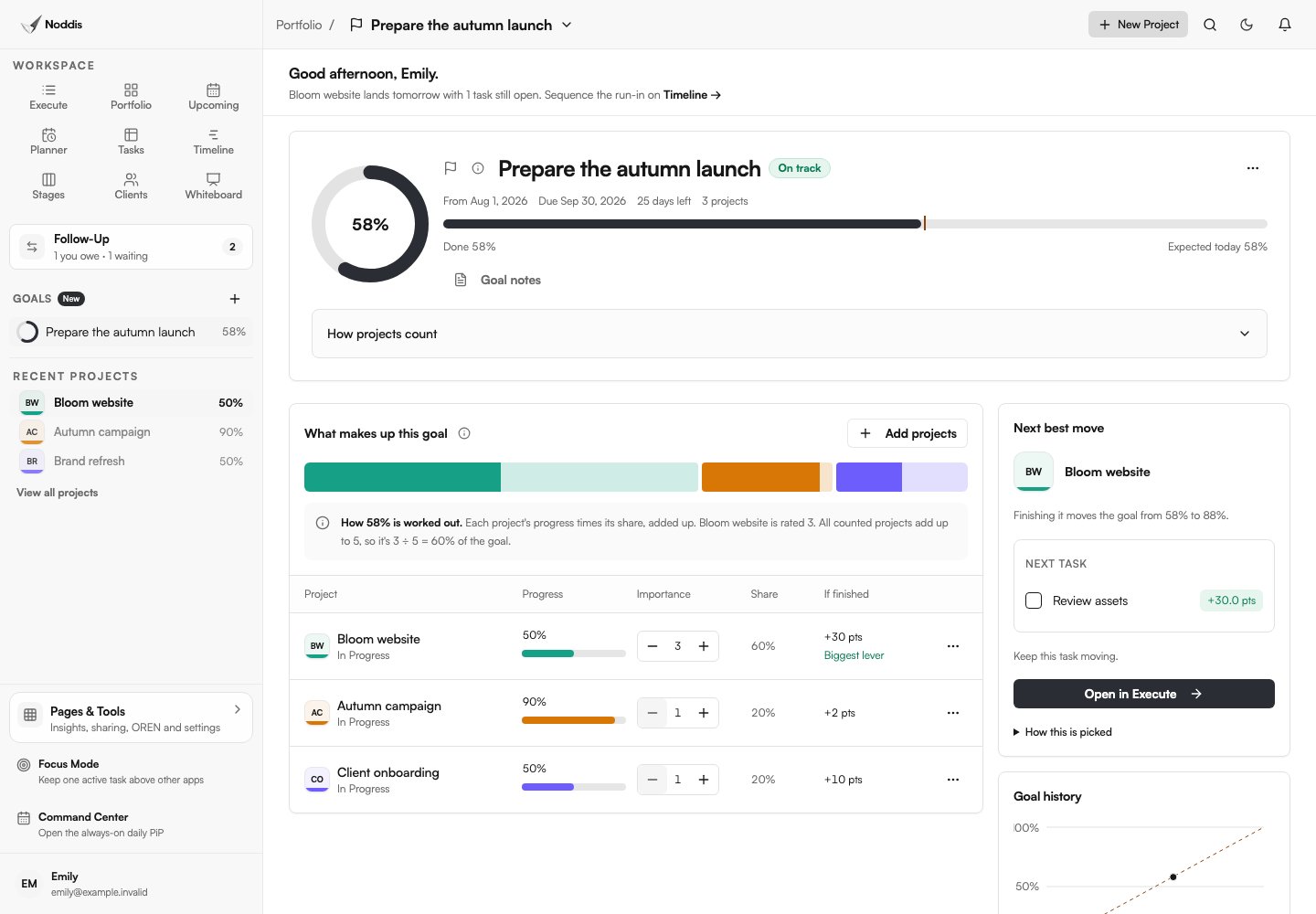
A Noddis Goal combines the progress of its included projects. Choose equal shares, shares based on project size, or importance ratings from 1 to 9. The goal percentage is the sum of each project’s progress multiplied by its share. Dates are optional; work progress still works without a schedule, but pace needs both a start and target date.
Start with an outcome and a concrete project boundary
“Improve the business” is hard to use as a weekly decision. “Prepare the autumn launch” is easier to connect to projects: the website, the customer email, and the launch materials. Write what finished means in the goal notes, then connect only the projects that contribute to it.
A project progress bar measures recorded work. Completing the launch checklist does not prove the launch earned revenue or satisfied customers. Keep the outcome measure in your review alongside the work measure, rather than treating 100% as evidence of success by itself.
Choose how the projects count
- Equally: each counted project has the same share. This works when each deliverable deserves the same influence.
- By size: shares use the number of counted tasks and subtasks. Larger recorded work trees contribute more; this is a count, not an estimate of hours.
- By importance: give each project a rating from 1 to 9. A rating of 3 has three times the share of a rating of 1. Renaming the rating does not change the calculation.
Use one interpretation consistently. If you choose importance, agree on what a high rating means before adjusting it because a percentage looks disappointing.
A two-project example you can check
Suppose the website is 50% complete and the launch email is 100% complete. Count them equally and the goal is (50% × 1/2) + (100% × 1/2) = 75%.
Now give the website an importance rating of 3 and the email a rating of 1. Their shares become 75% and 25%. The result is (50% × 75%) + (100% × 25%) = 62.5%, displayed as 63% after rounding. No task changed; the goal now gives more influence to the unfinished website.
Each project still uses its own Linear or Weighted progress setting. Goal weighting decides the share of a project, not the weights of its tasks.
Handle dates and pending projects deliberately
You can create an undated goal. With both dates present, expected progress uses the fraction of calendar days elapsed between them. That is a straight-line reference, not a forecast of effort or delivery.
“Leave pending projects out” redistributes shares among counted projects. Pending means the project is explicitly marked Pending, or every unfinished top-level task is paused or blocked. Seven or thirty days of inactivity does not qualify. A mixture of active and paused tasks does not pause the whole project. Completed projects remain counted.
Use the goal in a five-minute review
- Check the projects included and the counting method.
- Inspect each project’s share and its recorded progress.
- Review the suggested next move against your real constraints.
- Write the decision or change in goal notes.
- Check your actual outcome measure separately.
Archiving or excluding a project can change the denominator. Explain a large percentage change before interpreting it as a burst of productivity. The same goal calculation feeds the goal view, Analytics, and OREN; none of those turns a work percentage into proof of an outcome.
Common questions
Can I track a project goal without a deadline?
No. Work progress is available without dates. A pace comparison needs both a valid start date and a later target date.
Why does goal progress change when no task was completed?
Changing membership, project progress mode, project size, importance ratings, or pending exclusions can change the result. Check the shares and denominator.
Does completing every project task mean the business goal is achieved?
It means the counted work is complete. Measure the real-world outcome separately.

Katleen is the founder of Noddis. She runs client projects through her app studio, 693 Labs, and builds Noddis around the problems that work creates.
Last reviewed . Feature details reflect Noddis at the time of review.