
Short answer
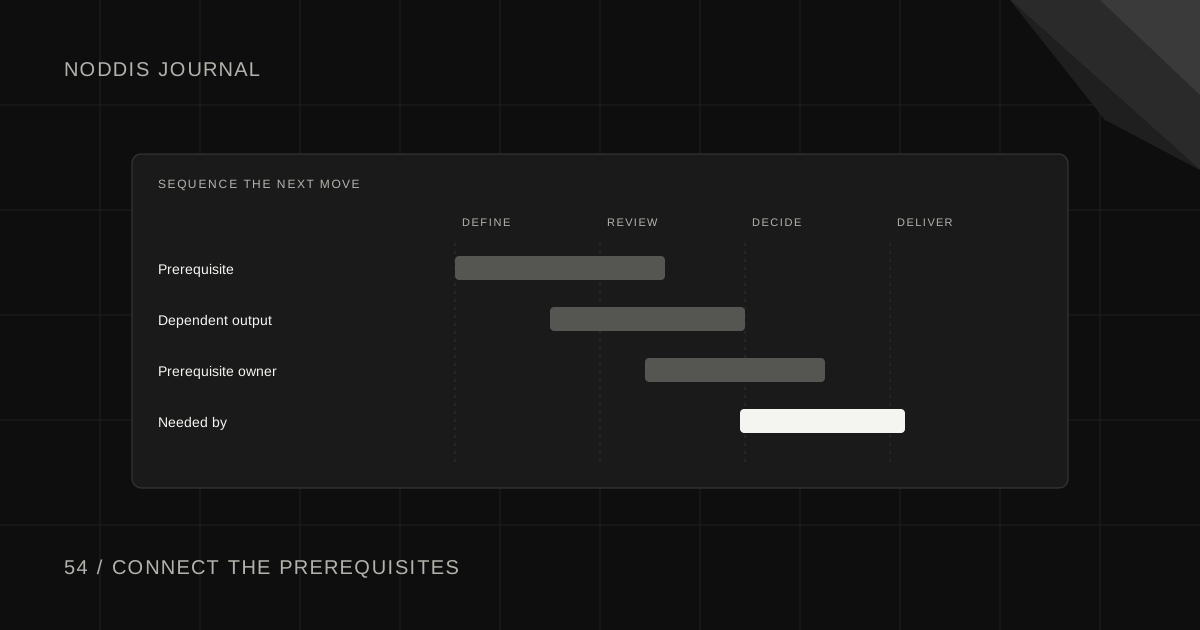
A project dependency tracker shows which tasks or decisions must happen before other work can begin or finish. Record the prerequisite, the dependent task, the owner, the expected handoff date, and the effect of delay. For small client projects, a simple dependency table often provides enough visibility without an elaborate scheduling system.
Free resource
Download the blank dependency tracker spreadsheet. No account is required. Save a copy before adding your project details.
What is a project dependency tracker?
A project dependency tracker is a list of relationships that determine task order. For example, a developer may need approved designs before implementing a page, and the client may need to review a working staging site before launch. Those are dependencies because one task needs the output of another.
Atlassian describes four standard dependency relationships, including finish-to-start and start-to-start. A freelancer usually needs to model only the relationships that materially affect handoffs or delivery dates.
A copyable dependency tracker template
The table below describes a fictional Orbit Bikes campaign site. Rows show prerequisites, not a list of every task in the project.
| Prerequisite | Dependent work | Relationship | Owner of prerequisite | Handoff target | Risk if late |
|---|---|---|---|---|---|
| Approve product copy | Build product page | Finish-to-start | Client editor | Nov 4 | Build cannot finish |
| Begin design system | Draft mobile navigation | Start-to-start | Designer | Nov 2 | Navigation waits |
| Grant CMS access | Configure contact form | Finish-to-start | Client admin | Nov 3 | Testing blocked |
| Finish staging QA | Request launch approval | Finish-to-start | Developer | Nov 8 | Launch review moves |
All dates are illustrative. Include the actual link to the required output, such as an approved copy document or accessible account invitation, so the recipient does not have to hunt for it.
Which dependencies should you record?
Record dependencies whose absence could block delivery, change the critical sequence, or require an external decision. Do not connect every adjacent task simply because it appears next in a checklist.
Use a simple test: Could task B start or finish if task A never happened? If yes, the relationship may be a preference rather than a dependency. If no, record it and name the output that makes the handoff complete.
For example, designing a footer and writing a service page may happen in parallel. A footer does not necessarily depend on the service copy. But publishing an approved claim may depend on the client's legal review. The latter is worth tracking.
How do you plan around an external approval?
Put the client's review window into the timeline as a genuine stage rather than pretending approval happens instantly. Include when the material becomes ready for review, how long the client has agreed to respond, and what task depends on that decision.
A simple sequence might be:
Design v2 complete
       ↓
Client review window
       ↓
Approved direction received
       ↓
Build final layout
       ↓
QA and release review
If feedback arrives late, update the projected handoff rather than merely moving the approval card. The downstream tasks may need new dates, and the client should understand the consequence.
How do you find the critical chain of work?
Start at the delivery milestone and work backward through essential prerequisites. The chain of tasks that directly governs when the milestone can happen deserves the closest attention. Do not assume the task with the most subtasks is the most schedule-critical.
Consider a site with three independent workstreams: design, copy, and hosting. If approved copy is the only missing input before the final build, speeding up an unrelated social graphic will not recover the website date. The dependency tracker makes that clearer than counting completed tasks.
For more complex projects with many overlapping relationships, use an appropriate schedule or dependency visualization. The Atlassian task dependency walkthrough offers examples of distinguishing genuine dependencies from ordinary task order.
How do you keep the tracker current?
Update the relationship only when a prerequisite changes, is completed, or is replaced. Record the handoff event, not only a checkbox. For critical dependencies, include a next-action owner and review date.
If the approval is delayed, ask whether the team can work on an independent task, whether a safe alternative exists, and whether the milestone must be renegotiated. The blocked task guide explains how a project overview can make the affected work visible.
Where does Noddis fit?
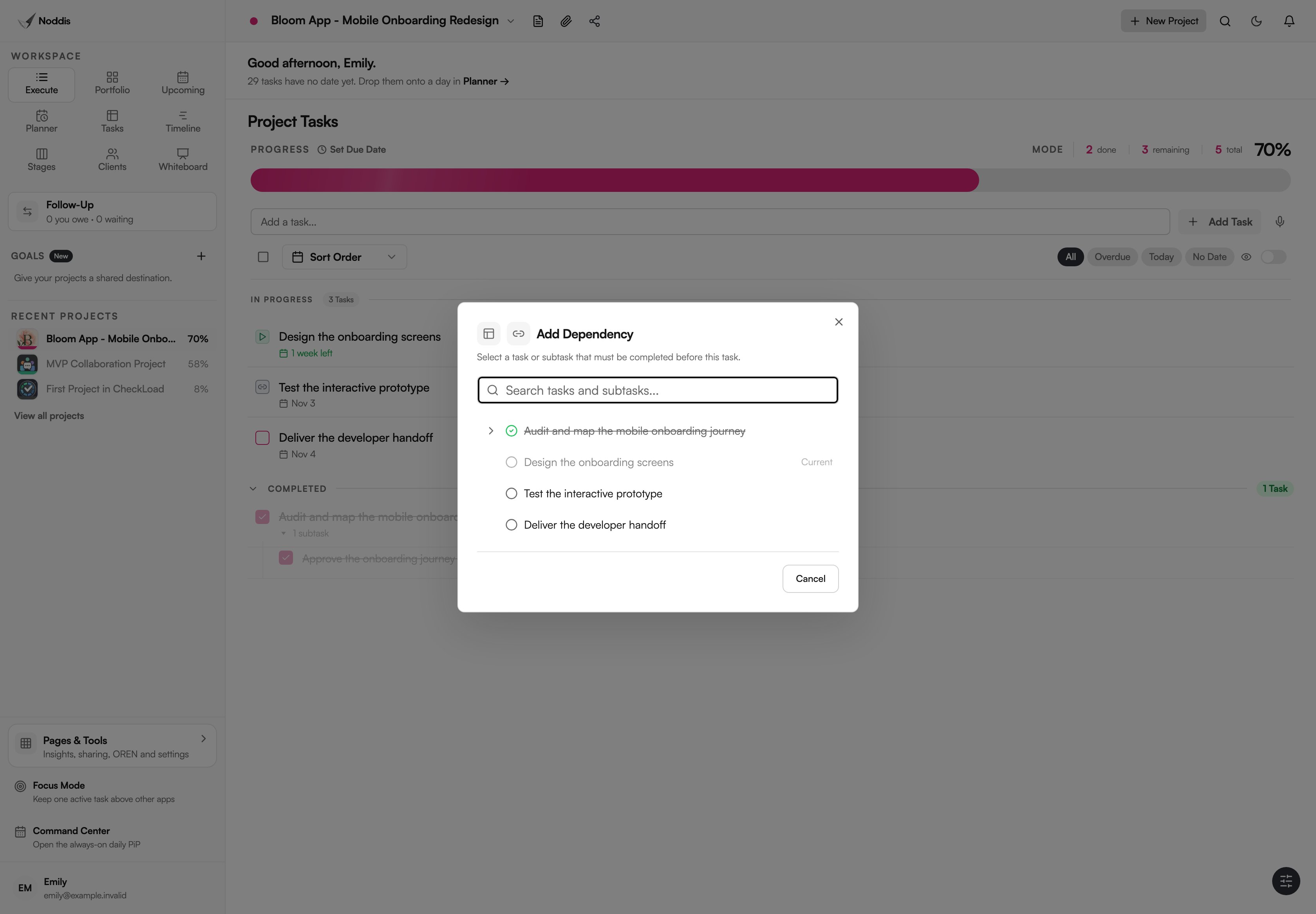
Noddis is a project management app with task hierarchies, timeline views, and project context. Keep the prerequisite and dependent output linked in your project notes or task descriptions, and use Follow-Up for approvals or responses owed by others. Signed-in workspaces support explicit dependencies between tasks and subtasks, and Timeline displays dependency connectors. These links do not automatically reschedule downstream dates; review the schedule when a prerequisite moves. Stages and Timeline are Pro workspaces for signed-in accounts; they can also be explored in the visitor demo. Explore the live demo.
Your next step
Choose one upcoming milestone and list the three or four outputs it actually depends on. Give each an owner and a handoff date. That is enough to start a useful dependency tracker.
Common questions
Is a dependency the same as a blocker?
No. A dependency is a relationship between work items. It becomes a blocker when the prerequisite is missing at the point the dependent task needs it. Track the relationship during planning so the blocker does not surprise the team later.
Should you track every minor dependency?
Usually not. Capture the dependencies that affect delivery, external handoffs, or meaningful sequencing. Too many trivial relationships make the tracker harder to maintain without improving decisions.
What happens when a dependent task's date changes?
Reassess the downstream tasks, available capacity, and committed milestone. A moved date in one row may affect other work even when those tasks have not changed individually.

Katleen is the founder of Noddis. She runs client projects through her app studio, 693 Labs, and builds Noddis around the problems that work creates.
Last reviewed . Feature details reflect Noddis at the time of review.