
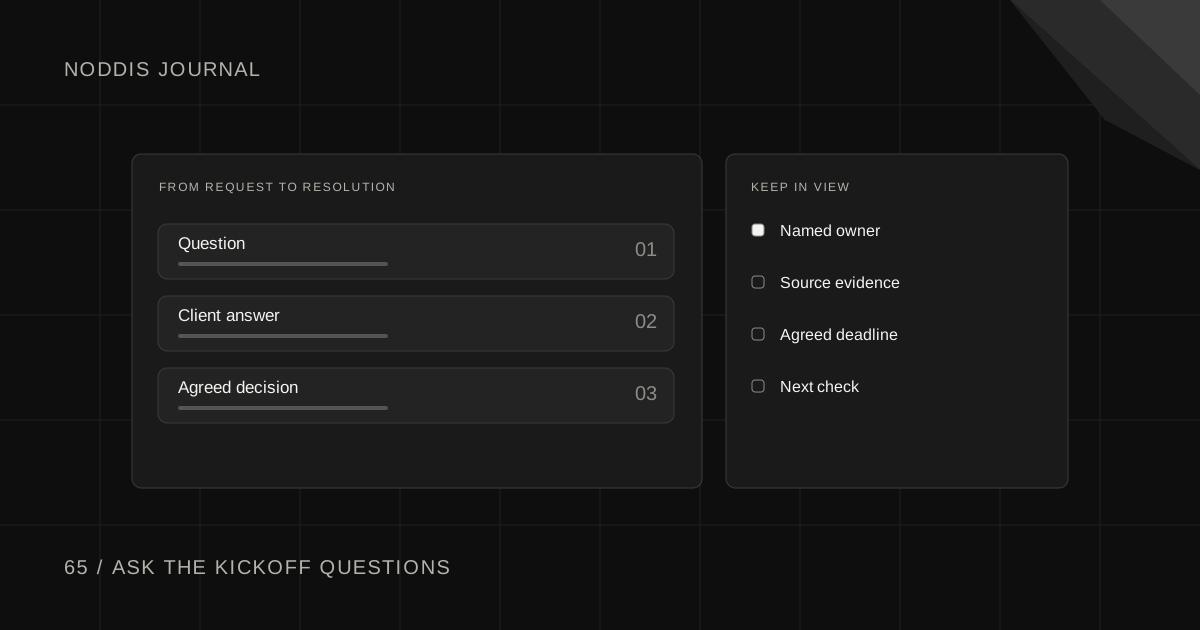
Short answer
A client kickoff questionnaire should surface the decisions and inputs that determine whether a project can begin smoothly: goals, stakeholders, approvals, deliverables, assets, constraints, deadlines, and change rules. It works best as a short guided conversation rather than a form that asks clients to write a complete project plan for you.
Free resource
Download the blank client kickoff decisions spreadsheet. No account is required. Save a copy before adding your project details.
What is a client kickoff questionnaire for?
A client kickoff questionnaire collects the information needed to clarify an engagement after the proposal has been accepted. It should expose hidden assumptions before those assumptions become revisions, missed milestones, or difficult scope conversations.
The existing Noddis client onboarding checklist covers the broader start-of-project process. This questionnaire focuses on the questions to ask and decisions to capture, not on repeating the full onboarding checklist.
Project Management Institute’s scope guidance emphasizes defining objectives and acceptance expectations before handling later changes. The questions below are designed to make those agreements explicit at the start.
Twenty client kickoff questions worth asking
Use the questions relevant to your project. A simple design assignment may require only a subset; a complex website may need more specialist discovery.
Goals and success
- What specific outcome should this project produce?
- What business or user problem is it meant to solve?
- How will you decide the result is acceptable at the end?
- Which existing materials or examples should we consider authoritative?
Scope and deliverables
- Which exact deliverables are included in this engagement?
- What related work is explicitly outside scope?
- Which requirements are fixed, and which are open to exploration?
- What revision rounds or feedback stages are planned?
People and decisions
- Who is the single day-to-day contact?
- Who has final authority to approve deliverables and changes?
- Who else must provide input before approval?
- How will conflicting comments from stakeholders be consolidated?
Inputs and constraints
- Which content, brand assets, files, or account permissions must the client supply?
- Who owns each missing input, and when can it be delivered?
- Are there legal, technical, accessibility, or brand requirements needing specialist review?
- Which other initiatives or vendors could affect this project's schedule?
Timing and communication
- What milestone dates are genuinely fixed, and why?
- How long does the client's review process usually take?
- Where should project updates and decisions be recorded?
- How should new requests be assessed and approved after work begins?
The most valuable response is often a follow-up question. If a client says “The CEO will approve everything,” ask whether that person is available during the planned review windows.
How do you turn answers into an agreed kickoff brief?
Do not store a 20-question transcript and call the project ready. Extract the actual decisions into a short reference everyone can use. Mark open answers rather than filling them with assumptions.
| Decision area | Confirmed answer | Owner | Next action |
|---|---|---|---|
| Success condition | Three agreed pages ready for launch QA | Project lead | Add acceptance criteria |
| Final approver | Marketing director | Client | Confirm review dates |
| Required assets | Approved copy and photography | Client editor | Send by Nov 4 |
| Exclusions | Ecommerce checkout | Project lead | Keep in scope baseline |
| Review cadence | Weekly consolidated review | Marketing director | Schedule window |
Illustrative fictional project. Share the summary with the client and ask for corrections before production depends on it.
Which answers should become tasks?
Convert answers into work only when an action is actually required. “Marketing director is the approver” belongs in project context. “Marketing director must approve homepage v2 by Nov 6” is an actionable commitment with a date and result.
Do not turn every preference into a deliverable. If a client expresses an interest in a second landing page but did not authorize it, capture the idea for review rather than treating it as included scope.
The client request intake guide explains how to review new requests, while client approval tracking deals with decisions after work is ready for review.
How do you ask difficult questions without creating friction?
Explain why the answer affects the outcome. “Who gets final approval?” can sound political. “To avoid conflicting review rounds, who should consolidate your team's feedback and confirm the final decision?” describes the practical reason.
Similarly, ask about realistic deadlines rather than accepting “as soon as possible.” A deadline tied to a public campaign is different from an internal preference and may require a different delivery plan.
How does Noddis support kickoff information?
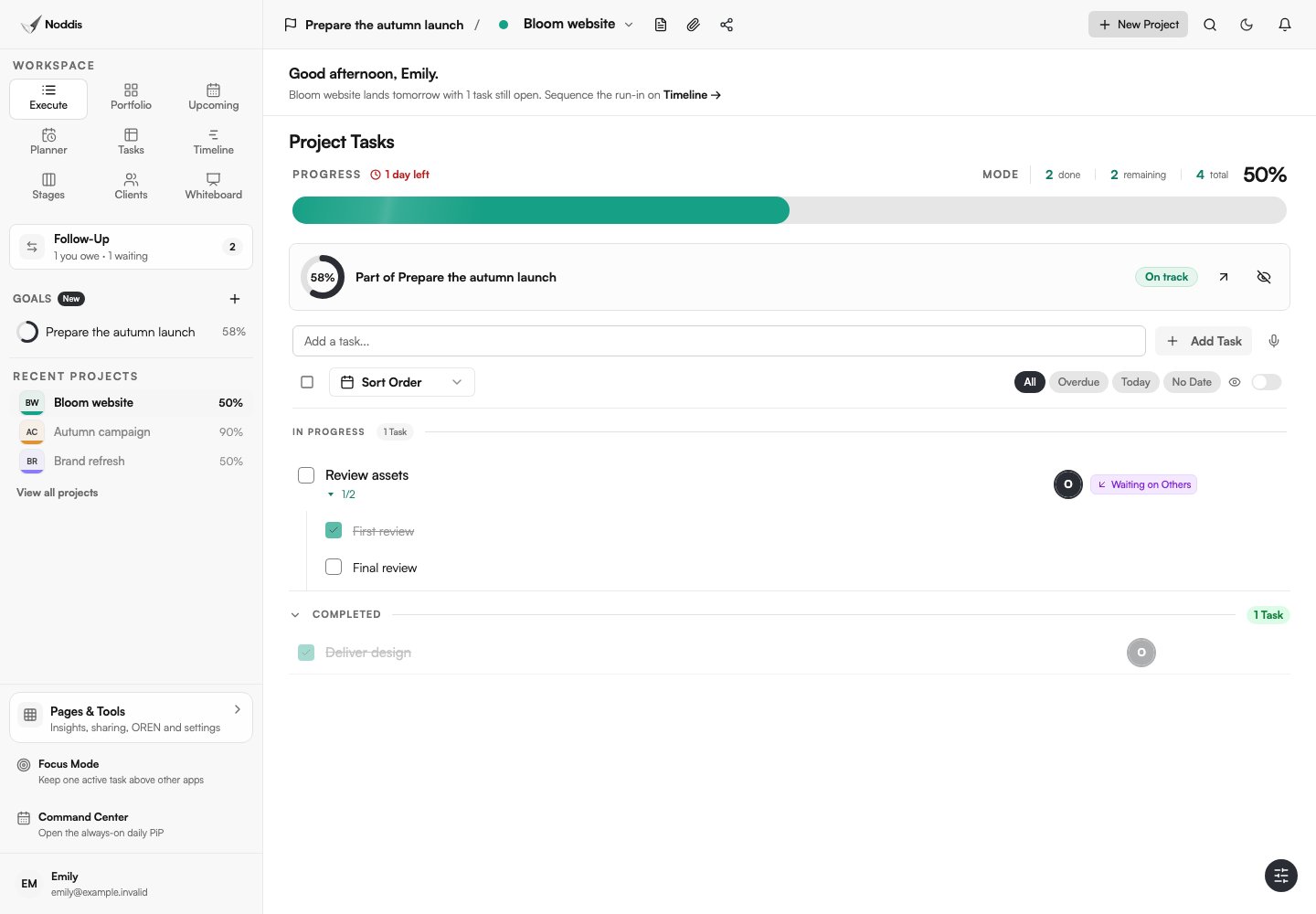
Noddis is a project management app designed to keep client projects and their context together. Use project notes for the approved kickoff summary, tasks for agreed actions, and Follow-Up for client inputs you are awaiting. A Pro client portal can share selected project details, but do not expose internal notes or private negotiations by default. The Noddis demo shows the project workspaces.
Your next step
Use the questionnaire for the next accepted engagement, then circulate a one-page decision summary. A good kickoff leaves fewer unanswered questions, not a longer meeting transcript.
Common questions
Should clients complete the questionnaire before the kickoff meeting?
Send the questions in advance when that reduces meeting time, but allow them to answer collaboratively during the call. Some decisions become clearer when you can ask follow-up questions in real time.
What if the client cannot name a final approver?
Treat that as an unresolved project dependency. Ask the client to establish a decision path before the first major approval milestone, and document how multiple required signatures will be handled.
Is a kickoff questionnaire a replacement for a contract?
No. It supports the working plan and may clarify assumptions, but legal and commercial terms belong in the appropriate agreement. Material changes should follow the agreed authorization process.

Katleen is the founder of Noddis. She runs client projects through her app studio, 693 Labs, and builds Noddis around the problems that work creates.
Last reviewed . Feature details reflect Noddis at the time of review.