
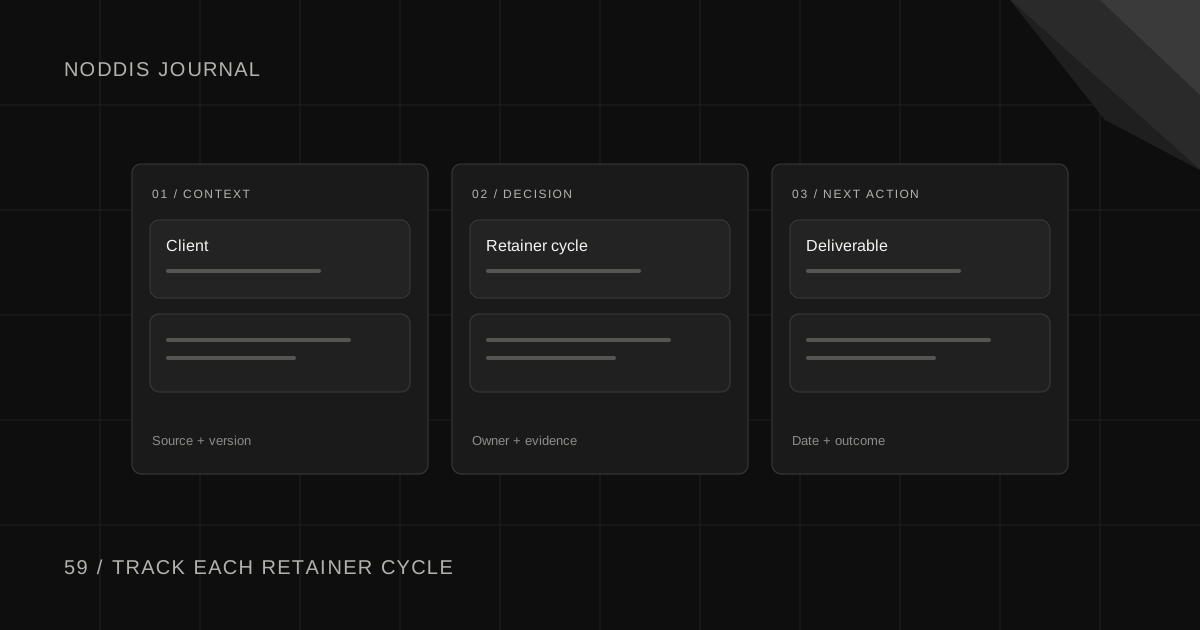
Short answer
A recurring client deliverables tracker shows what you owe each retainer client every cycle, who owns it, when the client reviews it, and whether the agreed output was delivered. Track the cycle separately from the individual tasks, so an unfinished September item does not disappear when October's work begins.
Free resource
Download the blank recurring deliverables spreadsheet. No account is required. Save a copy before adding your project details.
What is a recurring client deliverables tracker?
A recurring client deliverables tracker is a schedule and fulfillment record for work repeated every week, month, or quarter. It is especially useful for social content, newsletters, website maintenance, SEO reporting, and consulting retainers.
A typical to-do list can remind you to draft a newsletter. A fulfillment tracker answers whether the October newsletter for Leo was drafted, reviewed, delivered, and approved under the agreed service. That distinction matters when the same task title appears every month.
Copyable monthly retainer tracker
The example below is fictional. Use one row for each promised deliverable in a cycle, with links to the underlying tasks and reviewed files.
| Client | Cycle | Deliverable | Due | Review owner | State | Evidence |
|---|---|---|---|---|---|---|
| Juniper | November | Four social graphics | Nov 8 | Marketing lead | In production | Design folder |
| Juniper | November | Monthly performance summary | Nov 30 | Project lead | Not started | Reporting doc |
| Leo | November | Newsletter draft | Nov 12 | Business owner | Awaiting review | Draft v2 |
| Orbit Bikes | November | Website update batch | Nov 18 | Operations lead | Scheduled | Change list |
Store the cycle identifier explicitly. “Newsletter” is not enough when you need to distinguish a late October edition from a November edition. If a client approves the draft but the email is not yet sent, keep approval and delivery as separate states.
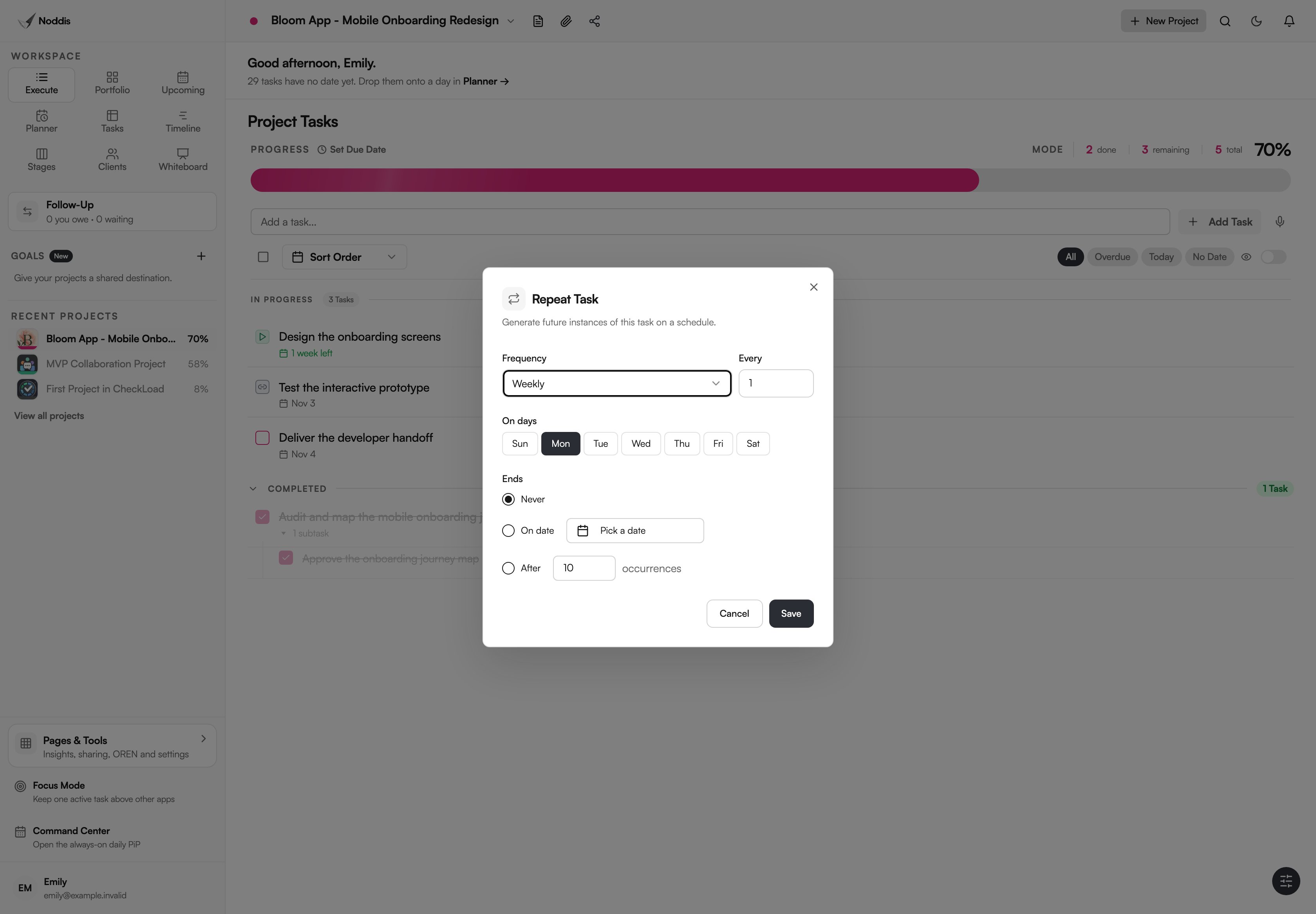
Many tools, including Google Tasks, support repeating tasks. The recurrence feature schedules a future item, but it does not by itself verify that a client received or approved the previous cycle’s output. That business distinction is why the fulfillment record is separate.
How do you set up the recurring cycle?
Begin with the agreement. Write down the included outputs, service period, client inputs, revision allowance, delivery dates, and what happens to unused or delayed work. Then create a repeatable monthly sequence rather than improvising the same calendar each time.
A simple newsletter cycle might be:
- First week: Request timely announcements and approved event details.
- Second week: Prepare draft and verify claims.
- Third week: Client review and revisions.
- Fourth week: Schedule/send and archive the final version.
The sequence is illustrative, not mandatory. An end-of-month newsletter may need a different production window. Confirm actual delivery expectations with the client.
What happens when a client misses the approval window?
Keep the original cycle and state visible. Record the requested approval, follow-up date, and downstream schedule effect. Then agree whether the deliverable will publish later, use previously approved material, or be rescheduled into a later cycle.
Do not assume unreviewed content can be published simply because it is recurring. Likewise, do not automatically carry unused services into a new period unless the agreement provides for it.
For instance, if Leo has not approved the November newsletter by the planned send date, record November newsletter: awaiting approval, send a specific decision request, and discuss a new send date. Creating a December task should not close November's unresolved commitment.
How do you prevent retainers from overloading the same week?
Build the work calendar across all clients, not only within each retainer. If five clients require first drafts on the same Monday, the workload may exceed the studio's real capacity even though each agreement looks reasonable by itself.
Use the freelancer capacity planning guide for usable-hour assumptions, then build a week-by-week view of fixed deliverables and review windows. Separate work that is promised from optional requests that still need approval.
How do you manage revisions and extra requests?
Write a clear acceptance condition for each recurring deliverable. For a social graphics batch, that might be four agreed posts in approved dimensions, plus a specified review round. If the client requests three additional formats, record the request and evaluate whether it is included in the retainer.
The out-of-scope requests guide explains how to propose an add-on or scope swap. Keep the fulfillment record accurate even if a new request is declined; declined work does not belong in the delivered count.
How should a small agency review the tracker?
At the start of each week, filter for deliverables due soon, items waiting on clients, and prior-cycle items still open. Assign an owner to each next action and choose the communication needed. At month-end, reconcile promised versus delivered outcomes, with any agreed deferrals.
Do not rely on a completion percentage alone. A 100% task count could still omit an unapproved deliverable or open correction. The actual contract and acceptance status determine fulfillment.
Noddis is a project management app with recurring tasks, connected project views, and Follow-Up commitments. Use recurring tasks to recreate the planned work as supported by the app, keep cycle information in the task context, and record pending client reviews explicitly. The tracker itself is a business record you maintain. Explore the Noddis demo.
Your next step
List every promised retainer output for the next month, with its review owner and real due date. Then look across clients for collisions before the cycle begins.
Common questions
Should I create a separate project each month?
It depends on reporting and billing needs. A long-running retainer may stay in one project with cycle labels and recurring tasks. An agency that needs separate monthly approvals or statements may prefer clearer period separation. Avoid duplicating the same live task in both places.
What if the client doesn't use their monthly allowance?
Follow the agreed terms. A retainer may cover reserved availability, defined deliverables, or a bank of hours, and the rollover rule depends on that arrangement. Document the decision rather than assuming unused work carries indefinitely.
Is a recurring task proof of a completed service?
No. A recurring task creates the planned work item. Delivery and acceptance must still be recorded, where required, for each cycle.

Katleen is the founder of Noddis. She runs client projects through her app studio, 693 Labs, and builds Noddis around the problems that work creates.
Last reviewed . Feature details reflect Noddis at the time of review.