
Short answer
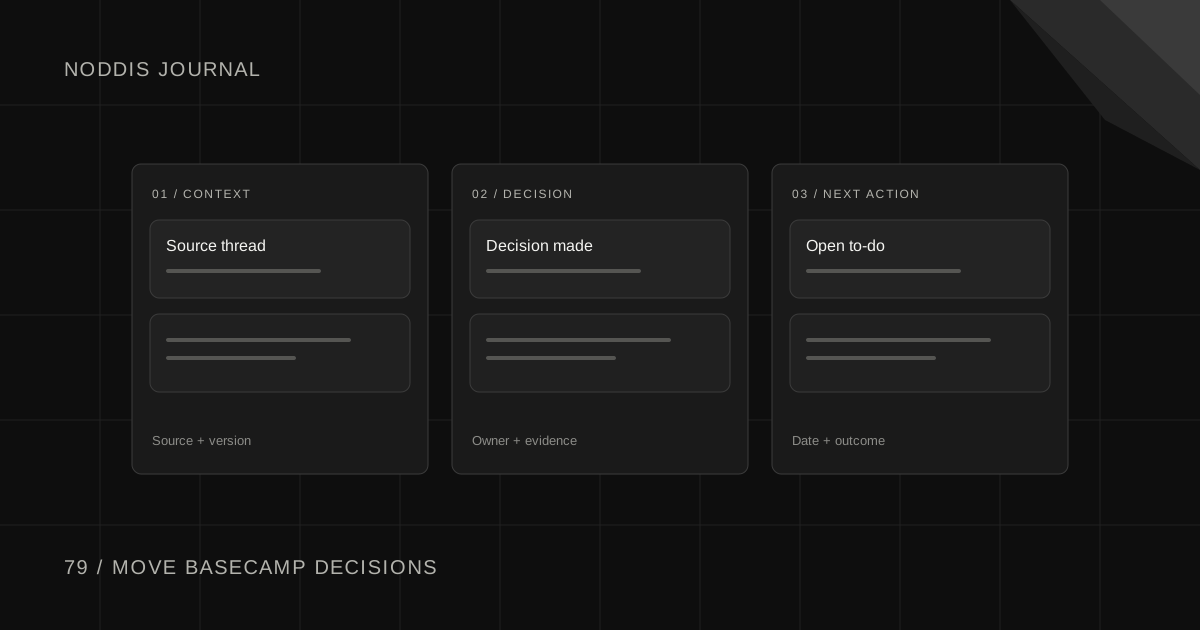
Keep Basecamp project decisions by saving the original export, opening the detail page for a conversation and identifying which decision still affects current work. Bring the discussion into project notes and give each remaining action its own task. Check a real decision and a real to-do against the archive before you switch.
Which Basecamp project decisions would you miss on Monday?
A message-board index is like a contents page. A subject line and a few lines of preview text can survive even when the replies that explain a decision are absent. Opening the archive in a browser and following one important conversation is a quick way to tell the difference.
Choose an example you recognize. Check the original message, the final reply and any referenced file. A reply saying “approved” has limited value if you cannot identify the version that was approved. Keep the complete original archive in a controlled location while you compare.
Before asking what a move can preserve, ask the team what they intend to bring. In one migration, u/PleasantDifficulty wrote, “all I really want are the documents.” For that team, locating the correct documents was the first acceptance check. For a team taking over unfinished client work, finding an approval in a discussion may matter just as much.
Which conversation would you miss on Monday morning?
Think about explaining one choice to a new account manager. Why did the team remove online payment from the launch? Who accepted the later date? The useful record might be a reply several messages down a thread. A board page that lists conversation titles cannot answer either question on its own.
Pick a decision somebody still relies on and follow it inside the downloaded archive. Note the project, thread title and final reply that settled the question. When there are linked attachments, check whether those files open independently. Preserve the original copy even if you can read the discussion in the new project.
| Source item | What to find after importing |
|---|---|
| Thread detail page | The decision text and enough context to identify its author or thread. |
| Open list item | A task in the expected list or hierarchy with the right completion state. |
| Referenced attachment | The original file or an accessible link checked separately. |
Check one conversation from end to end
Noddis can recognize supported Basecamp HTML and ZIP structures. Message-board conversations become Project Notes. Comments tied to recognized to-dos stay with the task. An index-only record is labeled as a preview so you can decide whether to find its detail page.
We tested this distinction with a publicly archived Basecamp discussion containing 27 replies. The check compared the authors, timestamps and text from the detail page. That example establishes the message behavior. For a to-do-heavy project, separately sample a real task list, a completed item and a task with comments from your own archive.
How do you separate decisions from promises?
Imagine a thread beginning with three suggestions for a checkout page. One reply approves guest checkout. A later reply asks the developer to test it on mobile. Preserve the suggestions and approval with the discussion, then give the developer one open task for the test. Turning every reply into a task would create three completed debates and hide the work that remains.
Add the date and a recognizable thread title to that task’s note. If somebody reopens the anonymous-checkout question, they can get from current work back to the reason for the decision. In a client project that link can matter more than the age of the conversation.
What should you check before closing the old workspace?
Ask two people to perform different checks. The account lead should be able to recover the chosen decision and its wording. The person doing the work should find an open to-do in the correct list or hierarchy, with its completion state intact. Count a small known list and inspect the first and last entries.
If an archive contains messages only, use it to check notes. You still need an actual to-do list to verify task migration. An attachment link also needs its own access check. Keep the original export and record any exceptions before the team relies on the new project for delivery.
Carry decisions into current work selectively
After import, review the last unresolved decision in Project Notes. If somebody promised a deliverable that still matters, create a task and reference the conversation. If the discussion settled a question years ago, leave it in the record.
Test attachment links and upload any original files you need to Project Files. Check who can see those files before sharing a portal. The point of the move is to preserve why decisions were made and make today’s work easy to act on.
For the next step, see How to Migrate Client Projects Without Losing Context and Client Decision Log Template: Keep Approvals and Reasons.
Sources and field notes
Partners in School Innovation published the browsable Basecamp archive used in the message-history check. Read the original source.
Basecamp explains what its browsable export includes.
A Basecamp administrator explains which parts of an export their team needed in SharePoint.
Common questions
Does a notes-only archive create placeholder tasks?
The supported notes-only flow can create project notes without adding a placeholder task. Look at the preview counts and open one expected note. If you also expect tasks, obtain the actual list detail pages and check a known open item separately.
What if the preview contains fewer replies than the source?
Check for the corresponding message detail HTML. Keep the archive and resolve the difference before treating the imported note as the full conversation. Pick a decision somebody still needs, follow its thread and confirm that the relevant text is readable. That provides a stronger check than a matching project title alone.
Should message-board replies become project notes or tasks?
Keep the conversation as project context. Create or confirm an individual task for an unfinished action someone still owns. Preserve the thread reference so the team can find the reason for it later. Include a link or identifiable thread title with the task so the decision can be understood after the move.

Katleen is the founder of Noddis. She runs client projects through her app studio, 693 Labs, and builds Noddis around the problems that work creates.
Last reviewed . Feature details reflect Noddis at the time of review.